Cardelli Marco, Aubin Jane E
Department of Medical Biophysics, University of Toronto, Toronto, Ontario, Canada.
Department of Medical Biophysics, University of Toronto, Toronto, Ontario, Canada; Department of Molecular Genetics, University of Toronto, Toronto, Ontario, Canada.
PLoS One. 2014 Oct 14;9(10):e109592. doi: 10.1371/journal.pone.0109592. eCollection 2014.
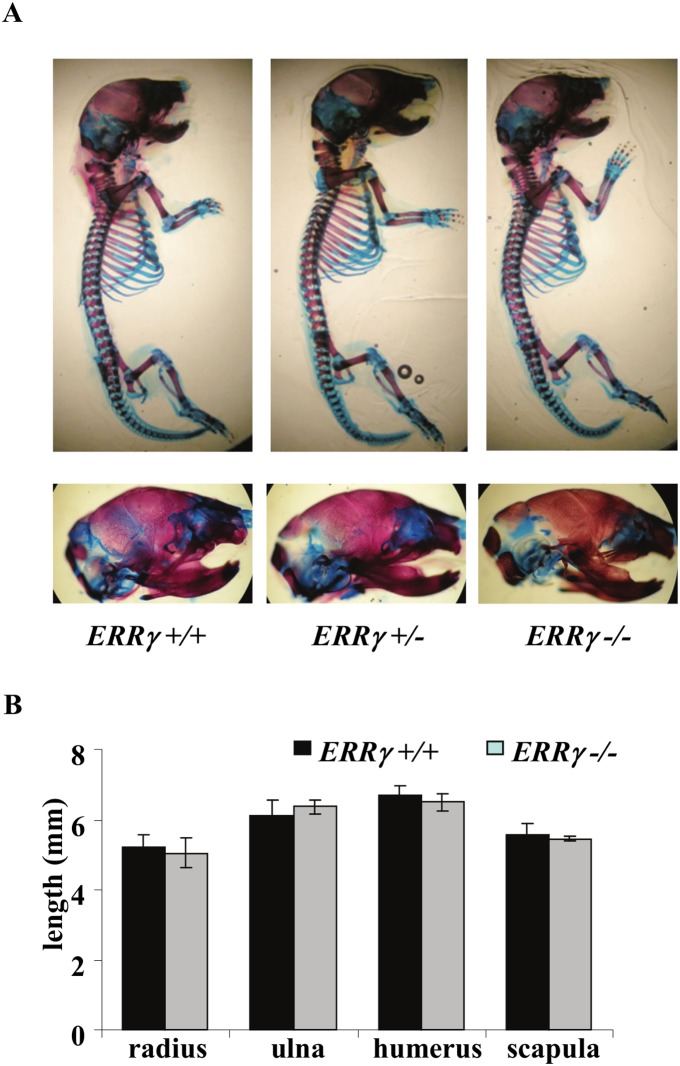
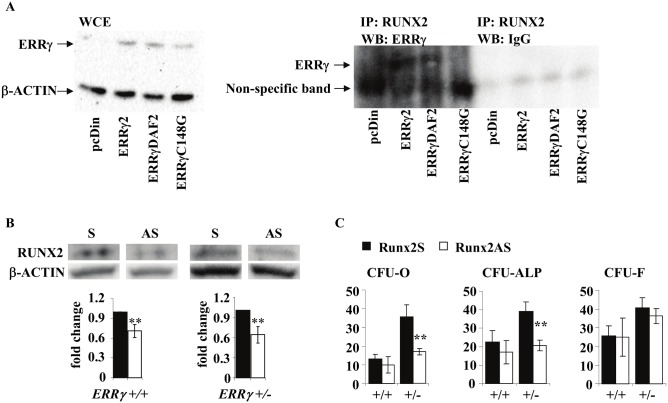
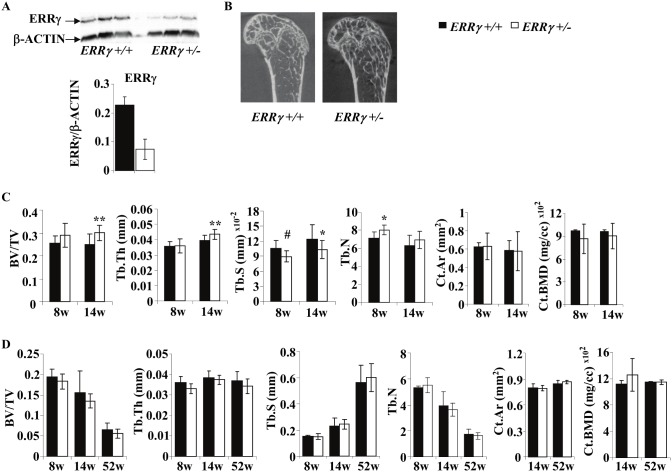
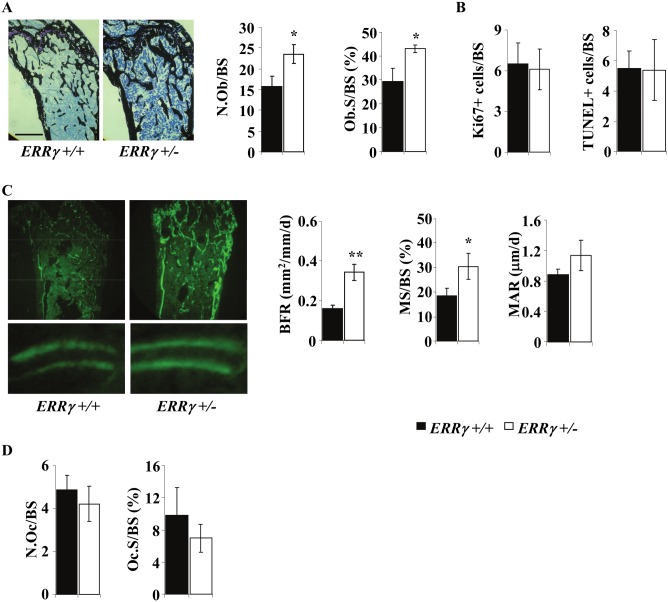
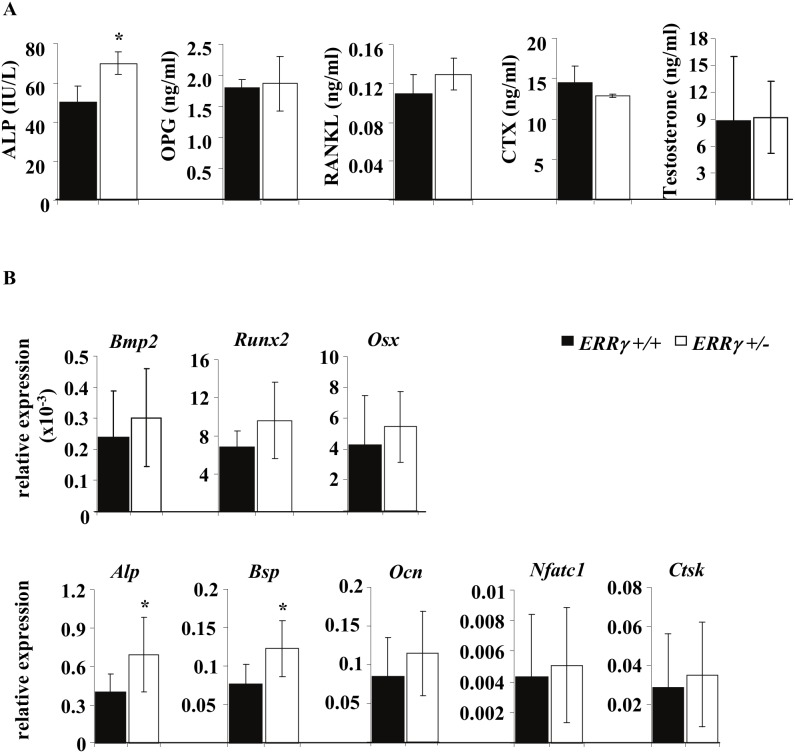
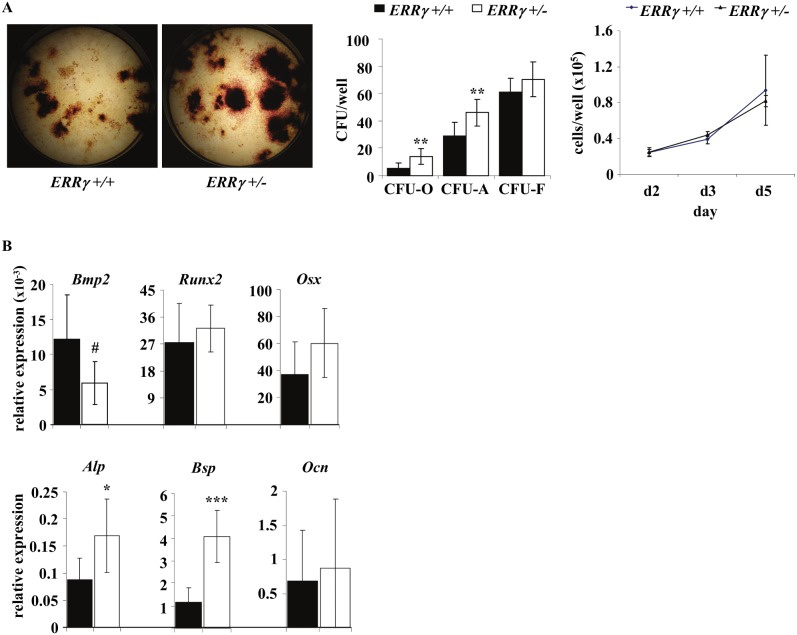
To assess the effects of the orphan nuclear Estrogen receptor-related receptor gamma (ERRγ) deficiency on skeletal development and bone turnover, we utilized an ERRγ global knockout mouse line. While we observed no gross morphological anomalies or difference in skeletal length in newborn mice, by 8 weeks of age ERRγ +/- males but not females exhibited increased trabecular bone, which was further increased by 14 weeks. The increase in trabecular bone was due to an increase in active osteoblasts on the bone surface, without detectable alterations in osteoclast number or activity. Consistent with the histomorphometric results, we observed an increase in gene expression of the bone formation markers alkaline phosphatase (Alp) and bone sialoprotein (Bsp) in bone and increase in serum ALP, but no change in the osteoclast regulators receptor activator of NF-κB ligand (RANKL) and osteoprotegerin (OPG) or the resorption marker carboxy-terminal collagen crosslinks (CTX). More colony forming units-alkaline phosphatase and -osteoblast (CFU-ALP, CFU-O respectively) but not CFU-fibroblast (CFU-F) formed in ERRγ +/- versus ERRγ +/+ stromal cell cultures, suggesting that ERRγ negatively regulates osteoblast differentiation and matrix mineralization but not mesenchymal precursor number. By co-immunoprecipitation experiments, we found that ERRγ and RUNX2 interact in an ERRγ DNA binding domain (DBD)-dependent manner. Treatment of post-confluent differentiating bone marrow stromal cell cultures with Runx2 antisense oligonucleotides resulted in a reduction of CFU-ALP/CFU-O in ERRγ +/- but not ERRγ +/+ mice compared to their corresponding sense controls. Our data indicate that ERRγ is not required for skeletal development but is a sex-dependent negative regulator of postnatal bone formation, acting in a RUNX2- and apparently differentiation stage-dependent manner.
为了评估孤儿核雌激素相关受体γ(ERRγ)缺乏对骨骼发育和骨转换的影响,我们使用了ERRγ全身敲除小鼠品系。虽然我们在新生小鼠中未观察到明显的形态异常或骨骼长度差异,但到8周龄时,ERRγ+/-雄性小鼠而非雌性小鼠的小梁骨增加,到14周时进一步增加。小梁骨的增加是由于骨表面活跃成骨细胞数量增加,而破骨细胞数量或活性未检测到改变。与组织形态计量学结果一致,我们观察到骨骼中骨形成标志物碱性磷酸酶(Alp)和骨唾液蛋白(Bsp)的基因表达增加,血清碱性磷酸酶升高,但破骨细胞调节因子核因子κB受体激活剂配体(RANKL)和骨保护素(OPG)或吸收标志物羧基末端胶原交联(CTX)没有变化。与ERRγ+/+基质细胞培养相比,ERRγ+/-培养中形成更多的集落形成单位碱性磷酸酶和成骨细胞(分别为CFU-ALP、CFU-O),但没有CFU-成纤维细胞(CFU-F),这表明ERRγ负向调节成骨细胞分化和基质矿化,但不调节间充质前体细胞数量。通过免疫共沉淀实验,我们发现ERRγ和RUNX2以ERRγ DNA结合结构域(DBD)依赖性方式相互作用。用Runx2反义寡核苷酸处理汇合后分化的骨髓基质细胞培养物,与相应的正义对照相比,ERRγ+/-小鼠而非ERRγ+/+小鼠的CFU-ALP/CFU-O减少。我们的数据表明,ERRγ不是骨骼发育所必需的,但它是出生后骨形成的性别依赖性负调节因子,以RUNX2依赖性且明显依赖分化阶段的方式发挥作用。