Leoci Raffaella, Aiudi Giulio, Silvestre Fabio, Lissner Elaine A, Lacalandra Giovanni M
Department of Emergency and Organ Transplantation (DETO), Section of Veterinary Clinic and Animal Production, University of Bari Aldo Moro, SP per Casamassima km 3, Valenzano, BA, Italy.
Parsemus Foundation, PO Box 2246, Berkeley, CA, 94702, USA.
Acta Vet Scand. 2014 Oct 14;56(1):62. doi: 10.1186/s13028-014-0062-2.
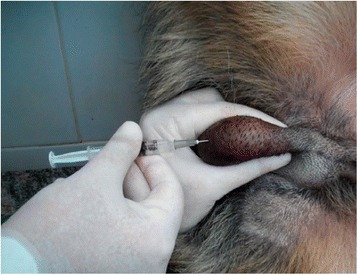
Surgical castration is widely used to sterilize male dogs, but has significant impacts on time to perform the operation, recovery of the animals as well as cost, which can limit population control programs. Previous research has shown intratesticular injection of calcium chloride dihydrate (CaCl2) in saline to be a promising alternative to surgery. However, long-term azoospermia was not maintained at dosages low enough to avoid side effects. In the search for an optimized formulation, the current investigation is the first study on long-term sterilization effects of intratesticular injection of CaCl2 in either lidocaine solution or alcohol in dogs. CaCl2 at 20% concentration in lidocaine solution or alcohol was administered via intratesticular injection to groups of 21 dogs each. The treated animals were examined at 2, 6, and 12 months for sperm production, blood levels of testosterone, and side effects; at time zero and 12 months for testicular size and semen volume. The experimentally treated animals were compared to a control group receiving saline injection only.
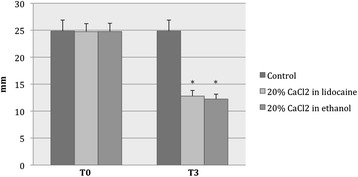
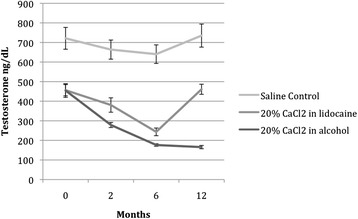
Testicles of dogs treated with CaCl2 in either diluent significantly decreased in size. After administration of CaCl2 in lidocaine solution, sterility was achieved for at least 12 months in 75% of treated dogs. However, optimal long-term contraceptive effectiveness was achieved with CaCl2 in alcohol, which resulted in azoospermia over the 12-month study period. Testosterone levels significantly decreased following treatment with CaCl2, and sexual activity disappeared. Although testosterone returned to baseline levels by 12 months for the group treated with CaCl2 in lidocaine, dogs injected with CaCl2 in alcohol had a 63.6% drop in testosterone level, which remained at the low end of physiological range throughout the study. No adverse effects were noted.
A single, bilateral intratesticular injection of 20% CaCl2 in 95% ethanol was a reliable method for induction of sterilization in 18-28 kg male dogs in this study. The approach showed long-term efficacy and reduced sexual behavior. This chemical method of sterilization might provide an effective, efficient alternative to surgical castration that can have positive impacts on dog welfare.
手术去势被广泛用于使雄性犬绝育,但对手术实施时间、动物恢复情况以及成本都有显著影响,这可能会限制种群控制计划。先前的研究表明,在盐水中睾丸内注射二水合氯化钙(CaCl2)是一种有前景的手术替代方法。然而,在剂量低到足以避免副作用时,长期无精子症无法维持。为了寻找优化配方,当前的研究是第一项关于在犬体内睾丸内注射利多卡因溶液或酒精中的CaCl2的长期绝育效果的研究。将浓度为20%的CaCl2溶于利多卡因溶液或酒精中,通过睾丸内注射给予每组21只犬。在2个月、6个月和12个月时检查受试动物的精子生成、睾酮血药浓度和副作用;在0个月和12个月时检查睾丸大小和精液量。将经实验处理的动物与仅接受盐水注射的对照组进行比较。
用两种稀释剂中任一种的CaCl2处理的犬的睾丸大小显著减小。在利多卡因溶液中注射CaCl2后,75%的受试犬至少12个月达到不育。然而,用酒精中的CaCl2可实现最佳的长期避孕效果,在12个月的研究期内导致无精子症。用CaCl2治疗后睾酮水平显著降低,性行为消失。虽然利多卡因中注射CaCl2的组在12个月时睾酮水平恢复到基线水平,但酒精中注射CaCl2的犬睾酮水平下降了63.6%,在整个研究过程中一直处于生理范围的低端。未观察到不良反应。
在本研究中,单次双侧睾丸内注射95%乙醇中的20%CaCl2是诱导18 - 28 kg雄性犬绝育的可靠方法。该方法显示出长期疗效并减少了性行为。这种化学绝育方法可能为手术去势提供一种有效、高效的替代方法,对犬的福利可能产生积极影响。