Sandberg Olof, Aspenberg Per
Orthopedics Section, Department of Clinical and Experimental Medicine , Linköping University, Linköping , Sweden.
Acta Orthop. 2015 Apr;86(2):243-7. doi: 10.3109/17453674.2014.973328. Epub 2014 Oct 17.
NSAIDs are commonly used in the clinic, and there is a general perception that this does not influence healing in common types of human fractures. Still, NSAIDs impair fracture healing dramatically in animal models. These models mainly pertain to fractures of cortical bone in shafts, whereas patients more often have corticocancellous fractures in metaphyses. We therefore tested the hypothesis that the effect of an NSAID is different in shaft healing and metaphyseal healing.
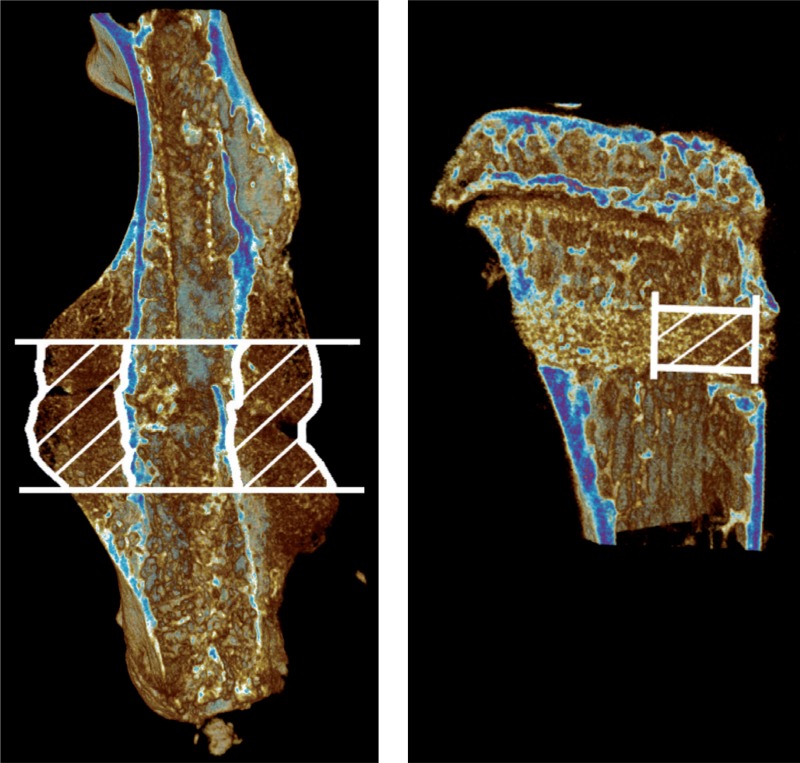
26 mice were given an osteotomy of their left femur with an intramedullary nail. 13 received injections of indomethacin, 1 mg/kg twice daily. After 17 days of healing, the femurs were analyzed with 3-point bending and microCT. 24 other mice had holes drilled in both proximal tibias, to mimic a stable metaphyseal injury. A screw was inserted in the right tibial hole only. After 7 days of indomethacin injections or control injections, screw fixation was measured with mechanical pull-out testing and the side without a screw was analyzed with microCT.
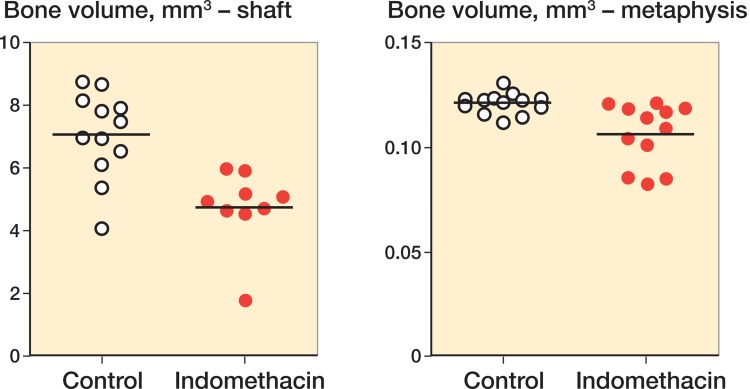
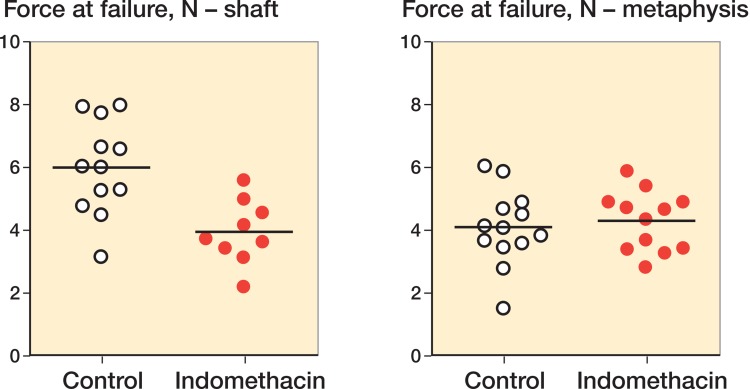
In the shaft model, indomethacin led to a 35% decrease in force at failure (95% CI: 14-54). Callus size was reduced to a similar degree, as seen by microCT. Metaphyseal healing was less affected by indomethacin, as no effect on pull-out force could be seen (95% CI: -27 to 17) and there was only a small drop in new bone volume inside the drill hole. The difference in the relative effect of indomethacin between the 2 models was statistically significant (p = 0.006).
Indomethacin had a minimal effect on stable metaphyseal fractures, but greatly impaired healing of unstable shaft fractures. This could explain some of the differences found between animal models and clinical experience.
非甾体抗炎药(NSAIDs)在临床上常用,人们普遍认为其不会影响人类常见类型骨折的愈合。然而,在动物模型中,NSAIDs会显著损害骨折愈合。这些模型主要涉及骨干皮质骨骨折,而患者更常见的是干骺端皮质松质骨骨折。因此,我们检验了以下假设:NSAIDs对骨干愈合和干骺端愈合的影响不同。
26只小鼠左股骨行髓内钉截骨术。13只每天两次注射吲哚美辛,剂量为1mg/kg。愈合17天后,对股骨进行三点弯曲和显微CT分析。另外24只小鼠双侧胫骨近端钻孔,模拟稳定的干骺端损伤。仅在右侧胫骨孔插入一枚螺钉。注射吲哚美辛或对照注射7天后,通过机械拔出试验测量螺钉固定情况,对未插入螺钉一侧进行显微CT分析。
在骨干模型中,吲哚美辛导致破坏时的力降低35%(95%可信区间:14 - 54)。显微CT显示骨痂大小也有类似程度的减小。吲哚美辛对干骺端愈合影响较小,未观察到对拔出力的影响(95%可信区间:-27至17),钻孔内新骨体积仅有小幅下降。两种模型中吲哚美辛相对作用的差异具有统计学意义(p = 0.006)。
吲哚美辛对稳定的干骺端骨折影响极小,但严重损害不稳定的骨干骨折愈合。这可以解释动物模型与临床经验之间发现的一些差异。