Ryu Ji-Ung, Kim Eun-Kyung, Youn You-Sook, Rhim Jung-Woo, Lee Kyung-Yil
Department of Pediatrics, The Catholic University of Korea College of Medicine, Seoul, Korea.
Department of Pediatrics, The Catholic University of Korea College of Medicine, Seoul, Korea. ; Department of Pediatrics, The Catholic University of Korea, Daejeon St. Mary's Hospital, Daejeon, Korea.
Korean J Pediatr. 2014 Sep;57(9):396-402. doi: 10.3345/kjp.2014.57.9.396. Epub 2014 Sep 30.
The introduction of the mumps vaccine has dramatically reduced the number of mumps cases, but outbreaks have recently occurred among highly vaccinated populations in developed countries. Epidemiological and clinical characteristics of patients with mumps admitted between 1989 and 2012 in a single hospital in Korea are described in the present study.
We retrospectively evaluated inpatients with mumps between 1989 and 2012 and outpatients and inpatients with mumps in 2011-2012.
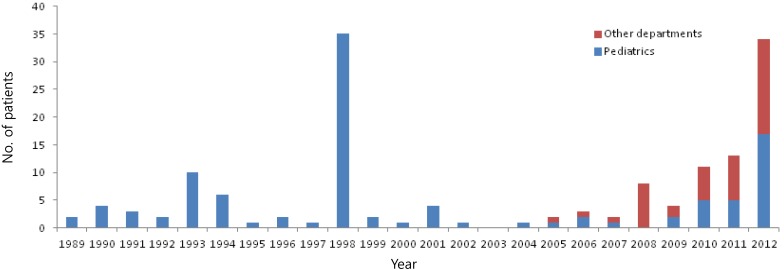
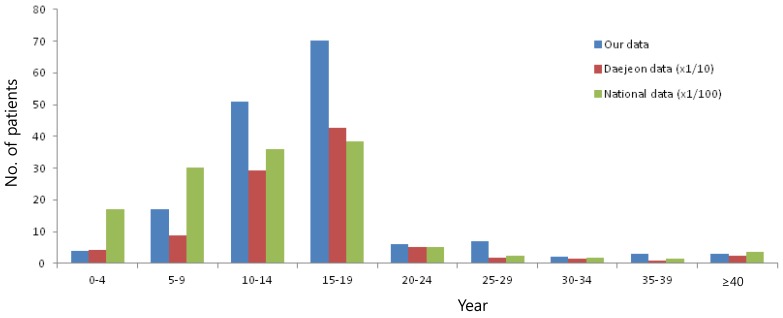
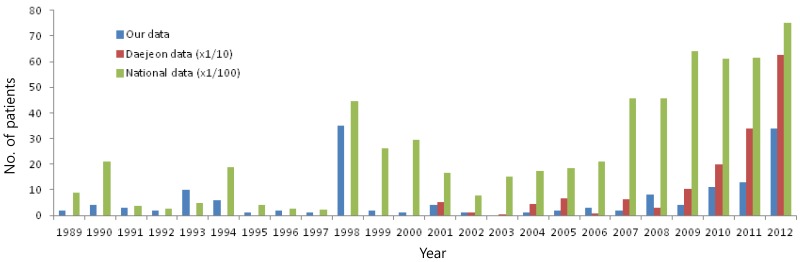
A total of 152 patients with mumps were admitted between 1989 and 2012, and 163 patients were recorded in 2011-2012. The highest number of admitted cases occurred in 1998 and 2012 (35 and 34 cases, respectively). Among the patients admitted in 2011-2012, the highest frequency was observed among people aged 15-19 years, and low frequency was observed in those aged <4 years and >20 years, compatible to the city data and national data. In patients admitted to our department in 1998 (35 cases) and in 2010-2012 (27 cases), there were significant differences in the mean age and the rate of secondary measles-mumps-rubella (MMR) vaccination, but had similar clinical features, including complications, except aseptic meningitis. Antimumps immunoglobulin (Ig) G was positive in 83% and 100%, and IgM was positive in 67% and 41%, respectively, in the two periods.
In Korea, recent mumps outbreaks have occurred mainly among secondary school students who received two doses of the MMR vaccine. The vaccinees might have a modified immune reaction to viral insults, manifesting modified epidemiological and clinical features.
腮腺炎疫苗的引入显著减少了腮腺炎病例的数量,但近期在发达国家高疫苗接种人群中出现了疫情暴发。本研究描述了1989年至2012年期间韩国一家医院收治的腮腺炎患者的流行病学和临床特征。
我们回顾性评估了1989年至2012年期间的腮腺炎住院患者以及2011 - 2012年期间的腮腺炎门诊和住院患者。
1989年至2012年期间共收治152例腮腺炎患者,2011 - 2012年记录了163例患者。收治病例数最多的年份是1998年和2012年(分别为35例和34例)。在2011 - 2012年收治的患者中,15 - 19岁人群的发病率最高,4岁以下和20岁以上人群的发病率较低,这与城市数据和国家数据相符。1998年(35例)和2010 - 2012年(27例)在我科收治的患者中,平均年龄和二次麻疹 - 腮腺炎 - 风疹(MMR)疫苗接种率存在显著差异,但临床特征相似,包括并发症,无菌性脑膜炎除外。两个时期抗腮腺炎免疫球蛋白(Ig)G阳性率分别为83%和100%,IgM阳性率分别为67%和41%。
在韩国,近期腮腺炎疫情主要发生在接种了两剂MMR疫苗的中学生中。疫苗接种者可能对病毒感染有改变的免疫反应,表现出改变的流行病学和临床特征。