Yip Cyril C Y, Lo Kin-Land, Que Tak-Lun, Lee Rodney A, Chan Kwok-Hung, Yuen Kwok-Yung, Woo Patrick C Y, Lau Susanna K P
Department of Microbiology, The University of Hong Kong, Hong Kong, Hong Kong.
Virol J. 2014 Oct 18;11:182. doi: 10.1186/1743-422X-11-182.
Emerging human picornaviruses, including human parechovirus (HPeV), Aichi virus (AiV) and salivirus (SalV) were found to be associated with gastroenteritis, but their roles in enteric infections are not fully understood. In addition, no report on the circulation of these viruses in Hong Kong is available. The objective of this study was to investigate the prevalence and genetic diversity of HPeV, AiV and SalV in fecal samples from hospitalized children with gastroenteritis in Hong Kong.
Fecal samples from hospitalized children with gastroenteritis were subject to detection of HPeV, AiV and SalV by RT-PCR using consensus primers targeted to their 5'UTRs. Positive samples were subject to capsid and/or 3CD region analysis for genotype determination. The epidemiology of HPeV, AiV and SalV infections was analyzed.
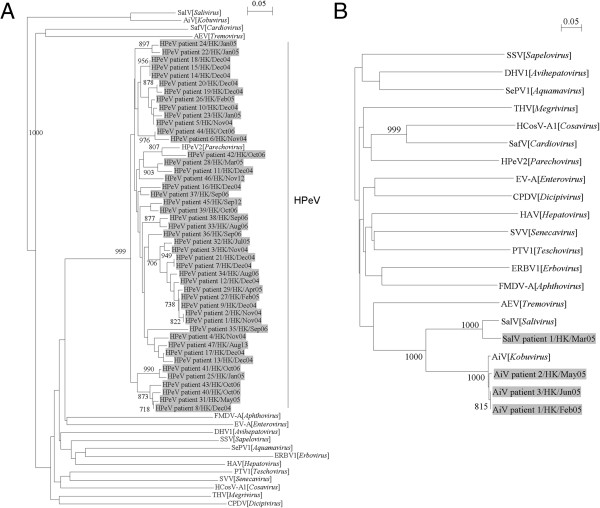
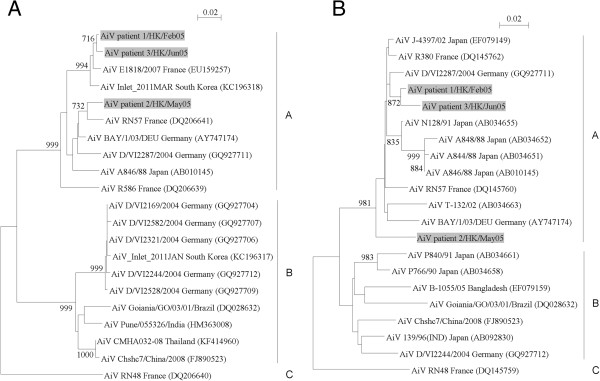
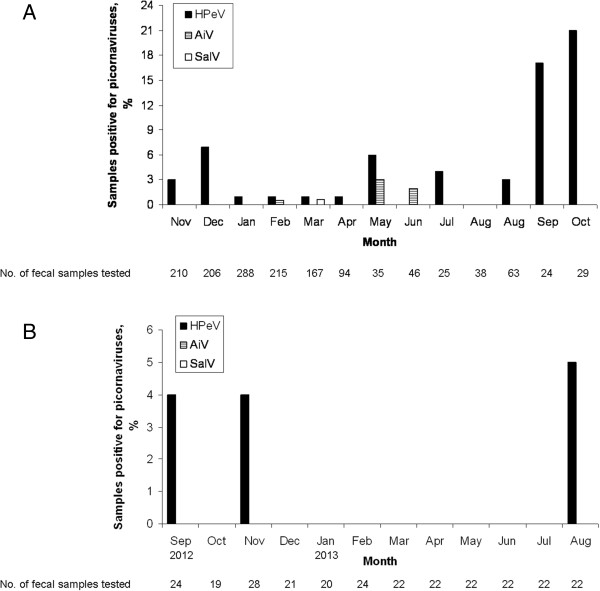
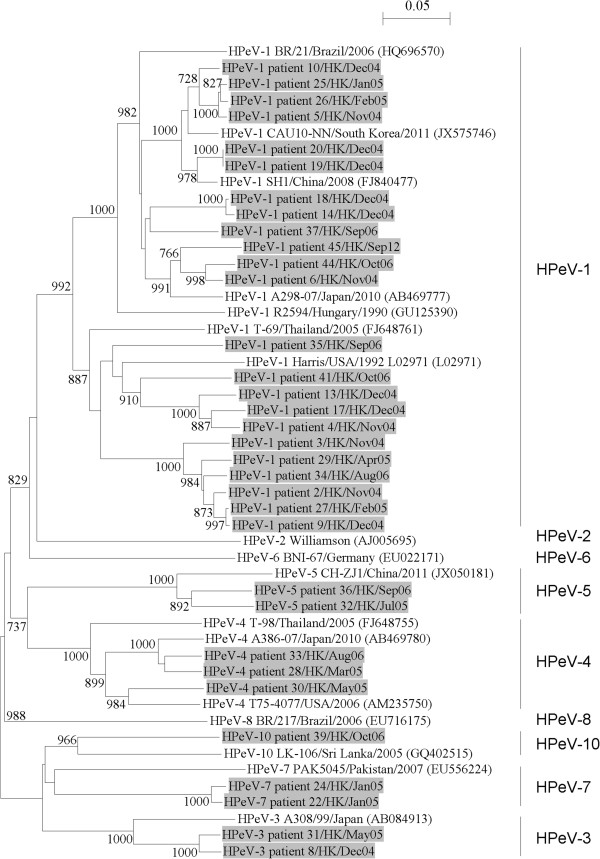
Among 1,708 fecal samples subjected to RT-PCR using primers targeted to 5'UTR of HPeV, AiV and SalV, viruses were detected in 55 samples, with 50 positive for HPeV only, 3 positive for AiV only, 1 positive for both HPeV and AiV, and 1 positive for both HPeV and SalV. Phylogenetic analysis of the partial VP1 gene of the 33 HPeV strains revealed the presence of genotypes of HPeV- 1, 3, 4, 5, 7, 10, among which HPeV-1 was the predominant genotype circulating in our population. The peak activity of HPeV infection was in fall. Of the 3 children with AiV infection, the 3 AiV strains were found to belong to genotype A based on the phylogenetic analysis of their partial VP1 and 3CD regions. The genotype of a SalV strain detected in this study could not be determined. Co-detection of different pathogens was observed in 24 samples (43.6%) of 55 fecal samples positive for HPeV, AiV and SalV.
HPeV, AiV and SalV were detected in fecal samples of hospitalized children with gastroenteritis in Hong Kong, with the former having the highest prevalence. HPeV-1 was the predominant genotype among HPeVs, while genotype A was the predominant genotype among AiVs in this study.
新出现的人微小核糖核酸病毒,包括人副肠孤病毒(HPeV)、爱知病毒(AiV)和唾液病毒(SalV),被发现与肠胃炎有关,但其在肠道感染中的作用尚未完全明确。此外,香港尚无关于这些病毒传播情况的报告。本研究的目的是调查香港肠胃炎住院儿童粪便样本中HPeV、AiV和SalV的流行情况及基因多样性。
对肠胃炎住院儿童的粪便样本,使用针对其5'非翻译区(5'UTR)的通用引物,通过逆转录聚合酶链反应(RT-PCR)检测HPeV、AiV和SalV。对阳性样本进行衣壳和/或3CD区域分析以确定基因型。分析HPeV、AiV和SalV感染的流行病学情况。
在1708份使用针对HPeV、AiV和SalV的5'UTR引物进行RT-PCR检测的粪便样本中,55份样本检测到病毒,其中仅HPeV阳性50份,仅AiV阳性3份,HPeV和AiV均阳性1份,HPeV和SalV均阳性1份。对33株HPeV毒株的部分VP1基因进行系统发育分析,发现存在HPeV-1、3、4、5、7、10基因型,其中HPeV-1是在我们研究人群中流行的主要基因型。HPeV感染的高峰活动期在秋季。在3例AiV感染儿童中,根据其部分VP1和3CD区域的系统发育分析,发现3株AiV毒株均属于A基因型。本研究中检测到的1株SalV毒株的基因型无法确定。在55份HPeV、AiV和SalV阳性粪便样本中的24份(43.6%)样本中观察到不同病原体的共同检测。
在香港肠胃炎住院儿童的粪便样本中检测到HPeV、AiV和SalV,其中HPeV的流行率最高。在本研究中,HPeV-1是HPeV中的主要基因型,而A基因型是AiV中的主要基因型。