Tak Vibhor, Mathur Purva, Varghese Prince, Gunjiyal Jacinta, Xess Immaculata, Misra Mahesh C
Department of Laboratory Medicine, JPNA Trauma Center, New Delhi, India.
Department of Hospital Infection Control, JPNA Trauma Center, New Delhi, India.
J Lab Physicians. 2014 Jul;6(2):96-101. doi: 10.4103/0974-2727.141506.
Candida spp. is a common cause of bloodstream infections. Candidemia is a potentially fatal infection that needs urgent intervention to salvage the patients. Trauma patients are relatively young individuals with very few comorbidities, and the epidemiology of candidemia is relatively unknown in this vulnerable and growing population. In this study, we report the epidemiology of candidemia in a tertiary care Trauma Center of India.
The study was conducted from January 2009 to July 2012. All patients from whose blood samples a Candida spp. was recovered were included in this study. A detailed history and follow up of the patients was done. The isolates of Candida were identified to the species level. The speciation was done by conventional methods, including morphology on Corn Meal Agar, color development on Triphenyl Tetrazolium Chloride Agar and CHROMagar, and germ tube tests. The VITEK 2 YST ID colorometric card, a fully automated identification system was also used. Antifungal susceptibility was performed using the VITEK 2 system.
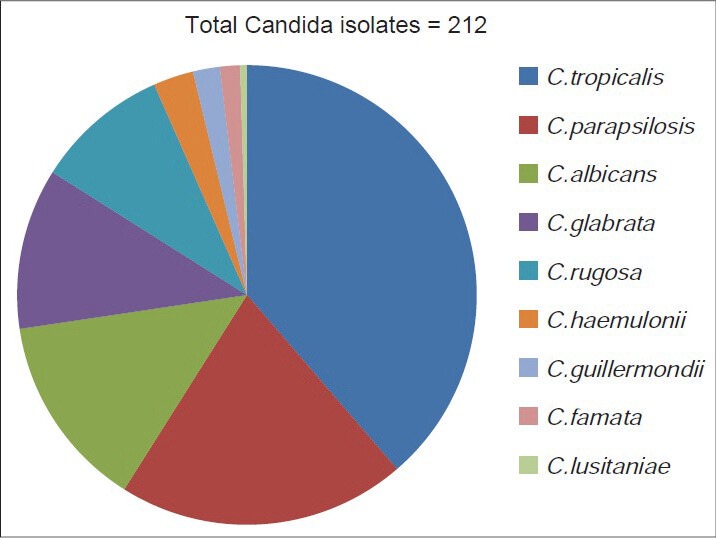
A total of 212 isolates of the Candida species were recovered from blood samples of 157 patients over the study period. Candida tropicalis, 82 (39%), was the most common, followed by C. parapsilosis, 43 (20%), C. albicans, 29 (14%), C. glabrata, 24 (11%), C. rugosa, 20 (9%), C. hemulonii,; 6 (3%), C. guilliermondii, 4 (2%), C. famata, 3 (1.5%), and C. lusitaniae 1 (0.5%). Out of all the candidemia patients, 68 (43%) had a fatal outcome. Fluconazole and Amphotericin B resistance was seen in seven (3.3%) and seven (3.3%) of the isolates, respectively.
Candidemia is a significant cause of mortality in trauma patients in our center, with C. tropicalis and C. parapsilosis being the predominant pathogens. Resistance to antifungal drugs is a matter of concern. Better hospital infection control practices and good antibiotic stewardship policies could possibly help in reducing the morbidity and mortality associated with candidemia.
念珠菌属是血流感染的常见病因。念珠菌血症是一种潜在致命的感染,需要紧急干预以挽救患者生命。创伤患者相对年轻,合并症较少,在这一脆弱且不断增长的人群中,念珠菌血症的流行病学情况相对未知。在本研究中,我们报告了印度一家三级护理创伤中心念珠菌血症的流行病学情况。
研究于2009年1月至2012年7月进行。所有血样中分离出念珠菌属的患者均纳入本研究。对患者进行了详细的病史询问和随访。念珠菌分离株鉴定到种水平。通过常规方法进行菌种鉴定,包括在玉米粉琼脂上观察形态、在氯化三苯四氮唑琼脂和CHROMagar上观察颜色变化以及芽管试验。还使用了全自动鉴定系统VITEK 2 YST ID比色卡。使用VITEK 2系统进行抗真菌药敏试验。
在研究期间,共从157例患者的血样中分离出212株念珠菌。热带念珠菌82株(39%)最为常见,其次是近平滑念珠菌43株(20%)、白色念珠菌29株(14%)、光滑念珠菌24株(11%)、皱落念珠菌20株(9%)、解脂念珠菌6株(3%)、季也蒙念珠菌4株(2%)、法塔念珠菌3株(1.5%)和葡萄牙念珠菌1株(0.5%)。在所有念珠菌血症患者中,68例(43%)有致命结局。分别有7株(3.3%)和7株(3.3%)分离株对氟康唑和两性霉素B耐药。
念珠菌血症是我们中心创伤患者死亡的重要原因,热带念珠菌和平滑念珠菌是主要病原体。抗真菌药物耐药是一个值得关注的问题。更好的医院感染控制措施和良好的抗生素管理政策可能有助于降低与念珠菌血症相关的发病率和死亡率。