Cui Huiru, Jin Yi, Wang Jijun, Weng Xuchu, Li Chunbo
Shanghai Mental Health Center, Shanghai Jiao Tong University School of Medicine, Shanghai, China.
Institute of Psychology, Chinese Academy of Sciences, Beijing, China.
Shanghai Arch Psychiatry. 2012 Oct;24(5):250-61. doi: 10.3969/j.issn.1002-0829.2012.05.002.
There is increasing interest in the role of brain-derived neurotrophic factor (BDNF) in the onset and course of schizophrenia, but there are conflicting reports about serum levels of BDNF in patients with schizophrenia.
Conduct a meta-analysis combining studies from China and other countries that have evaluated the relationship of serum BDNF levels to schizophrenia.
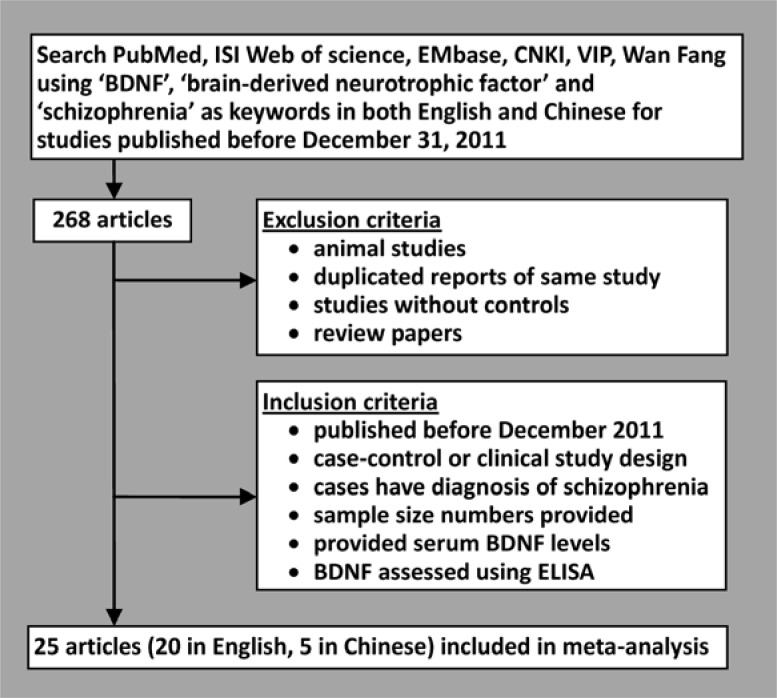
We used Cochrane methodology and RevMan 5.1 software to identify and pool the results of studies. Electronic searches of western and Chinese registries and follow-up assessment of references located 268 potential articles. Twenty-five articles (20 in English and 5 in Chinese) published before December 2011 that used case-control methods, included patients with schizophrenia who had no concurrent disorders, and used ELISA technology to assess serum BDNF were included in the analysis. The main outcome was the pooled standardized mean difference (SMD) between cases and controls. The quality of the studies was independently assessed by two raters using the GRADE system. The heterogeneity, sensitivity and potential publication bias of the studies was evaluated using RevMan.
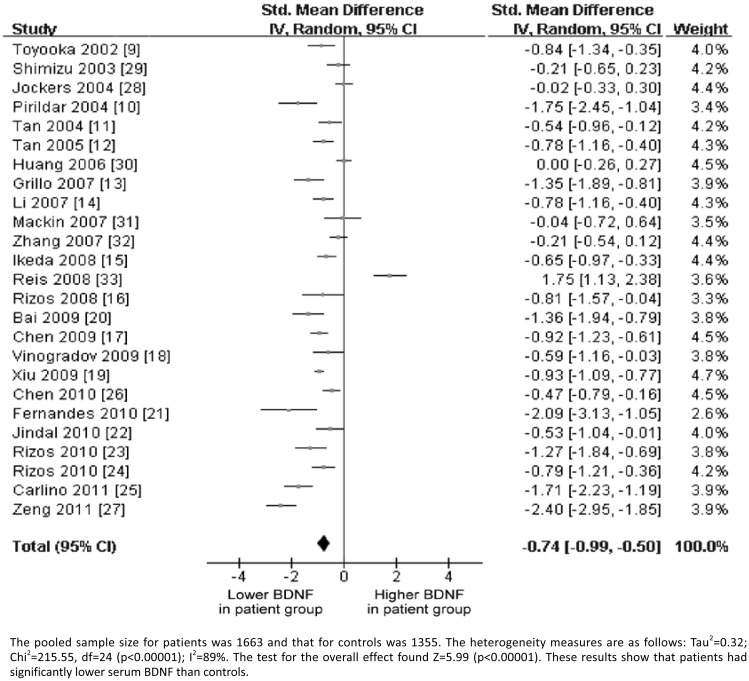
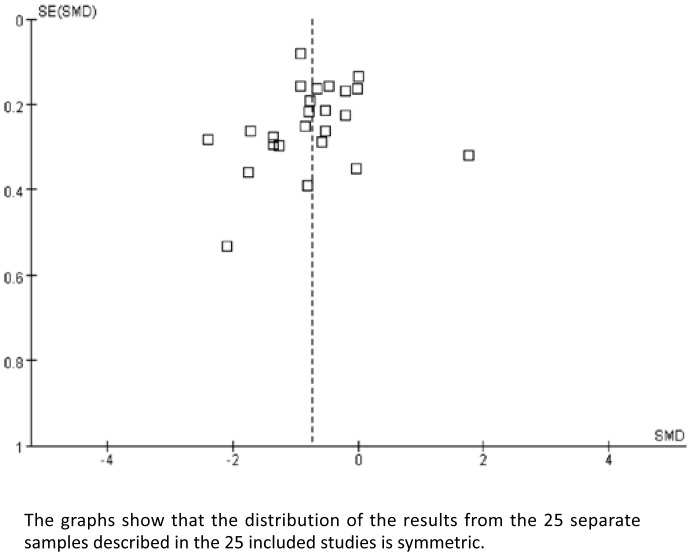
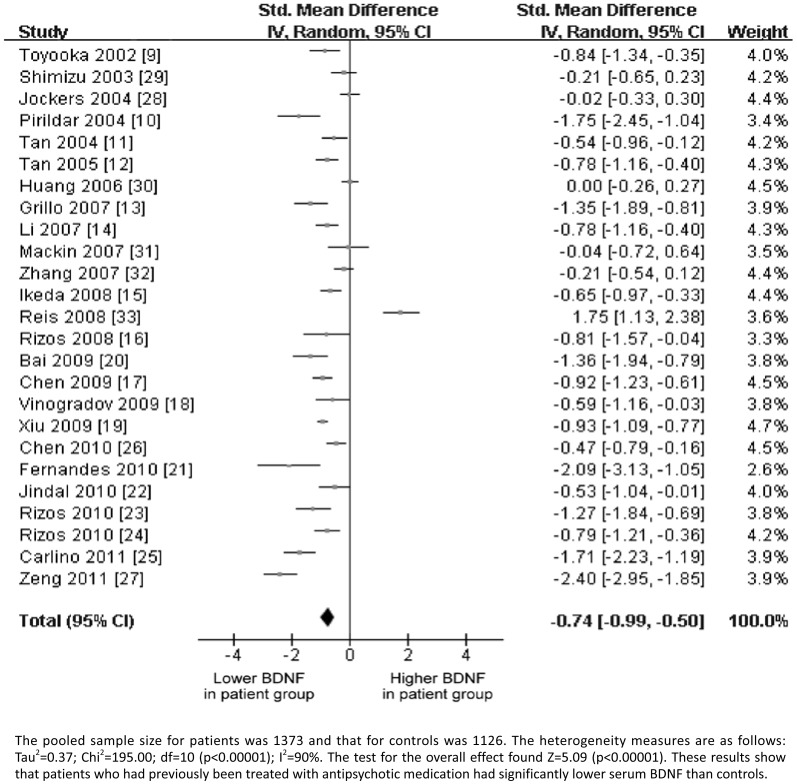
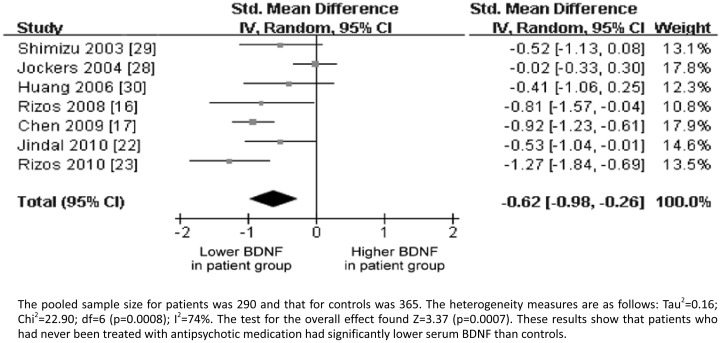
The pooled sample included 1663 patients with schizophrenia and 1355 controls. Fifteen of the included studies were rated as 'poor quality' and 10 were rated as 'very poor quality'. The results of the studies were quite heterogenous (I(2)=95%) but subgroup analyses found that the heterogeneity was not related to country of origin, sample size, age, gender, prior use of antipsychotic medication, or study quality. The pooled SMD (computed using a random-effect model because of study heterogeneity) was -0.74 (95% CI, -0.99∼-0.50; Z=5.99, p<0.001). Sensitivity analysis found that the result was stable and there was no evidence of publication bias.
Despite the robust statistical findings of lower serum BDNF in patients with schizophrenia than in controls, given the low quality of the available studies and the substantial heterogeneity between studies, the evidence of lower serum BDNF in patients with schizophrenia must be considered 'weak'. The potential use of serum BDNF as a biomarker for schizophrenia must wait until higher-quality prospective studies that follow patients over time and that use uniform selection and monitoring procedures confirm these preliminary results.
脑源性神经营养因子(BDNF)在精神分裂症的发病及病程中的作用越来越受到关注,但关于精神分裂症患者血清BDNF水平的报道存在矛盾。
进行一项荟萃分析,综合中国及其他国家评估血清BDNF水平与精神分裂症关系的研究。
我们采用Cochrane方法和RevMan 5.1软件来识别并汇总研究结果。通过对西方和中国的注册库进行电子检索以及对参考文献进行追踪评估,共找到268篇潜在文章。纳入分析的是2011年12月之前发表的25篇文章(20篇英文、5篇中文),这些文章采用病例对照方法,纳入无并发疾病的精神分裂症患者,并使用酶联免疫吸附测定(ELISA)技术评估血清BDNF。主要结局指标是病例组与对照组之间合并的标准化均数差(SMD)。由两名评估者使用GRADE系统独立评估研究质量。使用RevMan评估研究的异质性、敏感性及潜在发表偏倚。
汇总样本包括1663例精神分裂症患者和1355例对照。纳入的研究中15项被评为“质量差”,10项被评为“质量非常差”。研究结果存在较大异质性(I² = 95%),但亚组分析发现异质性与研究的国家来源、样本量、年龄、性别、既往是否使用抗精神病药物或研究质量无关。合并的SMD(由于研究异质性采用随机效应模型计算)为 -0.74(95%CI,-0.99~-0.50;Z = 5.99,p < 0.001)。敏感性分析发现结果稳定,且无发表偏倚的证据。
尽管有强有力的统计学结果表明精神分裂症患者血清BDNF低于对照组,但鉴于现有研究质量较低且研究间存在较大异质性,精神分裂症患者血清BDNF较低的证据必须被视为“薄弱”。血清BDNF作为精神分裂症生物标志物的潜在用途,必须等待高质量的前瞻性研究,这些研究要对患者进行长期随访,并采用统一的选择和监测程序来证实这些初步结果。