Watanabe Toshio, Tanigawa Tetsuya, Kobata Atsushi, Takeda Shogo, Nadatani Yuji, Otani Koji, Yamagami Hirokazu, Shiba Masatsugu, Tominaga Kazunari, Fujiwara Yasuhiro, Arakawa Tetsuo
Department of Gastroenterology, Osaka City University Graduate School of Medicine, Osaka, Japan.
Department of Pharmacology and Experimental Therapeutics, Kyoto Pharmaceutical University, Kyoto, Japan.
PLoS One. 2014 Oct 16;9(10):e110441. doi: 10.1371/journal.pone.0110441. eCollection 2014.
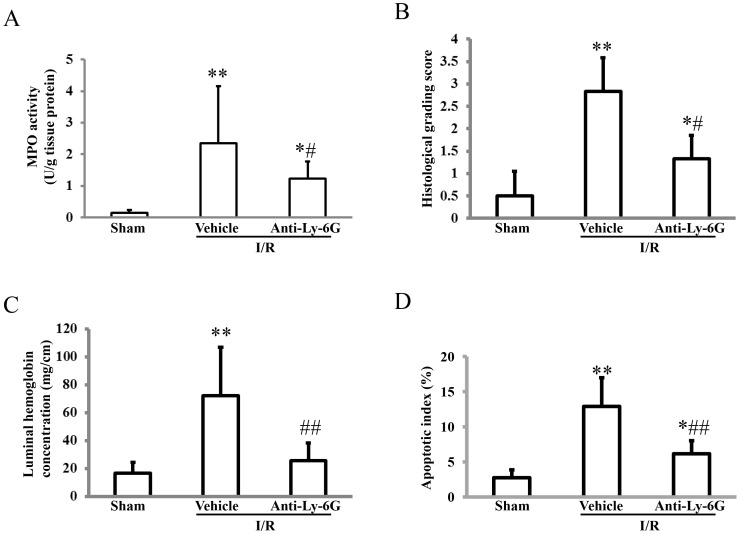
Toll-like receptor 2 (TLR2) recognizes conserved molecular patterns associated with both gram-negative and gram-positive bacteria, and detects some endogenous ligands. Previous studies demonstrated that in ischemia-reperfusion (I/R) injury of the small intestine, the TLR2-dependent signaling exerted preventive effects on the damage in young mice, but did not have a significant effect in neonatal mice. We investigated the role of TLR2 in adult ischemia-reperfusion injury in the small intestine. Wild-type and TLR2 knockout mice at 16 weeks of age were subjected to intestinal I/R injury. Some wild-type mice received anti-Ly-6G antibodies to deplete circulating neutrophils. In wild-type mice, I/R induced severe small intestinal injury characterized by infiltration by inflammatory cells, disruption of the mucosal epithelium, and mucosal bleeding. Compared to wild-type mice, TLR2 knockout mice exhibited less severe mucosal injury induced by I/R, with a 35%, 33%, and 43% reduction in histological grading score and luminal concentration of hemoglobin, and the numbers of apoptotic epithelial cells, respectively. The I/R increased the activity of myeloperoxidase (MPO), a marker of neutrophil infiltration, and the levels of mRNA expression of tumor necrosis factor-α (TNF-α), intercellular adhesion molecule-1 (ICAM-1), and cyclooxygenase-2 (COX-2) in the small intestine of the wild-type mice by 3.3-, 3.2-, and 13.0-fold, respectively. TLR2 deficiency significantly inhibited the I/R-induced increase in MPO activity and the expression of mRNAs for TNF-α and ICAM-1, but did not affect the expression of COX-2 mRNA. I/R also enhanced TLR2 mRNA expression by 2.9-fold. TLR2 proteins were found to be expressed in the epithelial cells, inflammatory cells, and endothelial cells. Neutrophil depletion prevented intestinal I/R injury in wild-type mice. These findings suggest that TLR2 may mediate I/R injury of the small intestine in adult mice via induction of inflammatory mediators such as TNF-α and ICAM-1.
Toll样受体2(TLR2)可识别与革兰氏阴性菌和革兰氏阳性菌相关的保守分子模式,并检测一些内源性配体。先前的研究表明,在小肠缺血再灌注(I/R)损伤中,TLR2依赖性信号传导对幼鼠的损伤具有预防作用,但对新生小鼠没有显著影响。我们研究了TLR2在成年小鼠小肠缺血再灌注损伤中的作用。对16周龄的野生型和TLR2基因敲除小鼠进行小肠I/R损伤。一些野生型小鼠接受抗Ly-6G抗体以耗尽循环中的中性粒细胞。在野生型小鼠中,I/R诱导了严重的小肠损伤,其特征为炎症细胞浸润、黏膜上皮破坏和黏膜出血。与野生型小鼠相比,TLR2基因敲除小鼠表现出由I/R诱导的较轻的黏膜损伤,组织学评分、管腔血红蛋白浓度和凋亡上皮细胞数量分别降低了35%、33%和43%。I/R增加了中性粒细胞浸润标志物髓过氧化物酶(MPO)的活性,以及野生型小鼠小肠中肿瘤坏死因子-α(TNF-α)、细胞间黏附分子-1(ICAM-1)和环氧合酶-2(COX-2)的mRNA表达水平,分别增加了3.3倍、3.2倍和13.0倍。TLR2缺陷显著抑制了I/R诱导的MPO活性增加以及TNF-α和ICAM-1 mRNA的表达,但不影响COX-2 mRNA的表达。I/R还使TLR2 mRNA表达增加了2.9倍。发现TLR2蛋白在上皮细胞、炎症细胞和内皮细胞中表达。中性粒细胞耗竭可预防野生型小鼠的小肠I/R损伤。这些发现表明,TLR2可能通过诱导TNF-α和ICAM-1等炎症介质介导成年小鼠小肠的I/R损伤。