Tao Chang-Juan, Lin Li, Zhou Guan-Qun, Tang Ling-Long, Chen Lei, Mao Yan-Ping, Zeng Mu-Sheng, Kang Tie-Bang, Jia Wei-Hua, Shao Jian-Yong, Mai Hai-Qiang, Lin Ai-Hua, Ma Jun, Sun Ying
Department of Radiation Oncology, Sun Yat-sen University Cancer Center, State Key Laboratory of Oncology in South China, Collaborative Innovation Center for Cancer Medicine, Guangzhou, Guangdong Province, People's Republic of China; Department of Radiation Oncology, Zhejiang Cancer Hospital, Hangzhou, Zhejiang Province, People's Republic of China.
Department of Radiation Oncology, Sun Yat-sen University Cancer Center, State Key Laboratory of Oncology in South China, Collaborative Innovation Center for Cancer Medicine, Guangzhou, Guangdong Province, People's Republic of China.
PLoS One. 2014 Oct 16;9(10):e110765. doi: 10.1371/journal.pone.0110765. eCollection 2014.
We aimed to compare the long-term survival outcomes and acute toxicity of cisplatin administered weekly versus every three weeks concurrently with intensity-modulated radiotherapy (IMRT) in patients with nasopharyngeal carcinoma (NPC).
This was a retrospective review of 154 patients with histologically proven, non-disseminated NPC who were treated using IMRT between January 2003 and December 2007. Seventy-three patients (47.4%) received 5-7 weeks of 30-40 mg/m2 cisplatin weekly; 81 patients (52.6%) received two or three cycles of 80 mg/m2 cisplatin every three weeks. IMRT was delivered at 68 Gy/30 fractions to the nasopharyngeal gross target volume and 60-66 Gy to the involved neck area.
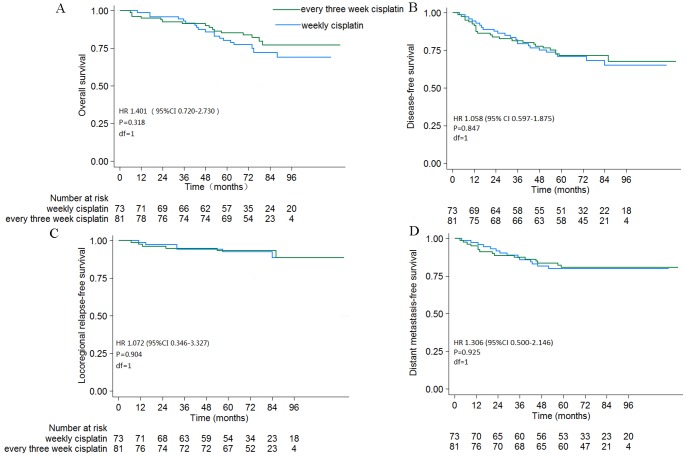
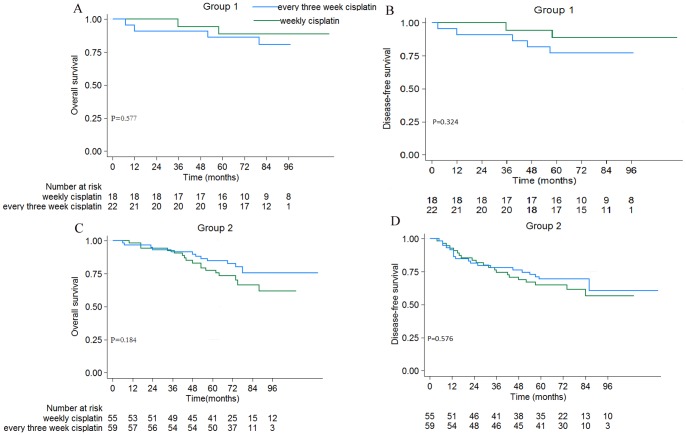
The clinical characteristics and treatment factors of the two groups were well-balanced. The median follow-up was 74 months (range, 6-123 months), and the 5-year overall survival, disease-free survival, locoregional relapse-free survival, and distant metastasis-free survival rates were 85.2% vs. 78.9% (P = 0.318), 71.6% vs. 71.0% (P = 0.847), 93.5% vs. 92.6% (P = 0.904), and 80.9% vs. 80.1% (P = 0.925) for the group treated every three weeks and weekly, respectively. Subgroup analyses indicated no significant differences in the survival rates of the two groups among patients with early- or advanced-stage disease. The incidence of acute toxicities was similar between groups.
IMRT with concurrent cisplatin administered weekly or every three weeks leads to similar long-term survival outcomes and acute toxicity in NPC regardless of whether patients have early- or advanced-stage disease.
我们旨在比较鼻咽癌(NPC)患者每周与每三周一次顺铂同步调强放疗(IMRT)的长期生存结果和急性毒性。
这是一项对154例经组织学证实的非播散性NPC患者的回顾性研究,这些患者于2003年1月至2007年12月期间接受IMRT治疗。73例患者(47.4%)每周接受5 - 7周的30 - 40mg/m²顺铂治疗;81例患者(52.6%)每三周接受两或三个周期的80mg/m²顺铂治疗。IMRT给予鼻咽大体靶体积68Gy/30次分割,给予受累颈部区域60 - 66Gy。
两组的临床特征和治疗因素均衡。中位随访时间为74个月(范围6 - 123个月),每三周和每周治疗组的5年总生存率、无病生存率、局部区域无复发生存率和远处转移无复发生存率分别为85.2%对78.9%(P = 0.318)、71.6%对71.0%(P = 0.847)、93.5%对92.6%(P = 0.904)和80.9%对80.1%(P = 0.925)。亚组分析表明,早期或晚期疾病患者两组的生存率无显著差异。两组急性毒性发生率相似。
无论患者处于早期还是晚期疾病,每周或每三周一次顺铂同步IMRT在NPC患者中导致相似的长期生存结果和急性毒性。