Jeon Young Joo, Zhou Yulin, Li Yihan, Guo Qiwei, Chen Jinchun, Quan Shengmao, Zhang Ahong, Zheng Hailing, Zhu Xingqiang, Lin Jin, Xu Huan, Wu Ayang, Park Sin-Gi, Kim Byung Chul, Joo Hee Jae, Chen Hongliang, Bhak Jong
TheragenEtex Bio Institute, Suwon, Republic of Korea; Genome Care, Seoul, South Korea.
Molecular Diagnostics Laboratory, Department of Medical Genetics, Prenatal Diagnosis Center, Xiamen Maternal and Child Health Hospital, Xiamen, Fujian, China.
PLoS One. 2014 Oct 20;9(10):e110240. doi: 10.1371/journal.pone.0110240. eCollection 2014.
Recent non-invasive prenatal testing (NIPT) technologies are based on next-generation sequencing (NGS). NGS allows rapid and effective clinical diagnoses to be determined with two common sequencing systems: Illumina and Ion Torrent platforms. The majority of NIPT technology is associated with Illumina platform. We investigated whether fetal trisomy 18 and 21 were sensitively and specifically detectable by semiconductor sequencer: Ion Proton.
From March 2012 to October 2013, we enrolled 155 pregnant women with fetuses who were diagnosed as high risk of fetal defects at Xiamen Maternal & Child Health Care Hospital (Xiamen, Fujian, China). Adapter-ligated DNA libraries were analyzed by the Ion Proton™ System (Life Technologies, Grand Island, NY, USA) with an average 0.3× sequencing coverage per nucleotide. Average total raw reads per sample was 6.5 million and mean rate of uniquely mapped reads was 59.0%. The results of this study were derived from BWA mapping. Z-score was used for fetal trisomy 18 and 21 detection.
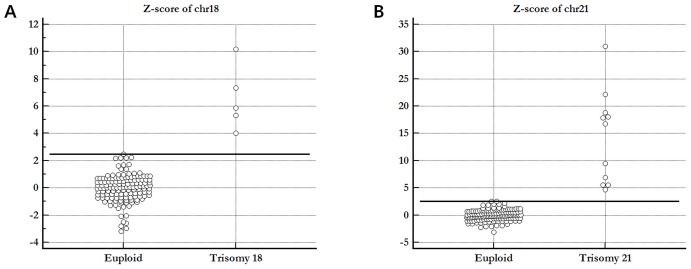
Interactive dot diagrams showed the minimal z-score values to discriminate negative versus positive cases of fetal trisomy 18 and 21. For fetal trisomy 18, the minimal z-score value of 2.459 showed 100% positive predictive and negative predictive values. The minimal z-score of 2.566 was used to classify negative versus positive cases of fetal trisomy 21.
These results provide the evidence that fetal trisomy 18 and 21 detection can be performed with semiconductor sequencer. Our data also suggest that a prospective study should be performed with a larger cohort of clinically diverse obstetrics patients.
近期的无创产前检测(NIPT)技术基于新一代测序(NGS)。NGS可通过两种常见的测序系统:Illumina和Ion Torrent平台来快速有效地确定临床诊断。大多数NIPT技术与Illumina平台相关。我们研究了半导体测序仪Ion Proton能否灵敏且特异地检测胎儿18三体和21三体。
2012年3月至2013年10月,我们纳入了155名孕妇,其胎儿在厦门妇幼保健院(中国福建厦门)被诊断为胎儿缺陷高危。用Ion Proton™系统(美国纽约州大岛市生命技术公司)分析连接了接头的DNA文库,每个核苷酸平均测序覆盖度为0.3倍。每个样本的平均原始总读数为650万,唯一比对读数的平均比例为59.0%。本研究结果来自BWA比对。Z值用于检测胎儿18三体和21三体。
交互式点图显示了区分胎儿18三体和21三体阴性与阳性病例的最小Z值。对于胎儿18三体,最小Z值2.459的阳性预测值和阴性预测值均为100%。最小Z值2.566用于分类胎儿21三体的阴性与阳性病例。
这些结果证明了半导体测序仪可用于检测胎儿18三体和21三体。我们的数据还表明,应该对更多临床情况各异的产科患者进行前瞻性研究。