
雪旺细胞移植与有氧运动相结合可促进坐骨神经再生。
A combination of Schwann-cell grafts and aerobic exercise enhances sciatic nerve regeneration.
作者信息
Goulart Camila Oliveira, Jürgensen Sofia, Souto Allana, Oliveira Júlia Teixeira, de Lima Silmara, Tonda-Turo Chiara, Marques Suelen Adriani, de Almeida Fernanda Martins, Martinez Ana Maria Blanco
机构信息
Laboratório de Neurodegeneração e Reparo, Departamento de Patologia, Faculdade de Medicina, HUCFF, UFRJ, Rio de Janeiro, RJ, Brazil.
Department of Mechanics, Politecnico di Torino, Turin, Italy.
出版信息
PLoS One. 2014 Oct 15;9(10):e110090. doi: 10.1371/journal.pone.0110090. eCollection 2014.
BACKGROUND
Despite the regenerative potential of the peripheral nervous system, severe nerve lesions lead to loss of target-organ innervation, making complete functional recovery a challenge. Few studies have given attention to combining different approaches in order to accelerate the regenerative process.
OBJECTIVE
Test the effectiveness of combining Schwann-cells transplantation into a biodegradable conduit, with treadmill training as a therapeutic strategy to improve the outcome of repair after mouse nerve injury.
METHODS
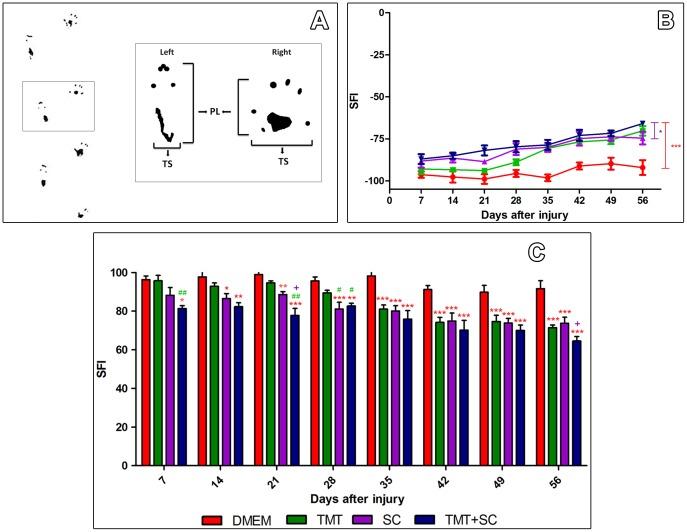
Sciatic nerve transection was performed in adult C57BL/6 mice; the proximal and distal stumps of the nerve were sutured into the conduit. Four groups were analyzed: acellular grafts (DMEM group), Schwann cell grafts (3×10⁵/2 µL; SC group), treadmill training (TMT group), and treadmill training and Schwann cell grafts (TMT + SC group). Locomotor function was assessed weekly by Sciatic Function Index and Global Mobility Test. Animals were anesthetized after eight weeks and dissected for morphological analysis.
RESULTS
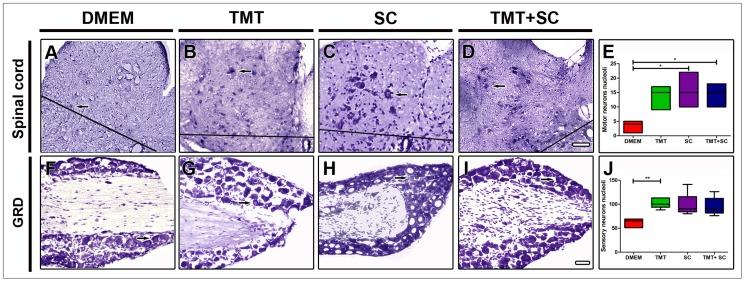
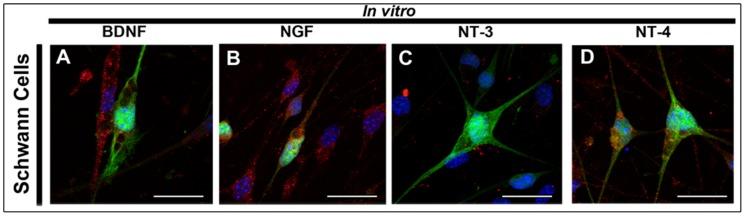
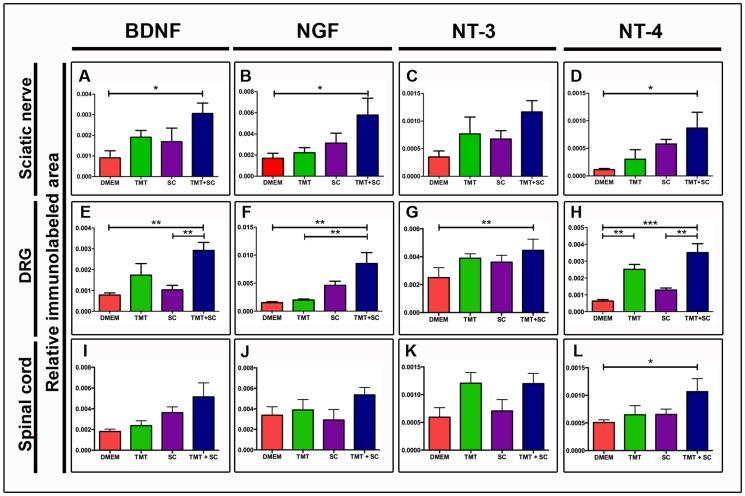
Combined therapies improved nerve regeneration, and increased the number of myelinated fibers and myelin area compared to the DMEM group. Motor recovery was accelerated in the TMT + SC group, which showed significantly better values in sciatic function index and in global mobility test than in the other groups. The TMT + SC group showed increased levels of trophic-factor expression compared to DMEM, contributing to the better functional outcome observed in the former group. The number of neurons in L4 segments was significantly higher in the SC and TMT + SC groups when compared to DMEM group. Counts of dorsal root ganglion sensory neurons revealed that TMT group had a significant increased number of neurons compared to DMEM group, while the SC and TMT + SC groups had a slight but not significant increase in the total number of motor neurons.
CONCLUSION
These data provide evidence that this combination of therapeutic strategies can significantly improve functional and morphological recovery after sciatic injury.
背景
尽管周围神经系统具有再生潜力,但严重的神经损伤会导致靶器官神经支配丧失,使完全功能恢复成为一项挑战。很少有研究关注结合不同方法以加速再生过程。
目的
测试将雪旺细胞移植到可生物降解导管中,并结合跑步机训练作为一种治疗策略,以改善小鼠神经损伤后修复效果的有效性。
方法
对成年C57BL/6小鼠进行坐骨神经横断;将神经的近端和远端残端缝合到导管中。分析四组:无细胞移植物(DMEM组)、雪旺细胞移植物(3×10⁵/2µL;SC组)、跑步机训练(TMT组)以及跑步机训练和雪旺细胞移植物(TMT + SC组)。每周通过坐骨神经功能指数和整体运动测试评估运动功能。八周后对动物进行麻醉并解剖以进行形态学分析。
结果
与DMEM组相比,联合治疗改善了神经再生,增加了有髓纤维数量和髓鞘面积。TMT + SC组的运动恢复加快,其坐骨神经功能指数和整体运动测试值明显优于其他组。与DMEM组相比,TMT + SC组的神经营养因子表达水平升高,这有助于在前一组中观察到更好的功能结果。与DMEM组相比,SC组和TMT + SC组L4节段的神经元数量明显更高。背根神经节感觉神经元计数显示,与DMEM组相比,TMT组的神经元数量显著增加,而SC组和TMT + SC组的运动神经元总数略有增加但不显著。
结论
这些数据证明,这种治疗策略的组合可显著改善坐骨神经损伤后的功能和形态恢复。





 Zotero 插件