Aebischer Nicholas J, Wheatley Christopher J, Rose Hugh R
Game & Wildlife Conservation Trust, Fordingbridge, Hampshire, United Kingdom.
British Deer Society, Fordingbridge, Hampshire, United Kingdom.
PLoS One. 2014 Oct 15;9(10):e109698. doi: 10.1371/journal.pone.0109698. eCollection 2014.
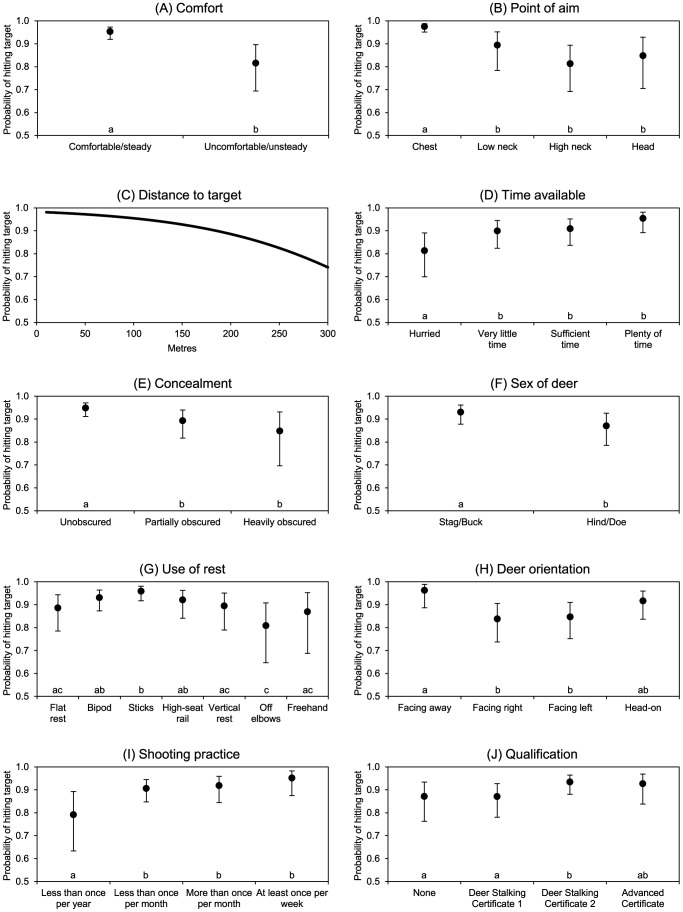
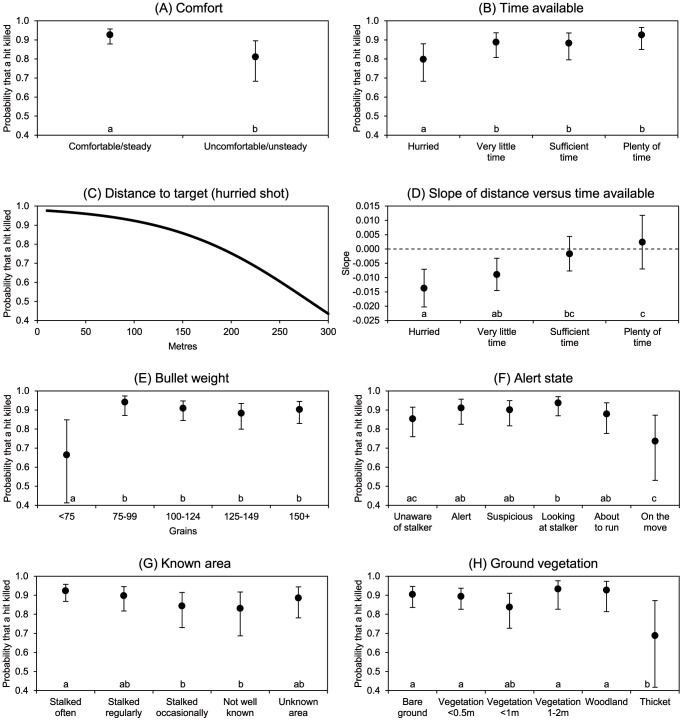
The amount of wounding during routine culling is an important factor in the welfare of wild deer. Little information exists on factors determining shooting accuracy and wounding rates under field conditions in the UK. In this study, 102 anonymous stalkers collected data on the outcomes and circumstances of 2281 shots. Using hot-deck imputation and generalised linear mixed modelling, we related the probability that a shot hit its target, and the probability that the shot killed the deer if it was hit, to 28 variables describing the circumstances of the shot. Overall, 96% of deer were hit, of which 93% were killed outright. A reduced probability of hitting the target was associated with an uncomfortable firing position, too little time available, shooting off elbows or freehand, taking the head or upper neck as point of aim, a heavily obscured target, a distant target, shooting at females, lack of shooting practice and a basic (or no) stalker qualification. An increase in the likelihood of wounding was associated with an uncomfortable firing position, shooting with insufficient time, a distant target (only when time was not sufficient), a bullet weight below 75 grains, a target concealed in thicket or on the move and an area rarely stalked. To maximise stalking success and deer welfare, we recommend that stalkers ensure a comfortable firing position, use a gun rest, aim at the chest, use bullets heavier than 75 grains, avoid taking a rushed shot, shoot a distant animal only if there is plenty of time, fire only when the target is stationary, avoid shooting at an obscured animal, take care when the ground is unfamiliar, and do shooting practice at least once a month. The high miss rate of basic-level stalkers suggests that training should include additional firing practice under realistic shooting conditions.
常规捕杀过程中的受伤程度是影响野生鹿福利的一个重要因素。关于在英国野外条件下决定射击准确性和受伤率的因素,目前几乎没有相关信息。在本研究中,102名匿名猎手收集了2281次射击的结果及相关情况的数据。通过热卡填充法和广义线性混合模型,我们将射击命中目标的概率以及射击命中后杀死鹿的概率与描述射击情况的28个变量关联起来。总体而言,96%的鹿被击中,其中93%被当场杀死。命中目标概率降低与射击姿势不舒服、可用时间过少、用肘部支撑或徒手射击、以头部或上颈部为瞄准点、目标严重遮挡、目标距离远、射击雌性鹿、缺乏射击练习以及猎手为基础水平(或无资格)有关。受伤可能性增加与射击姿势不舒服、射击时间不足、目标距离远(仅在时间不足时)、子弹重量低于75格令、目标隐藏在灌木丛中或移动、以及很少进行捕猎的区域有关。为了使捕猎成功率和鹿的福利最大化,我们建议猎手确保舒适的射击姿势、使用枪托、瞄准胸部、使用重量超过75格令的子弹、避免匆忙射击、仅在有足够时间时射击远处的动物、仅在目标静止时开枪、避免射击被遮挡的动物、在不熟悉的地面时小心谨慎,并且每月至少进行一次射击练习。基础水平猎手的高未命中率表明培训应包括在实际射击条件下增加射击练习。