Chang Shen-Chih, Chang Po-Yin, Butler Brendan, Goldstein Binh Y, Mu Lina, Cai Lin, You Nai-Chieh Y, Baecker Aileen, Yu Shun-Zhang, Heber David, Lu Qing-Yi, Li Liming, Greenland Sander, Zhang Zuo-Feng
Department of Epidemiology, University of California Los Angeles Fielding School of Public Health, Los Angeles, CA, United States of America.
Department of Social and Preventive Medicine, State University of New York at Buffalo, Buffalo, NY, United States of America.
PLoS One. 2014 Oct 22;9(10):e109235. doi: 10.1371/journal.pone.0109235. eCollection 2014.
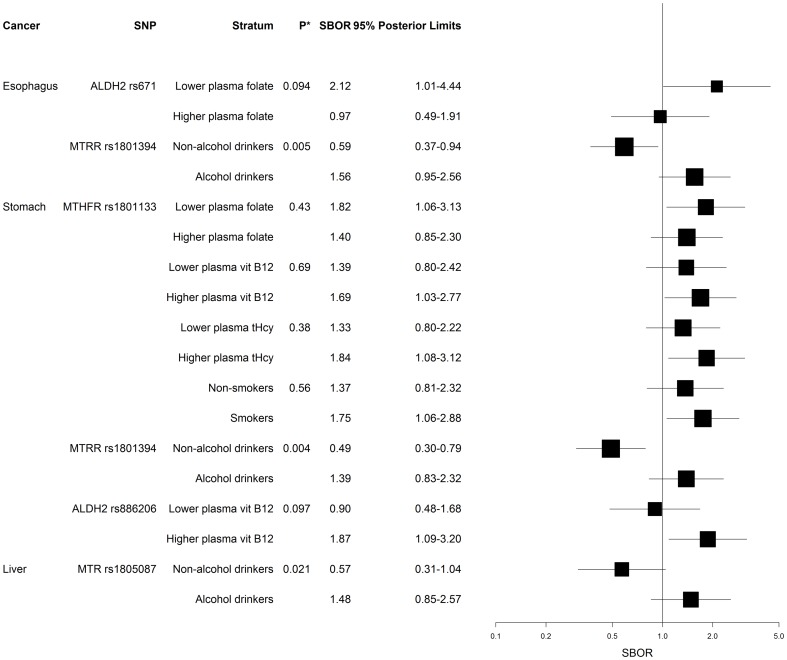
One-carbon metabolism (folate metabolism) is considered important in carcinogenesis because of its involvement in DNA synthesis and biological methylation reactions. We investigated the associations of single nucleotide polymorphisms (SNPs) in folate metabolic pathway and the risk of three GI cancers in a population-based case-control study in Taixing City, China, with 218 esophageal cancer cases, 206 stomach cancer cases, 204 liver cancer cases, and 415 healthy population controls. Study participants were interviewed with a standardized questionnaire, and blood samples were collected after the interviews. We genotyped SNPs of the MTHFR, MTR, MTRR, DNMT1, and ALDH2 genes, using PCR-RFLP, SNPlex, or TaqMan assays. To account for multiple comparisons and reduce the chances of false reports, we employed semi-Bayes (SB) shrinkage analysis. After shrinkage and adjusting for potential confounding factors, we found positive associations between MTHFR rs1801133 and stomach cancer (any T versus C/C, SB odds-ratio [SBOR]: 1.79, 95% posterior limits: 1.18, 2.71) and liver cancer (SBOR: 1.51, 95% posterior limits: 0.98, 2.32). There was an inverse association between DNMT1 rs2228612 and esophageal cancer (any G versus A/A, SBOR: 0.60, 95% posterior limits: 0.39, 0.94). In addition, we detected potential heterogeneity across alcohol drinking status for ORs relating MTRR rs1801394 to esophageal (posterior homogeneity P = 0.005) and stomach cancer (posterior homogeneity P = 0.004), and ORs relating MTR rs1805087 to liver cancer (posterior homogeneity P = 0.021). Among non-alcohol drinkers, the variant allele (allele G) of these two SNPs was inversely associated with the risk of these cancers; while a positive association was observed among ever-alcohol drinkers. Our results suggest that genetic polymorphisms related to one-carbon metabolism may be associated with cancers of the esophagus, stomach, and liver. Heterogeneity across alcohol consumption status of the associations between MTR/MTRR polymorphisms and these cancers indicates potential interactions between alcohol drinking and one-carbon metabolic pathway.
一碳代谢(叶酸代谢)被认为在致癌过程中很重要,因为它参与DNA合成和生物甲基化反应。在中国泰兴市开展的一项基于人群的病例对照研究中,我们调查了叶酸代谢途径中的单核苷酸多态性(SNP)与三种胃肠道癌症风险之间的关联,该研究纳入了218例食管癌病例、206例胃癌病例、204例肝癌病例以及415名健康人群作为对照。研究参与者接受了标准化问卷调查,并在调查后采集了血样。我们使用聚合酶链反应-限制性片段长度多态性分析(PCR-RFLP)、SNP分型芯片(SNPlex)或TaqMan检测法对亚甲基四氢叶酸还原酶(MTHFR)、甲硫氨酸合成酶(MTR)、甲硫氨酸合成酶还原酶(MTRR)、DNA甲基转移酶1(DNMT1)和乙醛脱氢酶2(ALDH2)基因的SNP进行基因分型。为了考虑多重比较并减少假报告的可能性,我们采用了半贝叶斯(SB)收缩分析。在收缩并调整潜在混杂因素后,我们发现MTHFR基因的rs1801133与胃癌(任何T基因型与C/C基因型相比,SB比值比[SBOR]:1.79,95%后验区间下限:1.18,2.71)和肝癌(SBOR:1.51,95%后验区间下限:0.98,2.32)之间存在正相关。DNMT1基因的rs2228612与食管癌(任何G基因型与A/A基因型相比,SBOR:0.60,95%后验区间下限:0.39,0.94)之间存在负相关。此外,我们检测到MTRR基因的rs1801394与食管癌(后验同质性P = 0.005)和胃癌(后验同质性P = 0.004)的比值比,以及MTR基因的rs1805087与肝癌的比值比(后验同质性P = 0.021)在饮酒状态方面存在潜在异质性。在不饮酒者中,这两个SNP的变异等位基因(等位基因G)与这些癌症的风险呈负相关;而在曾经饮酒者中观察到正相关。我们的结果表明,与一碳代谢相关的基因多态性可能与食管癌、胃癌和肝癌有关。MTR/MTRR基因多态性与这些癌症之间的关联在饮酒状态上的异质性表明饮酒与一碳代谢途径之间可能存在相互作用。