Ito Yasuhiro, Miyauchi Akira
aDepartment of Surgery bClinical Trial Management Center, Kuma Hospital, Center for Excellence in Thyroid Care, Kobe, Japan.
Curr Opin Oncol. 2015 Jan;27(1):15-20. doi: 10.1097/CCO.0000000000000143.
The global incidence of small papillary thyroid carcinoma (PTC) is increasing remarkably, mostly due to the increased use of imaging studies worldwide. The issue of how to manage low-risk small PTC has become urgent. In this review, we focus on how to treat low-risk papillary thyroid microcarcinomas (PMCs; i.e., PTCs measuring ≤10 mm).
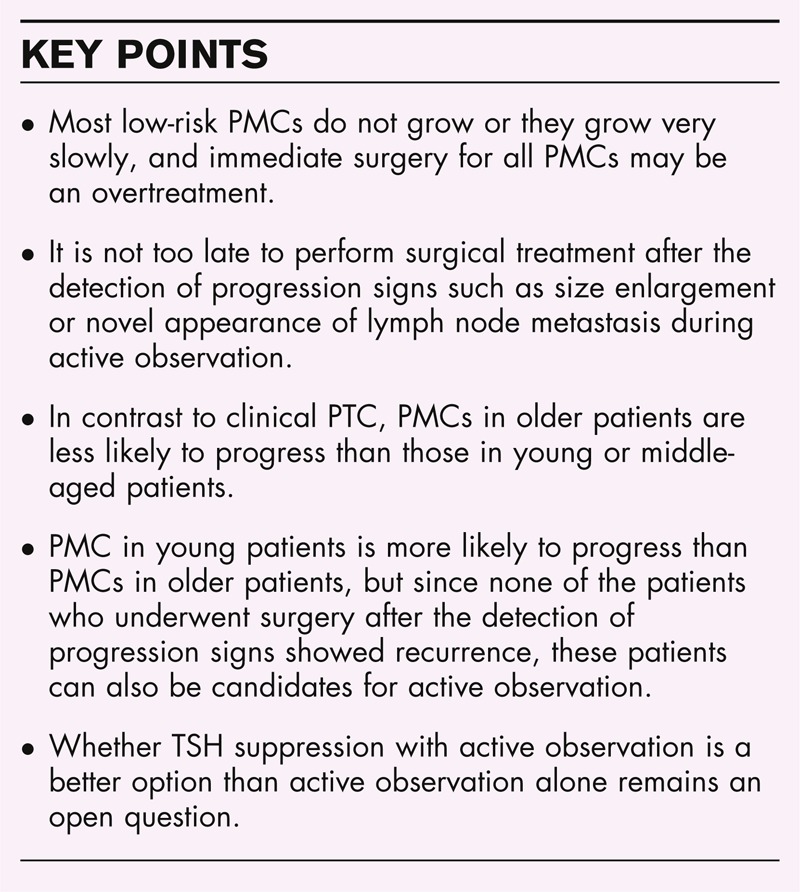
Studies of large numbers of patients with low-risk PMC clarified that most of the PMCs did not grow or grew very slowly and were harmless. Active observations of these patients discriminated rare progressive cases from the majority. Surgery performed after the detection of progression signs was not too late, and surgery immediately after the detection and diagnosis of low-risk PMC may be overtreatment for most patients. Interestingly, low-risk PMCs in elderly patients were most unlikely to progress, in sharp contrast to clinical PTC. The reason for this phenomenon remains unknown.
Active observation without immediate surgery can be a leading alternative to the classical surgical treatment in the majority of the patients with low-risk PMC. It is not too late to perform surgery after the detection of progression signs for these patients.
全球小乳头状甲状腺癌(PTC)的发病率显著上升,主要归因于全球范围内影像学检查使用的增加。如何处理低风险小PTC的问题变得紧迫。在本综述中,我们聚焦于如何治疗低风险甲状腺微小乳头状癌(PMCs;即直径≤10毫米的PTC)。
对大量低风险PMC患者的研究表明,大多数PMC不会生长或生长非常缓慢且无害。对这些患者进行积极观察可将罕见的进展性病例与大多数病例区分开来。在出现进展迹象后进行手术并不太晚,而在检测和诊断低风险PMC后立即进行手术对大多数患者可能属于过度治疗。有趣的是,老年患者中的低风险PMC最不可能进展,这与临床PTC形成鲜明对比。这种现象的原因尚不清楚。
对于大多数低风险PMC患者,不立即手术而是进行积极观察可以成为经典手术治疗的主要替代方案。对这些患者在出现进展迹象后进行手术并不太晚。