Petri Marcelo H, Laguna-Fernández Andrés, Gonzalez-Diez Maria, Paulsson-Berne Gabrielle, Hansson Göran K, Bäck Magnus
Experimental Cardiovascular Research Unit, Karolinska Institutet, Center for Molecular Medicine, L8: 03, Karolinska University Hospital, Stockholm 171 76, Sweden.
Atherosclerosis Research Unit, Center for Molecular Medicine, Department of Medicine, Karolinska Institutet, Stockholm, Sweden.
Cardiovasc Res. 2015 Jan 1;105(1):65-74. doi: 10.1093/cvr/cvu224. Epub 2014 Oct 23.
The formyl peptide receptor (FPR) subtype FPR2/ALX transduces pro-inflammatory responses and participates in the resolution of inflammation depending on activation. The aim of the present study was to unravel the role of FPR2/ALX signalling in atherosclerosis.
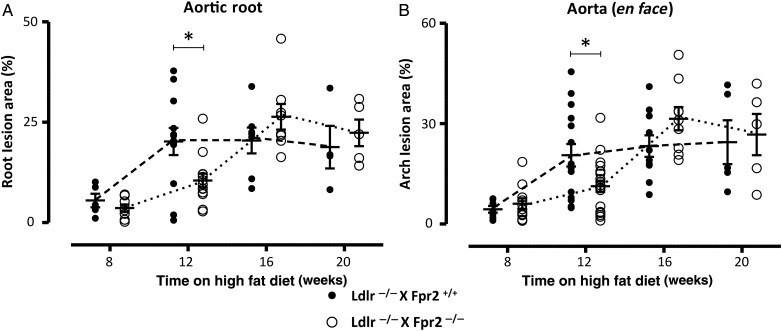
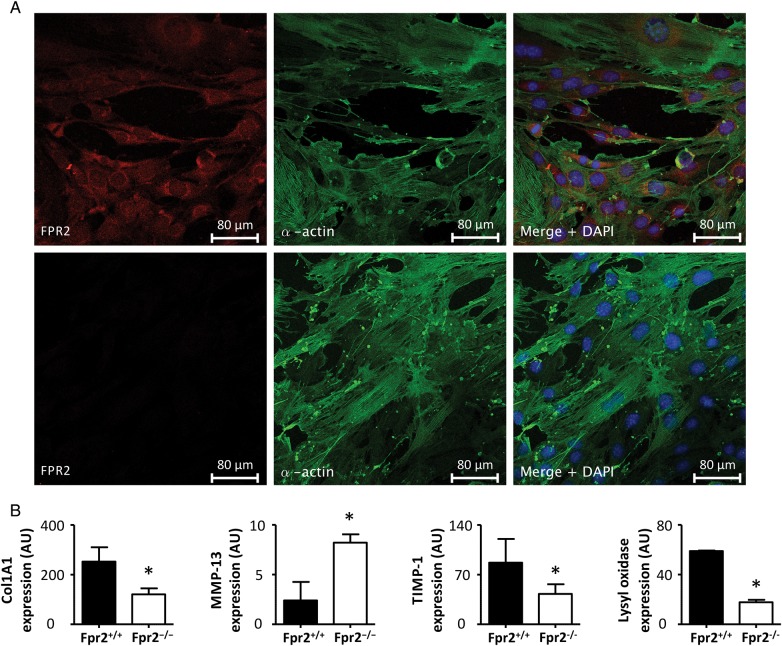
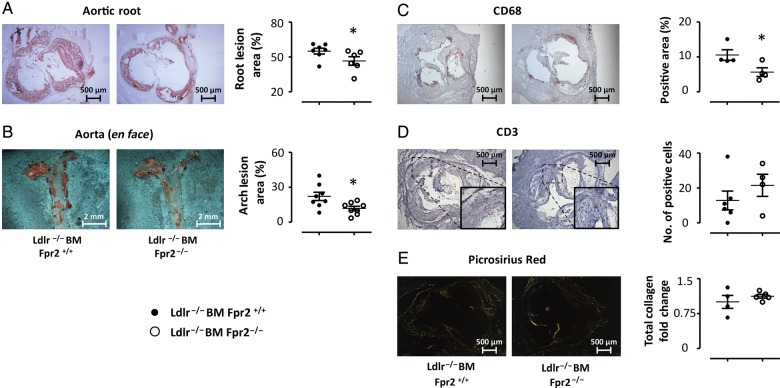
Expression of FPR2/ALX was analysed in 127 human carotid atherosclerotic lesions and revealed that this receptor was expressed on macrophages, smooth muscle cells (SMCs), and endothelial cells. Furthermore, FPR2/ALX mRNA levels were significantly up-regulated in atherosclerotic lesions compared with healthy vessels. In multiple regression, age, creatinine, and clinical signs of increased cerebral ischaemia were independent predictors of FPR2/ALX expression. To provide mechanistic insights into these observations, we generated Ldlr(-/-)xFpr2(-/-) mice, which exhibited delayed atherosclerosis development and less macrophage infiltration compared with Ldlr(-/-)xFpr2(+/+) mice. These findings were reproduced by transplantation of Fpr2(-/-) bone marrow into Ldlr(-/-) mice and further extended by in vitro experiments, demonstrating a lower inflammatory state in Fpr2(-/-) macrophages. FPR2/ALX expression correlated with chemo- and cytokines in human atherosclerotic lesions and leucocytes. Finally, atherosclerotic lesions in Ldlr(-/-)xFpr2(-/-) mice exhibited decreased collagen content, and Fpr2(-/-) SMCs exhibited a profile of increased collagenase and decreased collagen production pathways.
FPR2/ALX is proatherogenic due to effects on bone marrow-derived cells, but promoted a more stable plaque phenotype through effects on SMCs. Taken together, these results suggest a dual role of FPR2/ALX signalling in atherosclerosis by way of promoting disease progression and but increasing plaque stability.
甲酰肽受体(FPR)亚型FPR2/ALX可转导促炎反应,并根据激活情况参与炎症的消退。本研究的目的是阐明FPR2/ALX信号在动脉粥样硬化中的作用。
分析了127例人类颈动脉粥样硬化病变中FPR2/ALX的表达,发现该受体在巨噬细胞、平滑肌细胞(SMC)和内皮细胞上表达。此外,与健康血管相比,动脉粥样硬化病变中FPR2/ALX mRNA水平显著上调。在多元回归分析中,年龄、肌酐和脑缺血增加的临床体征是FPR2/ALX表达的独立预测因素。为了深入了解这些观察结果的机制,我们构建了Ldlr(-/-)xFpr2(-/-)小鼠,与Ldlr(-/-)xFpr2(+/+)小鼠相比,其动脉粥样硬化发展延迟,巨噬细胞浸润减少。将Fpr2(-/-)骨髓移植到Ldlr(-/-)小鼠中再现了这些发现,并通过体外实验进一步扩展,表明Fpr2(-/-)巨噬细胞的炎症状态较低。FPR2/ALX表达与人类动脉粥样硬化病变和白细胞中的趋化因子及细胞因子相关。最后,Ldlr(-/-)xFpr2(-/-)小鼠的动脉粥样硬化病变胶原含量降低,Fpr2(-/-) SMC表现出胶原酶增加和胶原生成途径减少的特征。
FPR2/ALX对骨髓来源细胞有影响,具有促动脉粥样硬化作用,但通过对SMC的作用促进了更稳定的斑块表型。综上所述,这些结果表明FPR2/ALX信号在动脉粥样硬化中具有双重作用,既促进疾病进展,又增加斑块稳定性。