Yoder Paul, Watson Linda R, Lambert Warren
Special Education, Vanderbilt University, Nashville, TN, USA,
J Autism Dev Disord. 2015 May;45(5):1254-70. doi: 10.1007/s10803-014-2286-4.
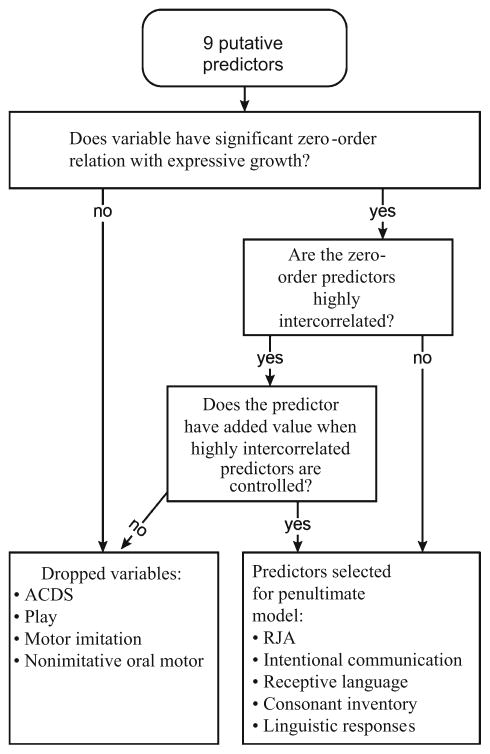
Eighty-seven preschoolers with autism spectrum disorders who were initially nonverbal (under 6 words in language sample and under 21 parent-reported words said) were assessed at five time points over 16 months. Statistical models that accounted for the intercorrelation among nine theoretically- and empirically-motivated predictors, as well as two background variables (i.e., cognitive impairment level, autism severity), were applied to identify value-added predictors of expressive and receptive spoken language growth and outcome. The results indicate that responding to joint attention, intentional communication, and parent linguistic responses were value-added predictors of both expressive and receptive spoken language growth. In addition, consonant inventory was a value-added predictor of expressive growth; early receptive vocabulary and autism severity were value-added predictors of receptive growth.
87名最初无语言能力(语言样本中少于6个单词且家长报告说出的单词少于21个)的自闭症谱系障碍学龄前儿童在16个月内的五个时间点接受了评估。采用统计模型,该模型考虑了九个理论和实证驱动的预测因素之间的相互关系,以及两个背景变量(即认知障碍水平、自闭症严重程度),以确定表达性和接受性口语发展及结果的增值预测因素。结果表明,对共同注意的反应、有意沟通和家长的语言反应是表达性和接受性口语发展的增值预测因素。此外,辅音清单是表达性发展的增值预测因素;早期接受性词汇和自闭症严重程度是接受性发展的增值预测因素。