Chen Gong, Zhong Hua, Belousov Anton, Devanarayan Viswanath
Roche Pharmaceutical Research and Early Development, Pharmaceutical Sciences, Roche Innovation Center New York, Roche TCRC, Inc., 430 East 29th Street, New York, NY 10016, U.S.A.
Stat Med. 2015 Jan 30;34(2):317-42. doi: 10.1002/sim.6343. Epub 2014 Oct 27.
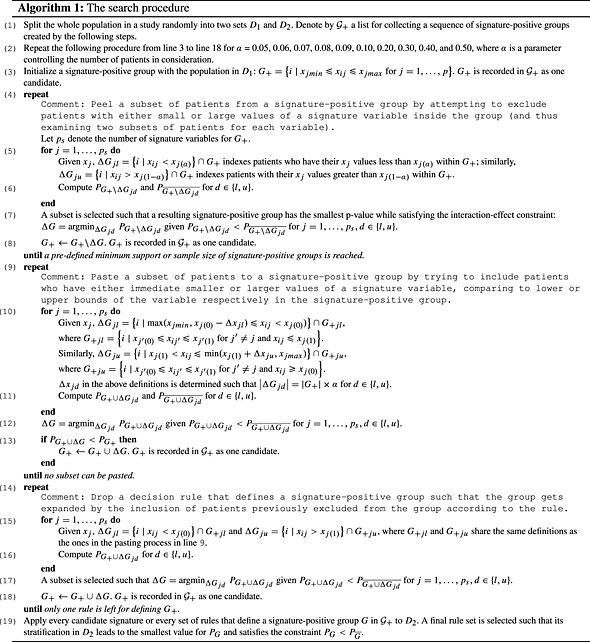
Patients often respond differently to a treatment because of individual heterogeneity. Failures of clinical trials can be substantially reduced if, prior to an investigational treatment, patients are stratified into responders and nonresponders based on biological or demographic characteristics. These characteristics are captured by a predictive signature. In this paper, we propose a procedure to search for predictive signatures based on the approach of patient rule induction method. Specifically, we discuss selection of a proper objective function for the search, present its algorithm, and describe a resampling scheme that can enhance search performance. Through simulations, we characterize conditions under which the procedure works well. To demonstrate practical uses of the procedure, we apply it to two real-world data sets. We also compare the results with those obtained from a recent regression-based approach, Adaptive Index Models, and discuss their respective advantages. In this study, we focus on oncology applications with survival responses.
由于个体异质性,患者对治疗的反应往往不同。如果在进行试验性治疗之前,根据生物学或人口统计学特征将患者分为反应者和无反应者,临床试验的失败率可以大幅降低。这些特征由一个预测特征来体现。在本文中,我们提出了一种基于患者规则归纳法来搜索预测特征的程序。具体来说,我们讨论了搜索中合适目标函数的选择,给出了其算法,并描述了一种可以提高搜索性能的重采样方案。通过模拟,我们刻画了该程序运行良好的条件。为了证明该程序的实际用途,我们将其应用于两个真实世界的数据集。我们还将结果与最近基于回归的方法——自适应指数模型得到的结果进行比较,并讨论它们各自的优点。在本研究中,我们专注于具有生存反应的肿瘤学应用。