Hwang Sungmin, Cordova Bryan, Chavarria Nikita, Elbanna Dina, McHugh Stephen, Rojas Jenny, Pfeiffer Friedhelm, Maupin-Furlow Julie A
Department of Microbiology and Cell Science, University of Florida, Gainesville, FL, 32611-0700, USA.
Department of Membrane Biochemistry, Max Planck Institute of Biochemistry, Am Klopferspitz 18, D-82152, Martinsried, Germany.
BMC Microbiol. 2014 Oct 28;14:260. doi: 10.1186/s12866-014-0260-0.
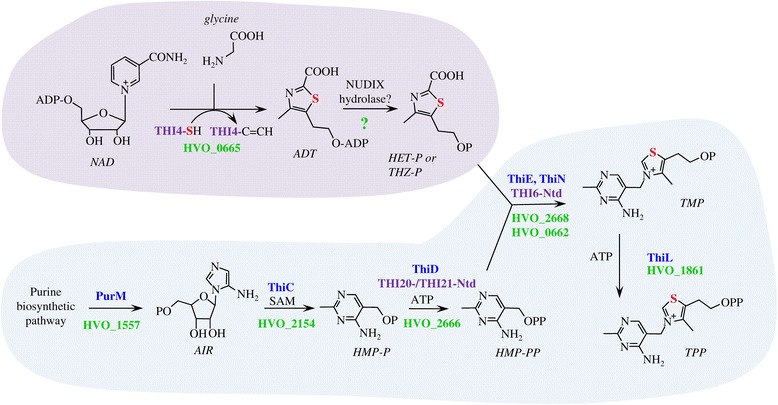
Thiamine (vitamin B1) is synthesized de novo by certain yeast, fungi, plants, protozoans, bacteria and archaea. The pathway of thiamine biosynthesis by archaea is poorly understood, particularly the route of sulfur relay to form the thiazole ring. Archaea harbor structural homologs of both the bacterial (ThiS-ThiF) and eukaryotic (THI4) proteins that mobilize sulfur to thiazole ring precursors by distinct mechanisms.
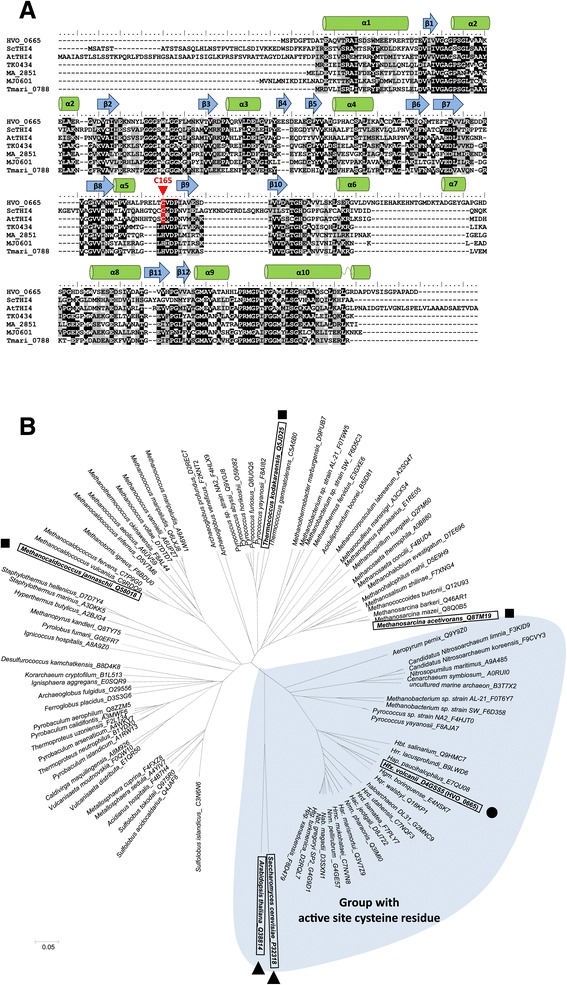
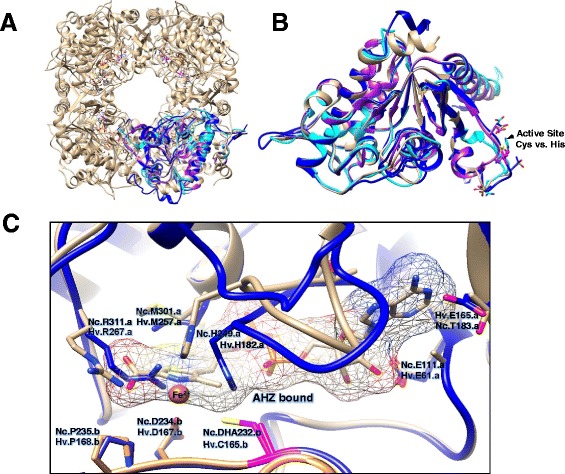
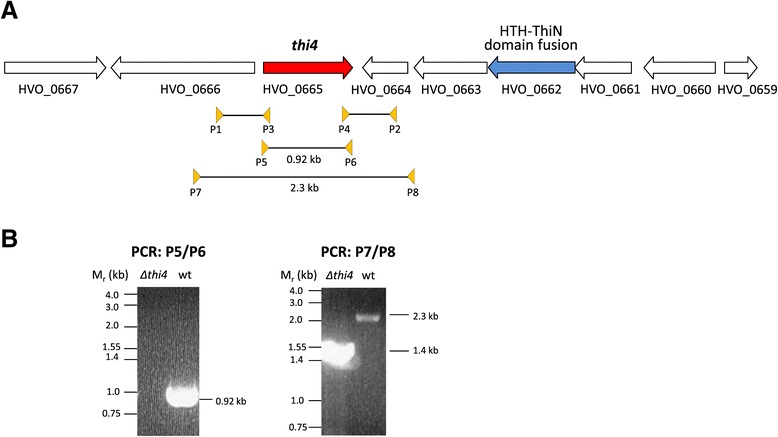
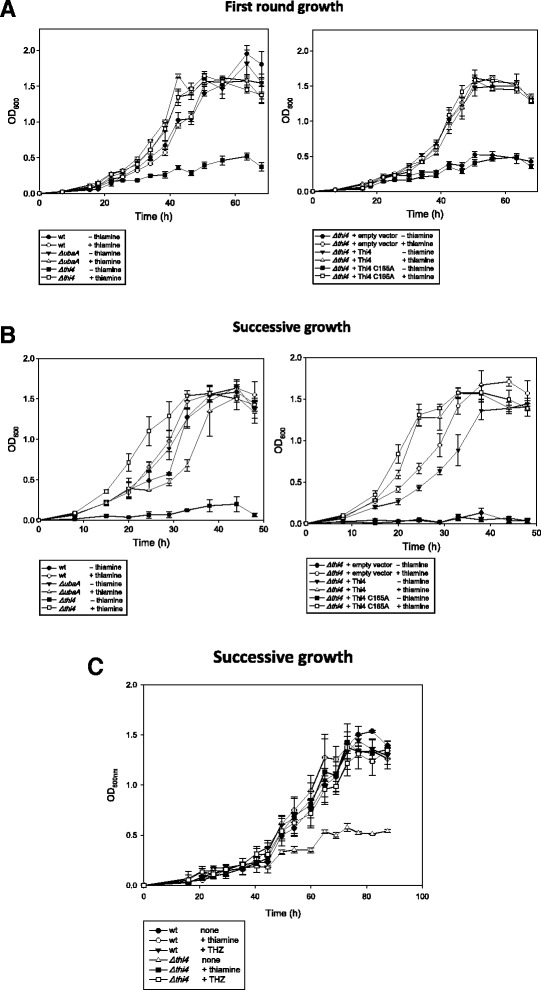
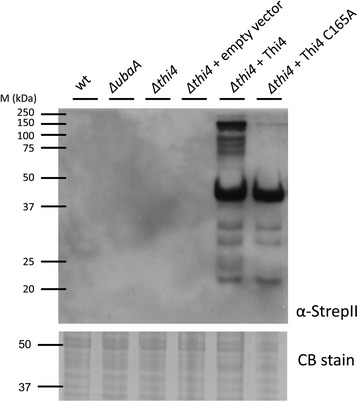
Based on comparative genome analysis, halophilic archaea are predicted to synthesize the pyrimidine moiety of thiamine by the bacterial pathway, initially suggesting that also a bacterial ThiS-ThiF type mechanism for synthesis of the thiazole ring is used in which the sulfur carrier ThiS is first activated by ThiF-catalyzed adenylation. The only ThiF homolog of Haloferax volcanii (UbaA) was deleted but this had no effect on growth in the absence of thiamine. Usage of the eukaryotic THI4-type sulfur relay was initially considered less likely for thiamine biosynthesis in archaea, since the active-site cysteine residue of yeast THI4p that donates the sulfur to the thiazole ring by a suicide mechanism is replaced by a histidine residue in many archaeal THI4 homologs and these are described as D-ribose-1,5-bisphosphate isomerases. The THI4 homolog of the halophilic archaea, including Hfx. volcanii (HVO_0665, HvThi4) was found to differ from that of methanogens and thermococci by having a cysteine residue (Cys165) corresponding to the conserved active site cysteine of yeast THI4p (Cys205). Deletion of HVO_0665 generated a thiamine auxotroph that was trans-complemented by a wild-type copy of HVO_0665, but not the modified gene encoding an HvThi4 C165A variant.
Based on our results, we conclude that the archaeon Hfx. volcanii uses a yeast THI4-type mechanism for sulfur relay to form the thiazole ring of thiamine. We extend this finding to a relatively large group of archaea, including haloarchaea, ammonium oxidizing archaea, and some methanogen and Pyrococcus species, by observing that these organisms code for THI4 homologs that have a conserved active site cysteine residue which is likely used in thiamine biosynthesis. Thus, archaeal members of IPR002922 THI4 family that have a conserved cysteine active site should be reexamined for a function in thiamine biosynthesis.
硫胺素(维生素B1)由某些酵母、真菌、植物、原生动物、细菌和古菌从头合成。古菌硫胺素生物合成途径尚不清楚,尤其是硫传递形成噻唑环的途径。古菌含有细菌(ThiS-ThiF)和真核生物(THI4)蛋白质的结构同源物,它们通过不同机制将硫转运到噻唑环前体。
基于比较基因组分析,预计嗜盐古菌通过细菌途径合成硫胺素的嘧啶部分,最初表明合成噻唑环也采用细菌ThiS-ThiF型机制,其中硫载体ThiS首先由ThiF催化的腺苷化激活。删除了沃氏嗜盐菌(Haloferax volcanii)唯一的ThiF同源物(UbaA),但这对无硫胺素条件下的生长没有影响。最初认为古菌硫胺素生物合成中不太可能使用真核生物THI4型硫传递,因为酵母THI4p通过自杀机制将硫提供给噻唑环的活性位点半胱氨酸残基在许多古菌THI4同源物中被组氨酸残基取代,并且这些被描述为D-核糖-1,5-二磷酸异构酶。发现嗜盐古菌的THI4同源物,包括沃氏嗜盐菌(HVO_0665,HvThi4),与产甲烷菌和嗜热球菌的不同,其具有对应于酵母THI4p保守活性位点半胱氨酸(Cys205)的半胱氨酸残基(Cys165)。删除HVO_0665产生硫胺素营养缺陷型,可由HVO_0665的野生型拷贝进行反式互补,但不能由编码HvThi4 C165A变体的修饰基因进行反式互补。
基于我们的结果,我们得出结论,古菌沃氏嗜盐菌使用酵母THI4型机制进行硫传递以形成硫胺素的噻唑环。通过观察这些生物编码具有保守活性位点半胱氨酸残基的THI4同源物,可能用于硫胺素生物合成,我们将这一发现扩展到相对较大的一组古菌,包括嗜盐古菌、氨氧化古菌以及一些产甲烷菌和火球菌属物种。因此,应重新审视具有保守半胱氨酸活性位点的IPR002922 THI4家族古菌成员在硫胺素生物合成中的功能。