Sedlmeier Eva-Maria, Brunner Stefanie, Much Daniela, Pagel Philipp, Ulbrich Susanne E, Meyer Heinrich Hd, Amann-Gassner Ulrike, Hauner Hans, Bader Bernhard L
ZIEL-PhD Graduate School 'Epigenetics, Imprinting and Nutrition', Research Center for Nutrition and Food Sciences (ZIEL), Technische Universität München, Freising-Weihenstephan, Germany.
BMC Genomics. 2014 Oct 27;15(1):941. doi: 10.1186/1471-2164-15-941.
Previously we have examined the effect of maternal dietary n-3 long-chain polyunsaturated fatty acid (LCPUFA) supplementation during pregnancy on offspring fat mass. Considering the involvement of the placenta in fetal programming, we aimed to analyze the sex-specific gene expression in human term placenta and its response to the n-3 LCPUFA intervention, as well as their correlations to offspring adiposity.
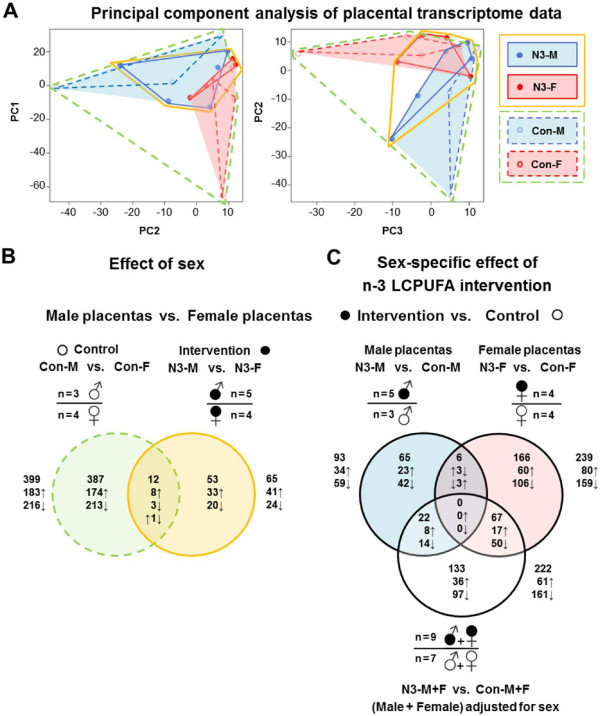
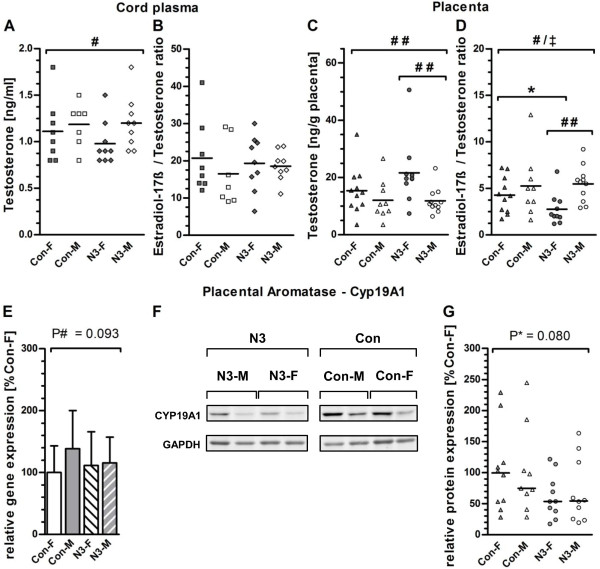
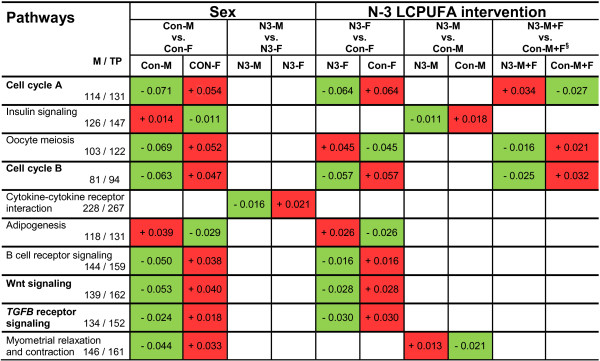
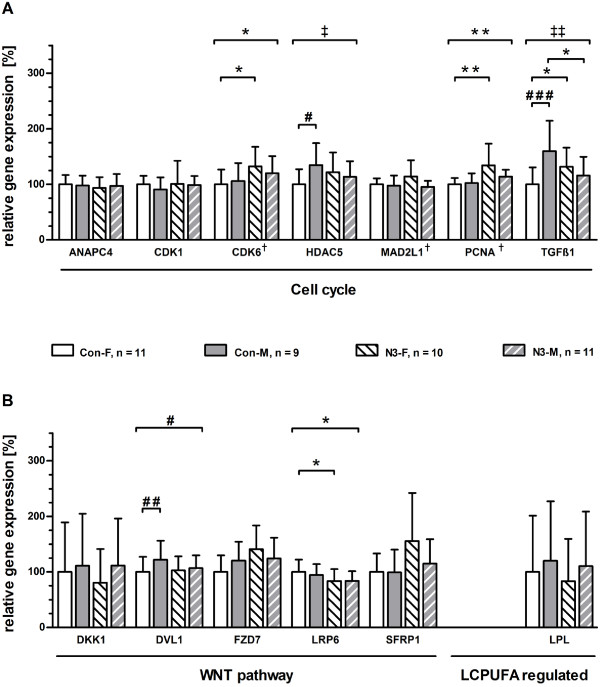
Placental gene expression was assessed in a control and n-3 LCPUFA intervention group by DNA microarrays, biological pathway analyses and RT-qPCR validation. Expression data were correlated with sex steroid hormone levels in placenta and cord plasma, and offspring anthropometric data. Transcriptome data revealed sexually dimorphic gene expression in control placentas per se, whereas in intervention placentas sex-specific expression changed, and more n-3 LCPUFA-regulated genes were found in female than male placentas. Sexually dimorphic gene expression and n-3 LCPUFA-responsive genes were enriched in the pathway for cell cycle and its associated modulator pathways. Significant mRNA expression changes for CDK6, PCNA, and TGFB1 were confirmed by RT-qPCR. CDK6 and PCNA mRNA levels correlated with offspring birth weight and birth weight percentiles. Significantly reduced placental estradiol-17β/testosterone ratio upon intervention found in female offspring correlated with mRNA levels for the 'Wnt signaling' genes DVL1 and LRP6.
Overall, human placentas show sexually dimorphic gene expression and responsiveness to maternal n-3 LCPUFA intervention during pregnancy with more pronounced effects in female placentas. The absence of correlations of analyzed placental gene expression with offspring adipose tissue growth in the first year is not mutually exclusive with programming effects, which may manifest later in life, or in other physiological processes.
此前我们研究了孕期母亲膳食补充n-3长链多不饱和脂肪酸(LCPUFA)对后代脂肪量的影响。考虑到胎盘在胎儿编程中的作用,我们旨在分析足月人胎盘的性别特异性基因表达及其对n-3 LCPUFA干预的反应,以及它们与后代肥胖的相关性。
通过DNA微阵列、生物途径分析和RT-qPCR验证,在对照组和n-3 LCPUFA干预组中评估胎盘基因表达。表达数据与胎盘和脐血血浆中的性类固醇激素水平以及后代人体测量数据相关。转录组数据显示,对照组胎盘本身存在性别二态性基因表达,而在干预组胎盘中,性别特异性表达发生了变化,并且在女性胎盘中发现的n-3 LCPUFA调节基因比男性胎盘更多。性别二态性基因表达和n-3 LCPUFA反应性基因在细胞周期及其相关调节途径中富集。RT-qPCR证实了CDK6、PCNA和TGFB1的显著mRNA表达变化。CDK6和PCNA mRNA水平与后代出生体重和出生体重百分位数相关。在雌性后代中发现,干预后胎盘雌二醇-17β/睾酮比值显著降低,这与“Wnt信号”基因DVL1和LRP6的mRNA水平相关。
总体而言,人类胎盘在孕期表现出性别特异性基因表达以及对母亲n-3 LCPUFA干预的反应性,在女性胎盘中的影响更为明显。所分析的胎盘基因表达与后代第一年脂肪组织生长之间缺乏相关性,这与编程效应并不相互排斥,编程效应可能在生命后期或其他生理过程中表现出来。