Thompson John F, Agarwala Sanjiv S, Smithers B Mark, Ross Merrick I, Scoggins Charles R, Coventry Brendon J, Neuhaus Susan J, Minor David R, Singer Jamie M, Wachter Eric A
Melanoma Institute Australia and the University of Sydney, Sydney, NSW, Australia.
Ann Surg Oncol. 2015 Jul;22(7):2135-42. doi: 10.1245/s10434-014-4169-5. Epub 2014 Oct 28.
This international, multicenter, single-arm trial assessed efficacy and safety of intralesional rose bengal (PV-10) in 80 patients with refractory cutaneous or subcutaneous metastatic melanoma.
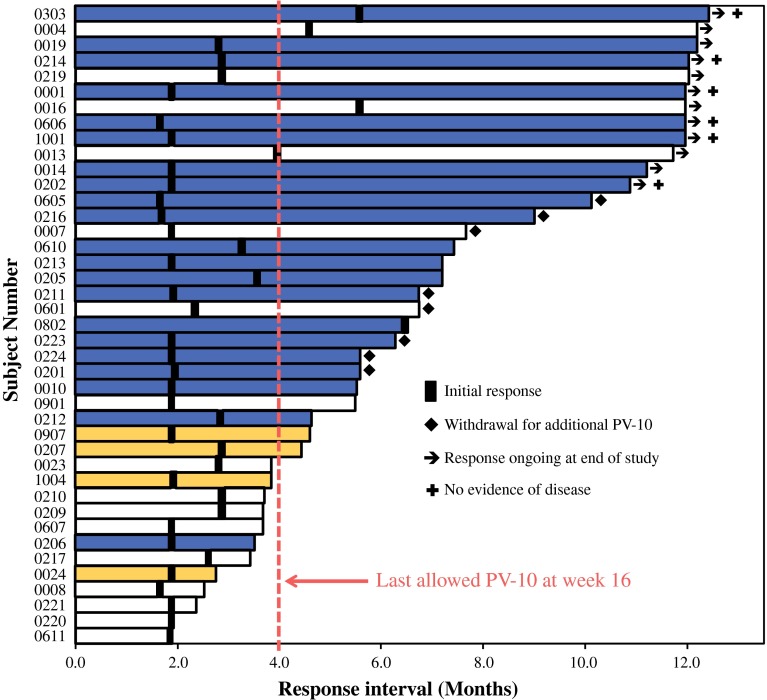
Sixty-two stage III and 18 stage IV melanoma patients with disease refractory to a median of six prior interventions received intralesional PV-10 into up to 20 cutaneous and subcutaneous lesions up to four times over a 16-week period and were followed for 52 weeks. Objectives were to determine best overall response rate in injected target lesions and uninjected bystander lesions, assess durability of response, and characterize adverse events.
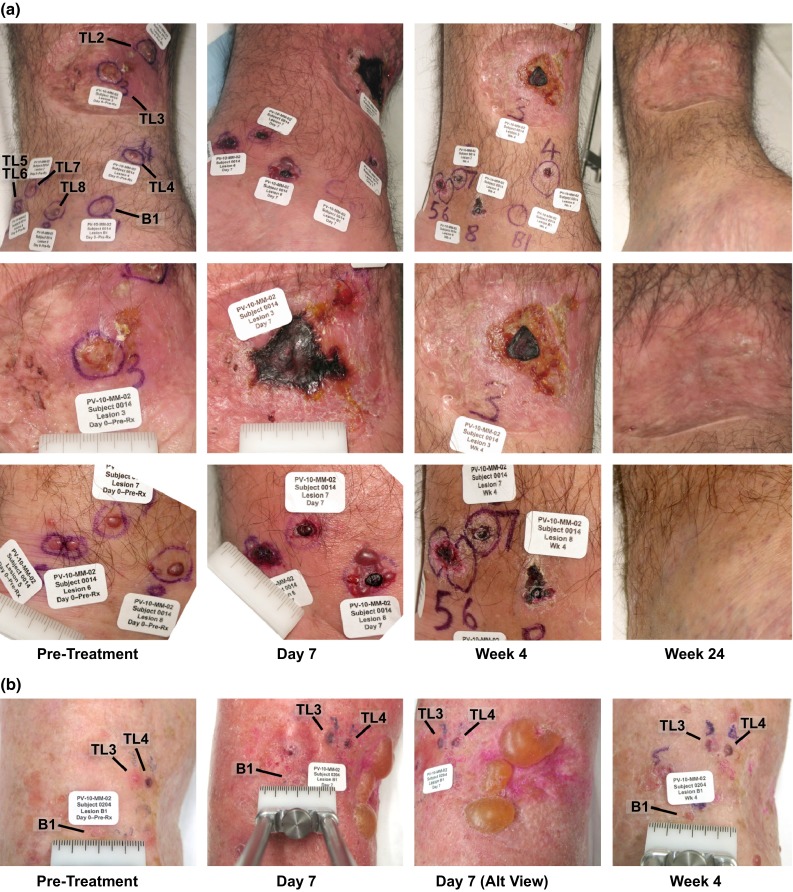
For target lesions, the best overall response rate was 51 %, and the complete response rate was 26 %. Median time to response was 1.9 months, and median duration of response was 4.0 months, with 8 % of patients having no evidence of disease after 52 weeks. Response was dependent on untreated disease burden, with complete response achieved in 50 % of patients receiving PV-10 to all of their disease. Response of target lesions correlated with bystander lesion regression and the occurrence of locoregional blistering. Adverse events were predominantly mild to moderate and locoregional to the treatment site, with no treatment-associated grade 4 or 5 adverse events.
Intralesional PV-10 yielded durable local control with high rates of complete response. Toxicity was confined predominantly to the injection site. Cutaneous bystander tumor regression is consistent with an immunologic response secondary to ablation. This intralesional approach for local disease control could be complementary to current and investigational treatments for melanoma.
这项国际多中心单臂试验评估了病灶内注射孟加拉玫瑰红(PV-10)对80例难治性皮肤或皮下转移性黑色素瘤患者的疗效和安全性。
62例III期和18例IV期黑色素瘤患者,疾病对中位6次先前干预难治,在16周内对多达20个皮肤和皮下病灶进行多达4次病灶内PV-10注射,并随访52周。目的是确定注射的靶病灶和未注射的旁观者病灶的最佳总体缓解率,评估缓解的持久性,并描述不良事件。
对于靶病灶,最佳总体缓解率为51%,完全缓解率为26%。中位缓解时间为1.9个月,中位缓解持续时间为4.0个月,8%的患者在52周后无疾病证据。缓解取决于未治疗的疾病负担,50%接受PV-10治疗所有病灶的患者实现了完全缓解。靶病灶的缓解与旁观者病灶消退和局部水疱形成相关。不良事件主要为轻至中度,局限于治疗部位,无治疗相关的4级或5级不良事件。
病灶内注射PV-10产生了持久的局部控制,完全缓解率高。毒性主要局限于注射部位。皮肤旁观者肿瘤消退与消融继发的免疫反应一致。这种病灶内局部疾病控制方法可能是黑色素瘤当前和研究性治疗的补充。