Adayev Tatyana, LaFauci Giuseppe, Dobkin Carl, Caggana Michele, Wiley Veronica, Field Michael, Wotton Tiffany, Kascsak Richard, Nolin Sarah L, Glicksman Anne, Hosmer Nicole, Brown W Ted
Department of Developmental Biochemistry, New York State Institute for Basic Research in Developmental Disabilities, 1050 Forest Hill Road, Staten Island, New York, 10314, USA.
Department of Human Genetics, New York State Institute for Basic Research in Developmental Disabilities, 1050 Forest Hill Road, Staten Island, New York, 10314, USA.
BMC Med Genet. 2014 Oct 28;15:119. doi: 10.1186/s12881-014-0119-0.
The fragile X syndrome (FXS) results from mutation of the FMR1 gene that prevents expression of its gene product, FMRP. We previously characterized 215 dried blood spots (DBS) representing different FMR1 genotypes and ages with a Luminex-based immunoassay (qFMRP). We found variable FMRP levels in the normal samples and identified affected males by the drastic reduction of FMRP.
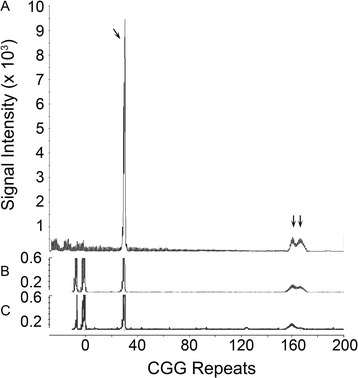
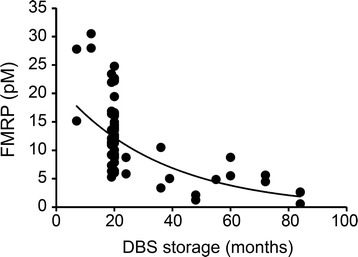
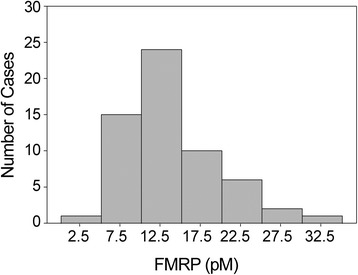
Here, to establish the variability of expression of FMRP in a larger random population we quantified FMRP in 2,000 anonymous fresh newborn DBS. We also evaluated the effect of long term storage on qFMRP by retrospectively assaying 74 aged newborn DBS that had been stored for 7-84 months that included normal and full mutation individuals. These analyses were performed on 3 mm DBS disks. To identify the alleles associated with the lowest FMRP levels in the fresh DBS, we analyzed the DNA in the samples that were more than two standard deviations below the mean.
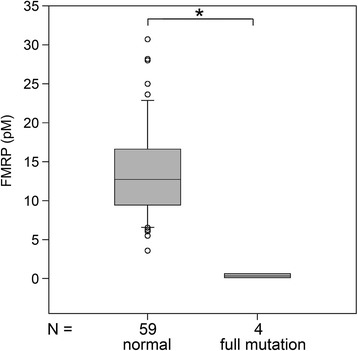
Analysis of the fresh newborn DBS revealed a broad distribution of FMRP with a mean approximately 7-fold higher than that we previously reported for fresh DBS in normal adults and no samples whose FMRP level indicated FXS. DNA analysis of the lowest FMRP DBS showed that this was the low extreme of the normal range and included a female carrying a 165 CGG repeat premutation. In the retrospective study of aged newborn DBS, the FMRP mean of the normal samples was less than 30% of the mean of the fresh DBS. Despite the degraded signal from these aged DBS, qFMRP identified the FXS individuals.
The assay showed that newborn DBS contain high levels of FMRP that will allow identification of males and potentially females, affected by FXS. The assay is also an effective screening tool for aged DBS stored for up to four years.
脆性X综合征(FXS)由FMR1基因突变导致其基因产物FMRP无法表达所致。我们之前利用基于Luminex的免疫测定法(qFMRP)对代表不同FMR1基因型和年龄的215份干血斑(DBS)进行了特征分析。我们发现正常样本中FMRP水平存在差异,并通过FMRP的大幅降低鉴定出受影响的男性。
在此,为了确定更大随机人群中FMRP表达的变异性,我们对2000份匿名新鲜新生儿DBS中的FMRP进行了定量。我们还通过回顾性分析74份已储存7 - 84个月的老年新生儿DBS(包括正常和全突变个体)来评估长期储存对qFMRP的影响。这些分析在3毫米的DBS圆盘上进行。为了鉴定与新鲜DBS中最低FMRP水平相关的等位基因,我们分析了样本中低于平均值两个标准差以上的DNA。
对新鲜新生儿DBS的分析显示FMRP分布广泛,平均值比我们之前报道的正常成年人新鲜DBS高约7倍,且没有样本的FMRP水平表明患有FXS。对最低FMRP DBS的DNA分析表明,这是正常范围的低端,包括一名携带165个CGG重复前突变的女性。在对老年新生儿DBS的回顾性研究中,正常样本的FMRP平均值不到新鲜DBS平均值的30%。尽管这些老年DBS的信号有所降解,但qFMRP仍能鉴定出FXS个体。
该测定法表明,新生儿DBS含有高水平的FMRP,这将有助于识别受FXS影响的男性以及潜在的女性。该测定法也是对储存长达四年的老年DBS进行有效筛查的工具。