Akter Farhima, Yokobayashi Yohei
†Department of Biomedical Engineering, University of California, Davis 451 Health Sciences Drive, Davis, California 95616, United States.
‡Nucleic Acid Chemistry and Engineering Unit, Okinawa Institute of Science and Technology Graduate University, 1919-1 Tancha, Onna-son, Okinawa 904-0495, Japan.
ACS Synth Biol. 2015 May 15;4(5):655-8. doi: 10.1021/sb500314r. Epub 2014 Nov 7.
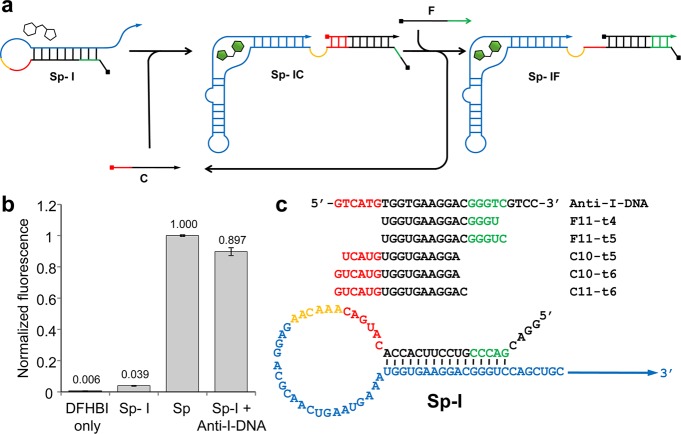
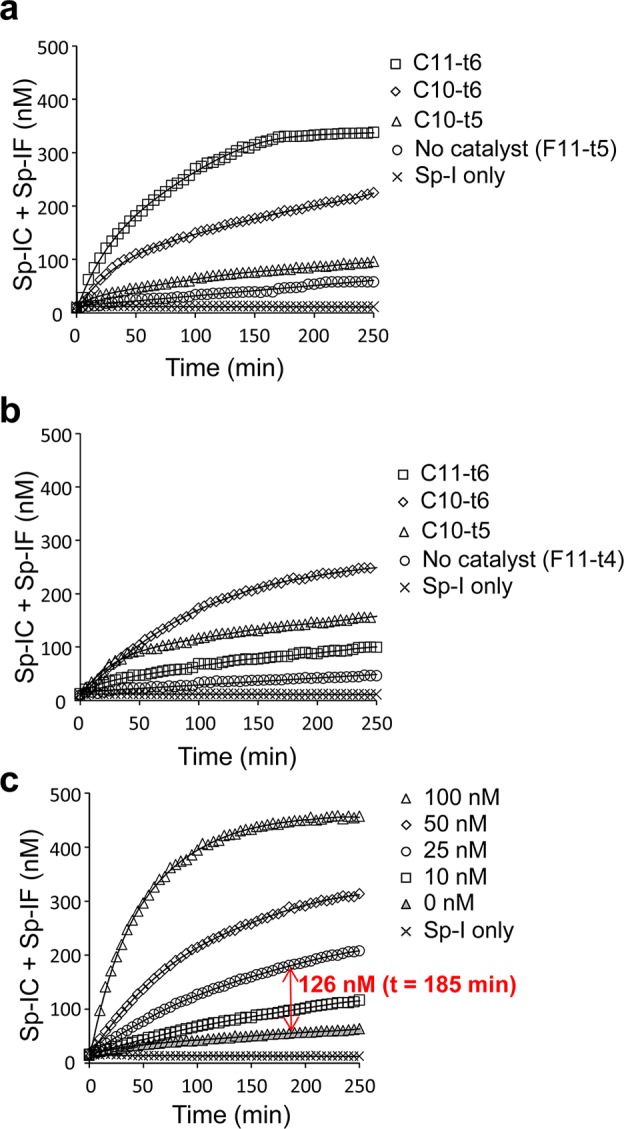
We designed an in vitro signal amplification circuit that takes a short RNA input that catalytically activates the Spinach RNA aptamer to produce a fluorescent output. The circuit consists of three RNA strands: an internally blocked Spinach aptamer, a fuel strand, and an input strand (catalyst), as well as the Spinach aptamer ligand 3,5-difluoro-4-hydroxylbenzylidene imidazolinone (DFHBI). The input strand initially displaces the internal inhibitory strand to activate the fluorescent aptamer while exposing a toehold to which the fuel strand can bind to further displace and recycle the input strand. Under a favorable condition, one input strand was able to activate up to five molecules of the internally blocked Spinach aptamer in 185 min at 30 °C. The simple RNA circuit reported here serves as a model for catalytic activation of arbitrary RNA effectors by chemical triggers.
我们设计了一种体外信号放大电路,该电路以短RNA作为输入,催化激活菠菜RNA适体以产生荧光输出。该电路由三条RNA链组成:一条内部封闭的菠菜适体、一条燃料链和一条输入链(催化剂),以及菠菜适体配体3,5-二氟-4-羟基苯亚甲基咪唑啉酮(DFHBI)。输入链最初取代内部抑制链以激活荧光适体,同时暴露一个可供燃料链结合的引物结合位点,从而进一步取代并循环利用输入链。在有利条件下,一条输入链在30℃下185分钟内能够激活多达五个内部封闭的菠菜适体分子。本文报道的简单RNA电路可作为化学触发物对任意RNA效应物进行催化激活的模型。