Reetz Olivia, Stadler Konstantin, Strauss Ulf
J Neuroinflammation. 2014 Oct 29;11:185. doi: 10.1186/s12974-014-0185-4.
Cytokines are key players in the interactions of the immune and nervous systems. Recently, we showed that such interplay is mediated by type I interferons (IFNs), which elevate the excitability of neocortical pyramidal neurons. A line of indirect evidence suggested that modulation of multiple ion channels underlies the effect. However, which currents are principally involved and how the IFN signaling cascade is linked to the respective ion channels remains elusive.
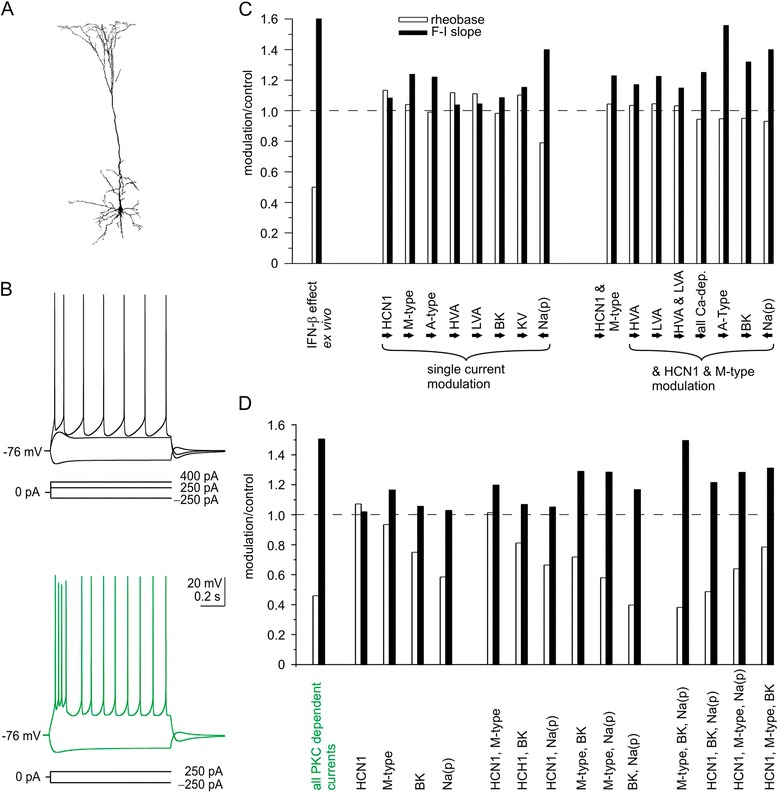
We tested several single and combined ionic current modulations using an in silico model of a neocortical layer 5 neuron. Subsequently we investigated resulting predictions by whole-cell patch-clamp recordings in layer 5 neurons of ex vivo neocortical rat brain slices pharmacologically reproducing or prohibiting neuronal IFN effects.
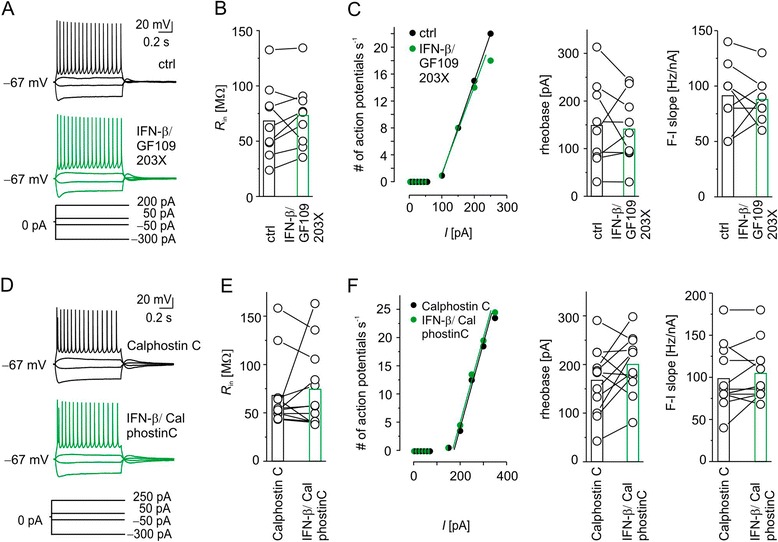
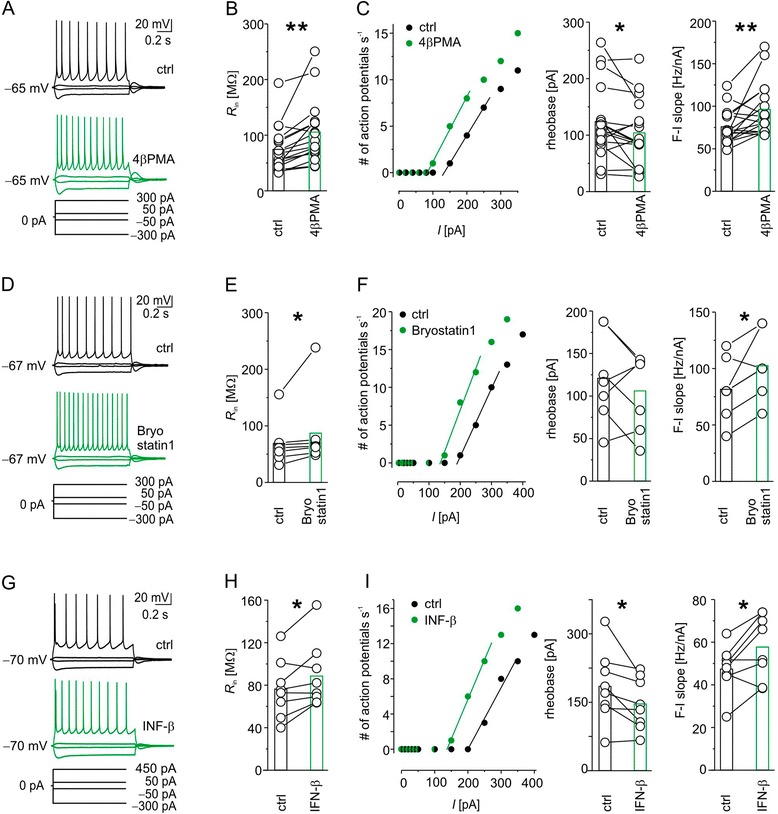
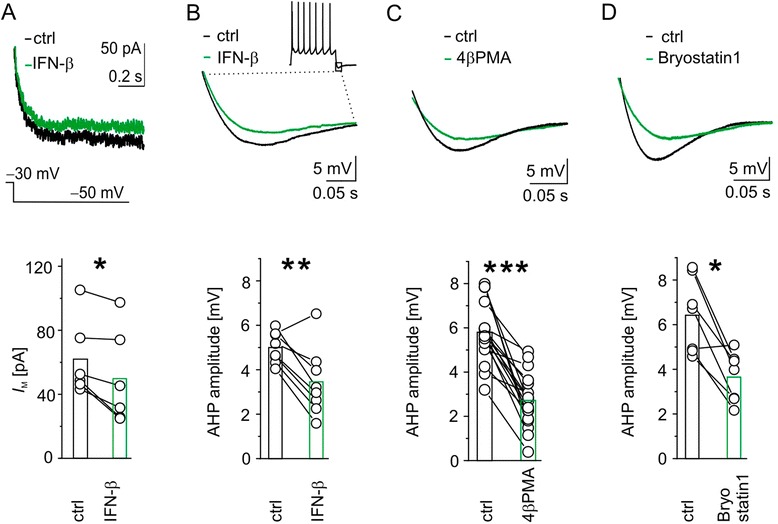
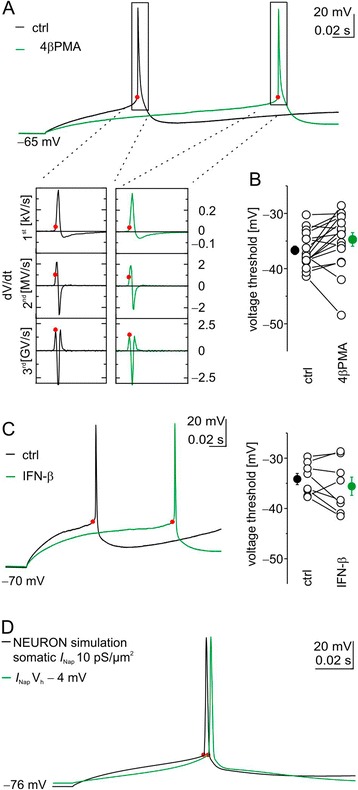
The amount and type of modulation necessary to replicate IFN effects in silico suggested protein kinase C (PKC) activation as link between the type I IFN signaling and ion channel modulations. In line with this, PKC activation with 4β-phorbol 12-myristate 13-acetate (4β-PMA) or Bryostatin1 augmented the excitability of neocortical layer 5 neurons comparable to IFN-β in our ex vivo recordings. In detail, both PKC activators attenuated the rheobase and increased the input-output gain as well as the input resistance, thereby augmenting the neuronal excitability. Similar to IFN-β they also left the threshold of action potential generation unaffected. In further support of PKC mediating type I IFN effects, IFN-β, 4β-PMA and Bryostatin1 reduced the amplitude of post-train after-hyperpolarizations in a similar manner. In conjunction with this finding, IFN-β reduced M-currents, which contribute to after-hyperpolarizations and are modulated by PKC. Finally, blocking PKC activation with GF109203X at the catalytic site or calphostin C at the regulatory site prevented the main excitatory effects of IFN-β.
Multiple ion channel modulations underlie the neuromodulatory effect of type I IFNs. PKC activation is both sufficient and necessary for mediating the effect, and links the IFN signaling cascade to the intrinsic ion channels. Therefore, we regard PKC activation as unitary mechanism for the neuromodulatory potential of type I IFNs in neocortical neurons.
细胞因子是免疫和神经系统相互作用中的关键参与者。最近,我们发现这种相互作用是由I型干扰素(IFN)介导的,I型干扰素可提高新皮质锥体神经元的兴奋性。一系列间接证据表明,多种离子通道的调节是这种效应的基础。然而,主要涉及哪些电流以及IFN信号级联如何与相应的离子通道相连仍不清楚。
我们使用新皮质第5层神经元的计算机模型测试了几种单一和组合的离子电流调节。随后,我们通过全细胞膜片钳记录在离体大鼠新皮质脑片的第5层神经元中研究了所得预测,这些脑片在药理学上再现或抑制了神经元IFN效应。
在计算机模拟中复制IFN效应所需的调节量和类型表明,蛋白激酶C(PKC)激活是I型IFN信号与离子通道调节之间的联系。与此一致的是,在我们的离体记录中,用4β-佛波醇12-肉豆蔻酸酯13-乙酸酯(4β-PMA)或苔藓抑素1激活PKC可增强新皮质第5层神经元的兴奋性,与IFN-β相当。详细地说,两种PKC激活剂都降低了阈强度并增加了输入-输出增益以及输入电阻,从而增强了神经元的兴奋性。与IFN-β类似,它们也未影响动作电位产生的阈值。为进一步支持PKC介导I型IFN效应,IFN-β、4β-PMA和苔藓抑素1以类似方式降低了训练后超极化的幅度。与此发现相结合,IFN-β降低了M电流,M电流有助于超极化后电位并受PKC调节。最后,在催化位点用GF109203X或在调节位点用钙磷蛋白C阻断PKC激活可防止IFN-β的主要兴奋作用。
多种离子通道调节是I型IFN神经调节作用的基础。PKC激活对于介导该效应既充分又必要,并将IFN信号级联与内在离子通道联系起来。因此,我们将PKC激活视为I型IFN在新皮质神经元中神经调节潜力的单一机制。