Centre of Marine Sciences - CCMAR, Campus de Gambelas, Universidade do Algarve 8005-139, Faro, Portugal.
Department of Zoology and Entomology, Rhodes University Grahamstown, 6140, South Africa.
Ecol Evol. 2014 Jun;4(11):2070-81. doi: 10.1002/ece3.1033. Epub 2014 Apr 25.
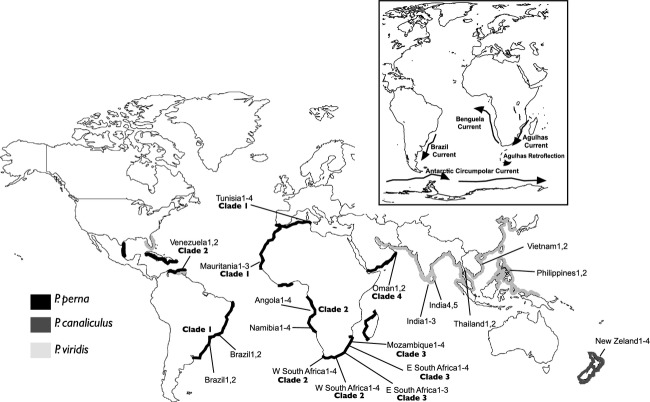
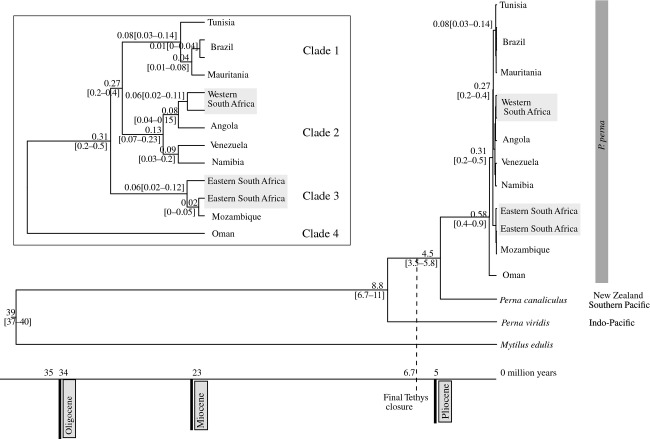
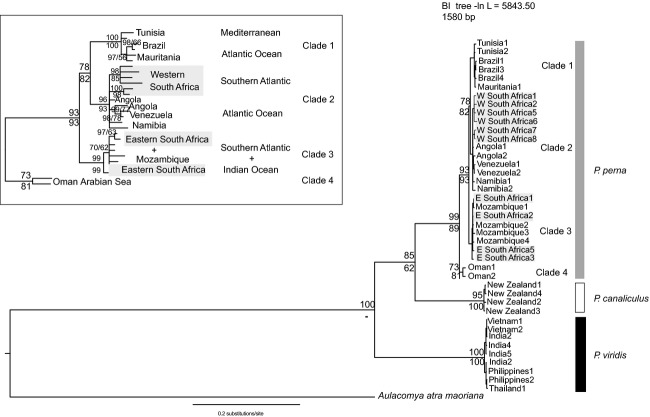
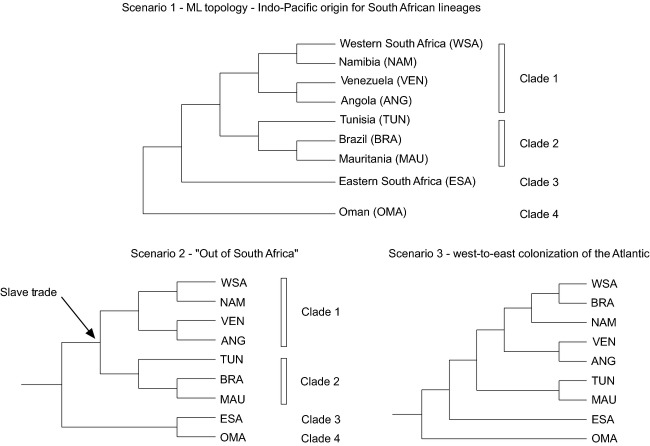
The accuracy of phylogenetic inference can be significantly improved by the addition of more taxa and by increasing the spatial coverage of sampling. In previous studies, the brown mussel Perna perna showed a sister-lineage relationship between eastern and western individuals contiguously distributed along the South African coastline. We used mitochondrial (COI) and nuclear (ITS) sequence data to further analyze phylogeographic patterns within P. perna. Significant expansion of the geographical coverage revealed an unexpected pattern. The western South African lineage shared the most recent common ancestor (MRCA) with specimens from Angola, Venezuela, and Namibia, whereas eastern South African specimens and Mozambique grouped together, indicating a non-sister relationship for the two South African lineages. Two plausible biogeographic scenarios to explain their origin were both supported by the hypotheses-testing analysis. One includes an Indo-Pacific origin for P. perna, dispersal into the Mediterranean and Atlantic through the Tethys seaway, followed by recent secondary contact after southward expansion of the western and eastern South African lineages. The other scenario (Out of South Africa) suggests an ancient vicariant divergence of the two lineages followed by their northward expansion. Nevertheless, the "Out of South Africa" hypothesis would require a more ancient divergence between the two lineages. Instead, our estimates indicated that they diverged very recently (310 kyr), providing a better support for an Indo-Pacific origin of the two South African lineages. The arrival of the MRCA of P. perna in Brazil was estimated at 10 [0-40] kyr. Thus, the hypothesis of a recent introduction in Brazil through hull fouling in wooden vessels involved in the transatlantic itineraries of the slave trade did not receive strong support, but given the range for this estimate, it could not be discarded. Wider geographic sampling of marine organisms shows that lineages with contiguous distributions need not share a common ancestry.
系统发育推断的准确性可以通过增加更多的分类群和增加采样的空间覆盖范围来显著提高。在以前的研究中,褐贻贝 Perna perna 在东、西个体之间表现出姐妹谱系关系,这些个体沿着南非海岸线连续分布。我们使用线粒体(COI)和核(ITS)序列数据进一步分析了 P. perna 的地理格局。显著扩大地理覆盖范围揭示了一个出人意料的模式。南非西部谱系与安哥拉、委内瑞拉和纳米比亚的标本共享最近的共同祖先(MRCA),而南非东部的标本和莫桑比克则聚集在一起,表明这两个南非谱系之间没有姐妹关系。两个似是而非的生物地理情景都得到了假设检验分析的支持。一种情景包括 P. perna 的印度洋-太平洋起源,通过特提斯海道扩散到地中海和大西洋,然后在南非西部和东部谱系向南扩张后,最近发生了二次接触。另一种情景(离开南非)表明,这两个谱系在古代发生了分歧,然后向北扩张。然而,“离开南非”的假设要求这两个谱系之间有一个更古老的分歧。相反,我们的估计表明,它们最近才分化(310 千年前),这为两个南非谱系的印度洋-太平洋起源提供了更好的支持。P. perna 的 MRCA 到达巴西的时间估计为 10 [0-40] 千年前。因此,通过在参与跨大西洋奴隶贸易的木制船只上的船体污垢将其引入巴西的假设并没有得到强有力的支持,但鉴于这个估计的范围,它也不能被排除。对海洋生物更广泛的地理采样表明,具有连续分布的谱系不一定具有共同的祖先。