Departament de Biologia Animal (Vertebrats), Facultat de Biologia, Universitat de Barcelona Barcelona, ES-08028, Spain ; CAPES Foundation, Ministry of Education of Brazil Brasília, DF, 70040-020, Brazil ; Programa de Pós-Graduação em Ecologia e Conservação da Biodiversidade, Universidade Estadual de Santa Cruz Ilhéus, BA, 45662-000, Brazil.
Programa de Pós-Graduação em Ecologia e Evolução, Universidade Federal de Goiás Goiânia, GO, 74001-970, Brazil.
Ecol Evol. 2014 Jun;4(12):2505-14. doi: 10.1002/ece3.1073. Epub 2014 May 21.
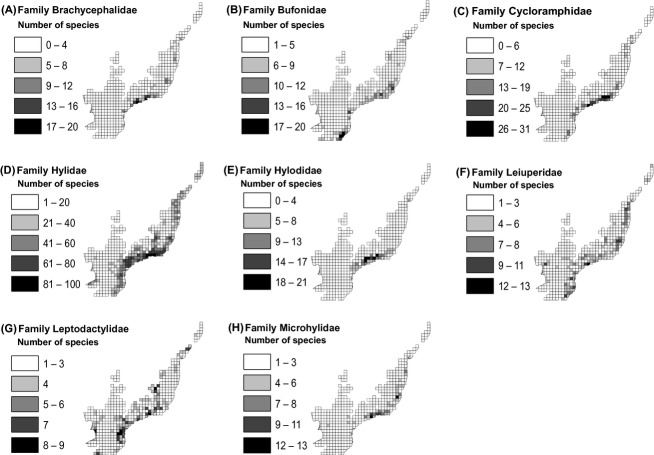
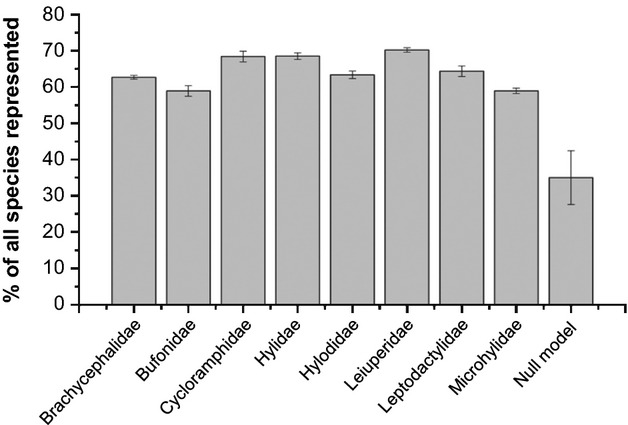
The adequate selection of indicator groups of biodiversity is an important aspect of the systematic conservation planning. However, these assessments differ in the spatial scales, in the methods used and in the groups considered to accomplish this task, which generally produces contradictory results. The quantification of the spatial congruence between species richness and complementarity among different taxonomic groups is a fundamental step to identify potential indicator groups. Using a constructive approach, the main purposes of this study were to evaluate the performance and efficiency of eight potential indicator groups representing amphibian diversity in the Brazilian Atlantic Forest. Data on the geographic range of amphibian species that occur in the Brazilian Atlantic Forest were overlapped to the full geographic extent of the biome, which was divided into a regular equal-area grid. Optimization routines based on the concept of complementarily were applied to verify the performance of each indicator group selected in relation to the representativeness of the amphibians in the Brazilian Atlantic Forest as a whole, which were solved by the algorithm "simulated annealing," through the use of the software MARXAN. Some indicator groups were substantially more effective than others in regard to the representation of the taxonomic groups assessed, which was confirmed by the high significance of the data (F = 312.76; P < 0.01). Leiuperidae was considered as the best indicator group among the families analyzed, as it showed a good performance, representing 71% of amphibian species in the Brazilian Atlantic Forest (i.e., 290 species), which may be associated with the diffuse geographic distribution of their species. In this sense, this study promotes understanding of how the diversity standards of amphibians can be informative for systematic conservation planning on a regional scale.
生物多样性指标组的适当选择是系统保护规划的一个重要方面。然而,这些评估在空间尺度、使用的方法和考虑的组群方面存在差异,这通常会产生相互矛盾的结果。量化不同分类群之间物种丰富度和互补性的空间一致性是确定潜在指标组的基本步骤。本研究采用建设性方法,主要目的是评估代表巴西大西洋森林中两栖动物多样性的八个潜在指标组的表现和效率。发生在巴西大西洋森林中的两栖物种的地理范围数据与生物群落的完整地理范围重叠,后者被划分为一个规则的等面积网格。基于互补性概念的优化例程被应用于验证每个所选指标组在代表巴西大西洋森林中所有两栖动物方面的表现,这些例程通过使用软件 MARXAN 中的“模拟退火”算法得到解决。一些指标组在代表评估的分类群方面比其他指标组更有效,这一点得到了数据的高度显著性(F = 312.76;P < 0.01)的证实。Leiuperidae 被认为是分析的科中最好的指标组,因为它表现出良好的性能,代表了巴西大西洋森林中 71%的两栖动物物种(即 290 种),这可能与其物种的广泛地理分布有关。从这个意义上说,本研究促进了对如何使两栖动物多样性标准在区域尺度上对系统保护规划具有信息性的理解。