Jia Zhiyuan, Yi Yao, Liu Jianhua, Cao Jingyuan, Zhang Yong, Tian Ruiguang, Yu Tao, Wang Hao, Wang Xinying, Su Qiudong, Zhou Wenting, Cui Fuqiang, Liang Xiaofeng, Bi Shengli
National Institute of Virology Disease Control and Prevention, Chinese Center for Disease Control and Prevention, Beijing, China.
Guangzhou Center for Disease Control and Prevention, Guangzhou, China.
PLoS One. 2014 Oct 31;9(10):e110837. doi: 10.1371/journal.pone.0110837. eCollection 2014.
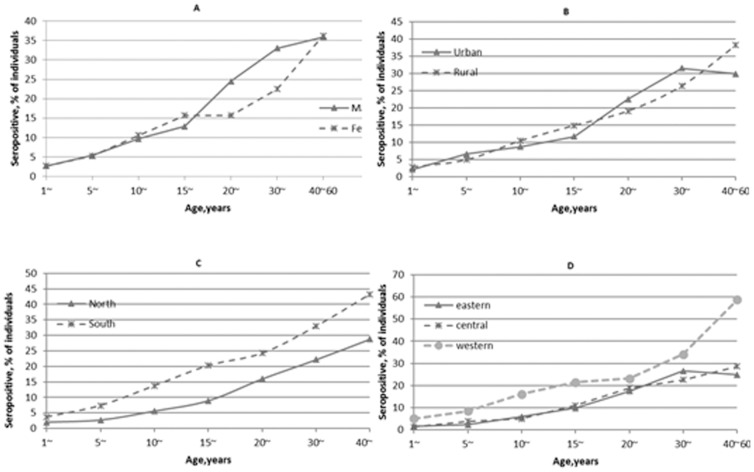
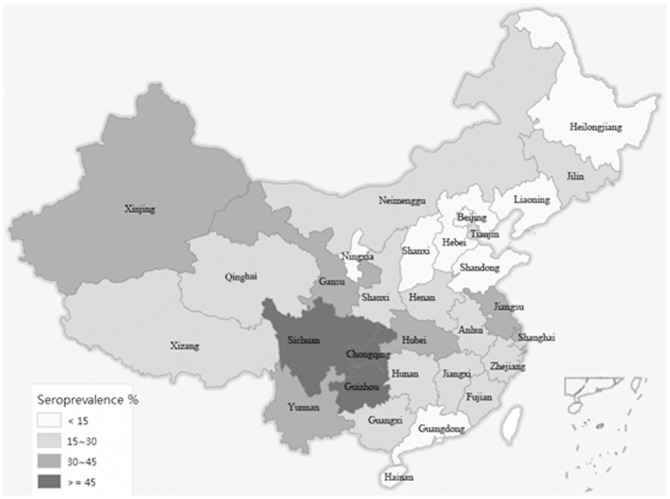
In China, hepatitis E virus (HEV) is prevalent and causes disease, but its epidemiological profile is not well understood. We used a commercial enzyme-linked immunosorbent assay to detect total antibodies to hepatitis E virus in 15,862 serum samples collected during the Third National Viral Hepatitis Prevalence Survey. The results were analyzed to calculate estimates of HEV seroprevalence and to examine the effects of some putative risk factors. The seroprevalence of HEV in the general Chinese population during the period from 2005 through 2006 was 23.46% (95% confidence interval [CI], 18.41%-28.50%). The farming population, the age group of 15-60 year olds, and those living in the Midwest or Mideast region and in Xinjiang province had the highest seroprevalence estimates. The prevalence of HEV is high in China. The seroprevalence rate of HEV shows an unbalanced distribution among areas with different geographic location and economic development levels. The characteristics of the distribution associated may be due to the route of HEV transmission (via contaminated water or animal reservoirs). Within the same region, the seroprevalence of HEV is generally increased with age.
在中国,戊型肝炎病毒(HEV)普遍存在并引发疾病,但其流行病学特征尚未得到充分了解。我们使用一种商业酶联免疫吸附测定法,检测了在第三次全国病毒性肝炎流行情况调查期间收集的15862份血清样本中戊型肝炎病毒的总抗体。对结果进行分析,以计算戊型肝炎病毒血清流行率的估计值,并研究一些假定风险因素的影响。2005年至2006年期间,中国普通人群中戊型肝炎病毒的血清流行率为23.46%(95%置信区间[CI],18.41%-28.50%)。农业人口、15至60岁年龄组以及居住在中西部或中东地区和新疆维吾尔自治区的人群血清流行率估计值最高。戊型肝炎病毒在中国的流行率很高。戊型肝炎病毒的血清流行率在不同地理位置和经济发展水平的地区之间呈现不均衡分布。这种相关分布特征可能归因于戊型肝炎病毒的传播途径(通过受污染的水或动物宿主)。在同一地区内,戊型肝炎病毒的血清流行率通常随年龄增长而升高。