Iturrieta-González Isabel Antonieta, Padovan Ana Carolina Barbosa, Bizerra Fernando César, Hahn Rosane Christine, Colombo Arnaldo Lopes
Laboratório Especial de Micologia, Disciplina de Infectologia, Universidade Federal de São Paulo, São Paulo, SP, Brazil.
Laboratório Especial de Micologia, Disciplina de Infectologia, Universidade Federal de São Paulo, São Paulo, SP, Brazil; Departamento de Microbiologia e Imunologia, Instituto de Ciências Biomédicas, Universidade Federal de Alfenas, Alfenas, MG, Brazil.
PLoS One. 2014 Oct 31;9(10):e109553. doi: 10.1371/journal.pone.0109553. eCollection 2014.
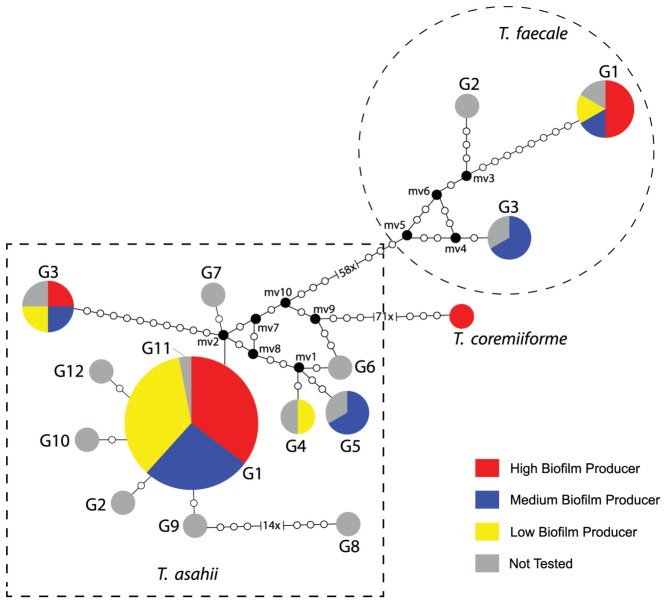
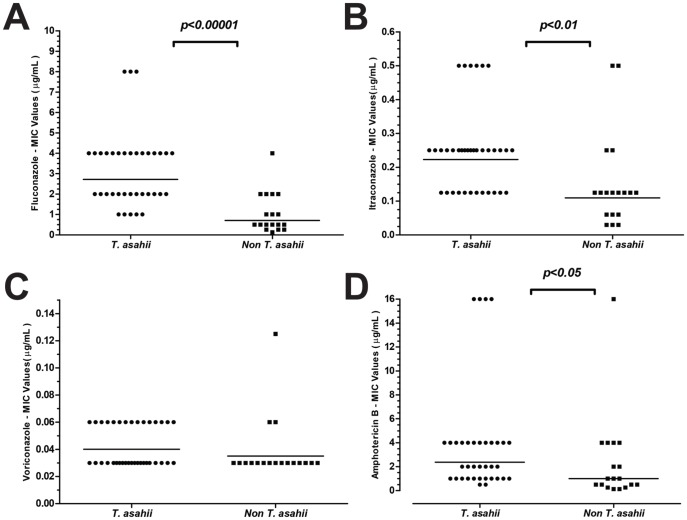
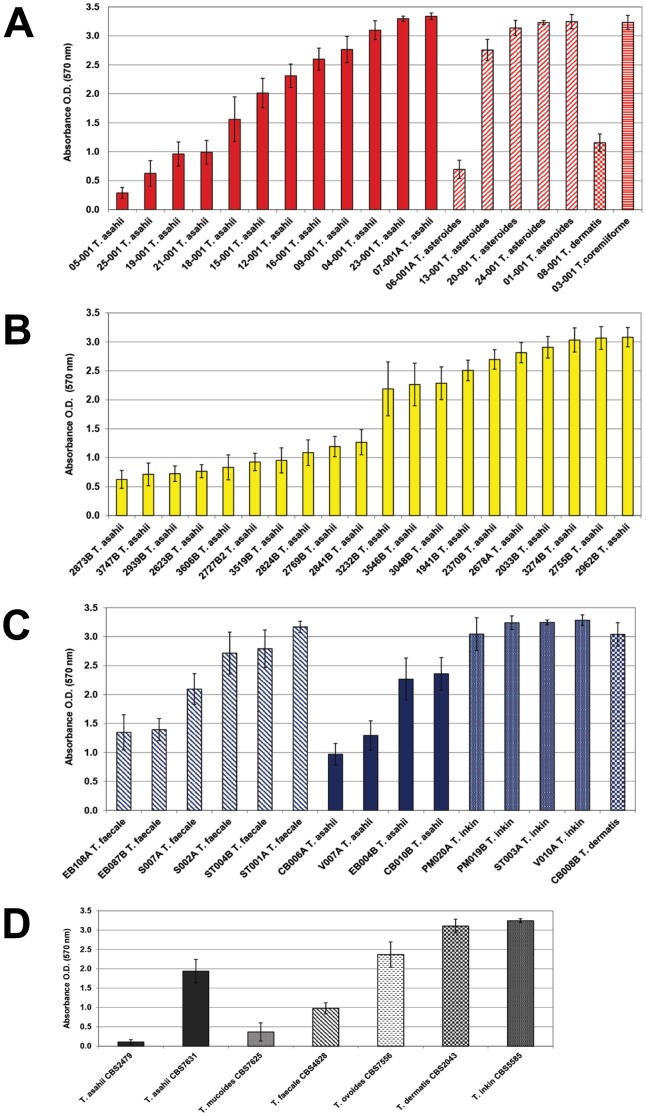
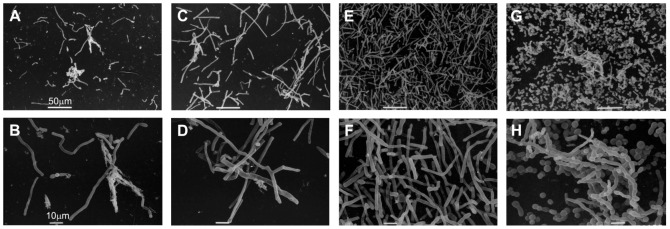
Invasive infections caused by Trichosporon spp. have increased considerably in recent years, especially in neutropenic and critically ill patients using catheters and antibiotics. The genus presents limited sensitivity to different antifungal agents, but triazoles are the first choice for treatment. Here, we investigated the biofilm production and antifungal susceptibility to triazoles and amphotericin B of 54 Trichosporon spp. isolates obtained from blood samples (19), urine (20) and superficial mycosis (15). All isolates and 7 reference strains were identified by sequence analysis and phylogenetic inferences of the IGS1 region of the rDNA. Biofilms were grown on 96-well plates and quantitation was performed using crystal violet staining, complemented with Scanning Electron Microscopy (SEM). Susceptibility tests for fluconazole, itraconazole, voriconazole and amphotericin B were processed using the microdilution broth method (CLSI) for planktonic cells and XTT reduction assay for biofilm-forming cells. Our results showed that T. asahii was the most frequent species identified (66.7%), followed by T. faecale (11.1%), T. asteroides (9.3%), T. inkin (7.4%), T. dermatis (3.7%) and one T. coremiiforme (1.8%). We identified 4 genotypes within T. asahii isolates (G1, G3, G4 and G5) and 2 genotypes within T. faecale (G1 and G3). All species exhibited high adhesion and biofilm formation capabilities, mainly T. inkin, T. asteroides and T. faecale. Microscopy images of high biofilm-producing isolates showed that T. asahii presented mainly hyphae and arthroconidia, whereas T. asteroides exhibited mainly short arthroconidia and few filaments. Voriconazole exhibited the best in vitro activity against all species tested. Biofilm-forming cells of isolates and reference strains were highly resistant to all antifungals tested. We concluded that levels of biofilm formation by Trichosporon spp. were similar or even greater than those described for the Candida genus. Biofilm-forming cells were at least 1,000 times more resistant to antifungals than planktonic cells, especially to voriconazole.
近年来,毛孢子菌属引起的侵袭性感染显著增加,尤其是在使用导管和抗生素的中性粒细胞减少及危重症患者中。该属对不同抗真菌药物的敏感性有限,但三唑类是治疗的首选药物。在此,我们研究了从血液样本(19株)、尿液(20株)和浅表真菌病(15株)中分离得到的54株毛孢子菌属菌株的生物膜形成情况以及对三唑类和两性霉素B的抗真菌敏感性。通过对rDNA的IGS1区域进行序列分析和系统发育推断,对所有分离株和7株参考菌株进行了鉴定。生物膜在96孔板中生长,并使用结晶紫染色进行定量,辅以扫描电子显微镜(SEM)观察。采用微量稀释肉汤法(CLSI)对浮游细胞进行氟康唑、伊曲康唑、伏立康唑和两性霉素B的药敏试验,对形成生物膜的细胞采用XTT还原试验。我们的结果表明,鉴定出的最常见菌种是阿萨希毛孢子菌(66.7%),其次是粪便毛孢子菌(11.1%)、星状毛孢子菌(9.3%)、因金毛孢子菌(7.4%)、皮肤毛孢子菌(3.7%)和1株串珠毛孢子菌(1.8%)。我们在阿萨希毛孢子菌分离株中鉴定出4种基因型(G1、G3、G4和G5),在粪便毛孢子菌中鉴定出2种基因型(G1和G3)。所有菌种均表现出较高的黏附能力和生物膜形成能力,主要是因金毛孢子菌、星状毛孢子菌和粪便毛孢子菌。高生物膜产生分离株的显微镜图像显示,阿萨希毛孢子菌主要呈现菌丝和关节孢子,而星状毛孢子菌主要呈现短关节孢子和少量菌丝。伏立康唑对所有测试菌种均表现出最佳的体外活性。分离株和参考菌株的生物膜形成细胞对所有测试的抗真菌药物均具有高度抗性。我们得出结论,毛孢子菌属的生物膜形成水平与念珠菌属描述的水平相似甚至更高。生物膜形成细胞对抗真菌药物的抗性至少比浮游细胞高1000倍,尤其是对伏立康唑。