Chung Sung-Hoon, Seol Hyun-Joo, Choi Yong-Sung, Oh Soo-Young, Kim Ahm, Bae Chong-Woo
Department of Pediatrics, Kyung Hee University School of Medicine, Seoul, Korea.
Department of Obstetrics and Gynecology, Kyung Hee University School of Medicine, Seoul, Korea.
J Korean Med Sci. 2014 Oct;29(10):1341-52. doi: 10.3346/jkms.2014.29.10.1341. Epub 2014 Oct 8.
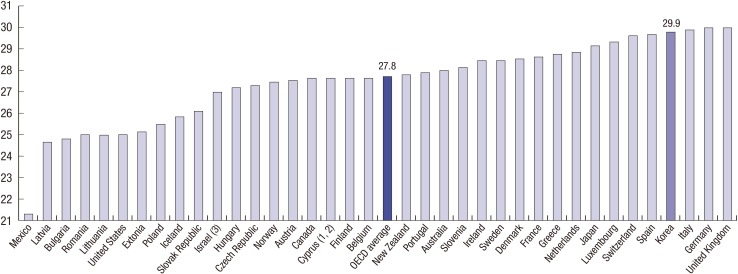
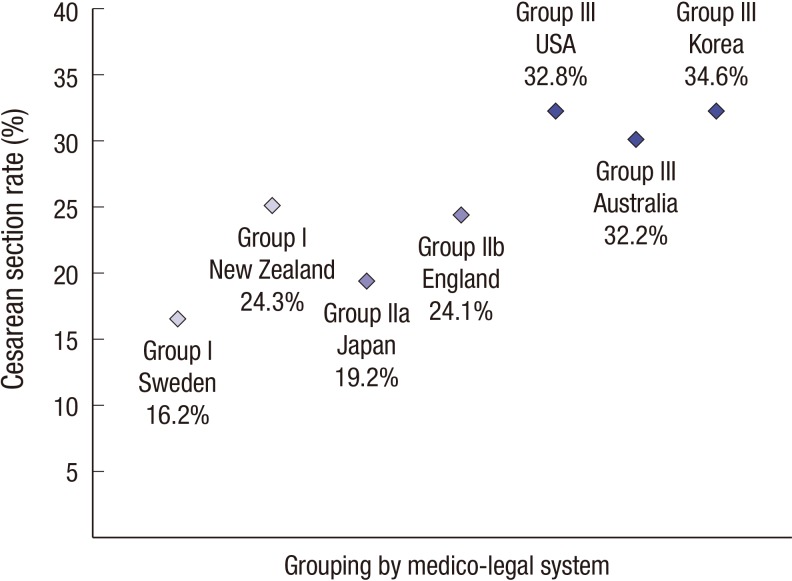
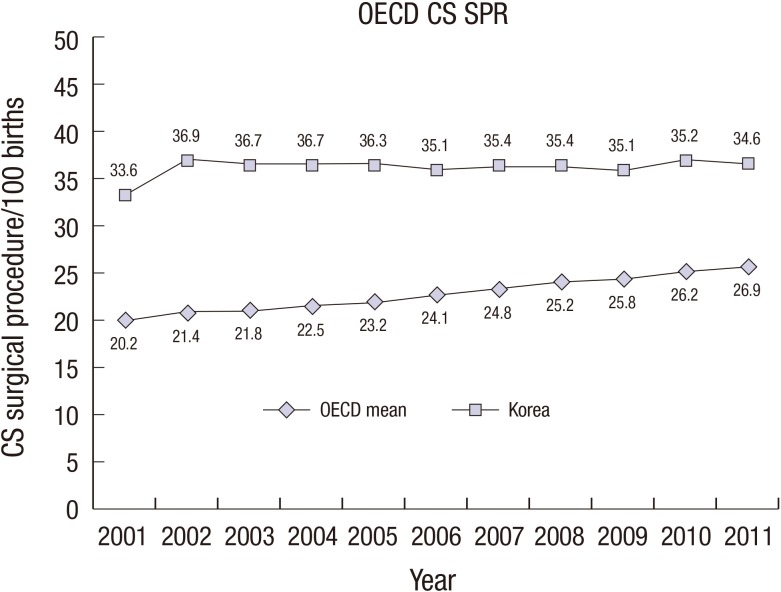
Although Cesarean section (CS) itself has contributed to the reduction in maternal and perinatal mortality, an undue rise in the CS rate (CSR) has been issued in Korea as well as globally. The CSR in Korea increased over the past two decades, but has remained at approximately 36% since 2006. Contributing factors associated with the CSR in Korea were an improvement in socio-economic status, a higher maternal age, a rise in multiple pregnancies, and maternal obesity. We found that countries with a no-fault compensation system maintained a lower CSR compared to that in countries with civil action, indicating the close relationship between the CSR and the medico-legal system within a country. The Korean government has implemented strategies including an incentive system relating to the CSR or encouraging vaginal birth after Cesarean to decrease CSR, but such strategies have proved ineffective. To optimize the CSR in Korea, efforts on lowering the maternal childbearing age or reducing maternal obesity are needed at individual level. And from a national view point, reforming health care system, which could encourage the experienced obstetricians to be trained properly and be relieved from legal pressure with deliveries is necessary.
尽管剖宫产(CS)本身有助于降低孕产妇和围产期死亡率,但韩国以及全球范围内的剖宫产率(CSR)却出现了不当上升。韩国的剖宫产率在过去二十年中有所上升,但自2006年以来一直保持在约36%。与韩国剖宫产率相关的因素包括社会经济地位的改善、产妇年龄的提高、多胎妊娠的增加以及产妇肥胖。我们发现,与采用民事诉讼的国家相比,拥有无过错赔偿制度的国家保持着较低的剖宫产率,这表明一个国家的剖宫产率与医疗法律制度之间存在密切关系。韩国政府已实施了包括与剖宫产率相关的激励制度或鼓励剖宫产后阴道分娩等策略以降低剖宫产率,但这些策略已被证明无效。为了优化韩国的剖宫产率,在个人层面需要努力降低产妇生育年龄或减少产妇肥胖。从国家层面来看,改革医疗保健系统是必要的,这可以鼓励经验丰富的产科医生得到适当培训,并在分娩时减轻法律压力。