Simon Joe J, Skunde Mandy, Hamze Sinno Maria, Brockmeyer Timo, Herpertz Sabine C, Bendszus Martin, Herzog Wolfgang, Friederich Hans-Christoph
Department of General Internal Medicine and Psychosomatics, Centre for Psychosocial Medicine, University Hospital Heidelberg , Heidelberg , Germany.
Department of General Adult Psychiatry, Centre for Psychosocial Medicine, University Hospital Heidelberg , Heidelberg , Germany.
Front Behav Neurosci. 2014 Oct 17;8:359. doi: 10.3389/fnbeh.2014.00359. eCollection 2014.
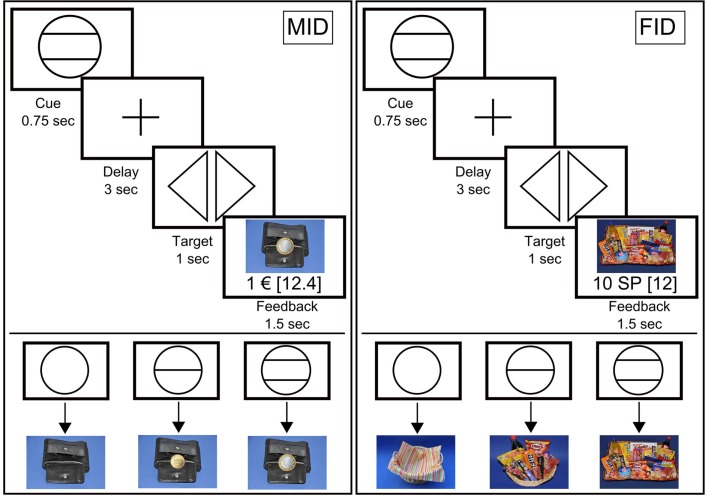
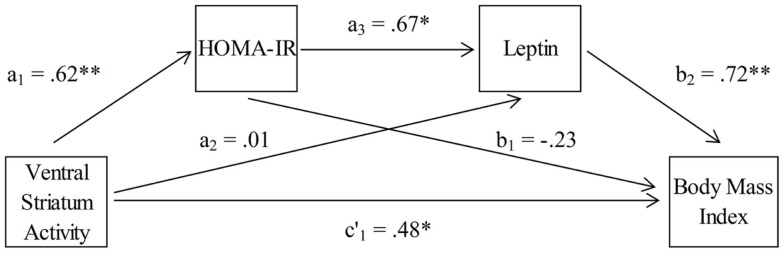
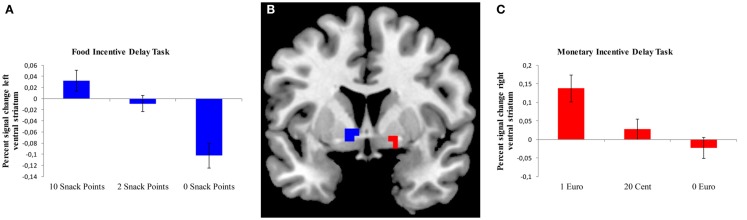
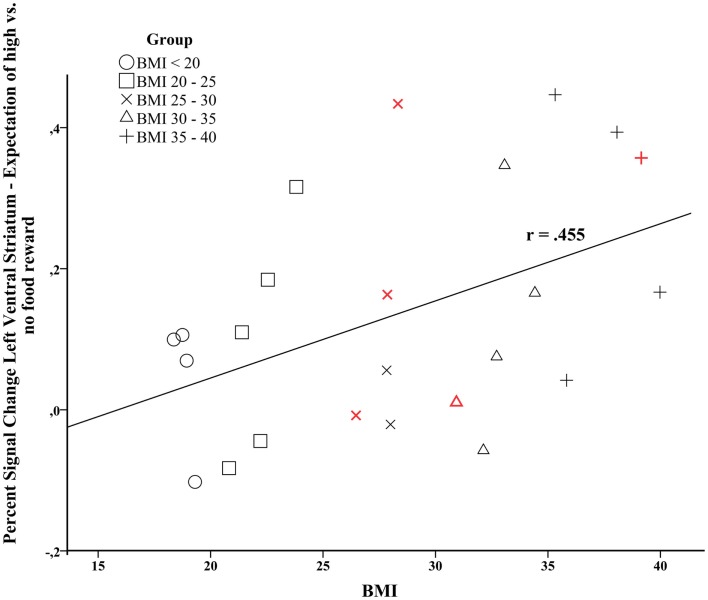
The anticipation of the pleasure derived from food intake drives the motivation to eat, and hence facilitate overconsumption of food, which ultimately results in obesity. Brain imaging studies provide evidence that mesolimbic brain regions underlie both general as well as food-related anticipatory reward processing. In light of this knowledge, the present study examined the neural responsiveness of the ventral striatum (VS) in participants with a broad BMI spectrum. The study differentiated between general (i.e., monetary) and food-related anticipatory reward processing. We recruited a sample of volunteers with greatly varying body weights, ranging from a low BMI (below 20 kg/m(2)) over a normal (20-25 kg/m(2)) and overweight (25-30 kg/m(2)) BMI, to class I (30-35 kg/m(2)) and class II (35-40 kg/m(2)) obesity. A total of 24 participants underwent functional magnetic resonance imaging while performing both a food and monetary incentive delay task, which allows to measure neural activation during the anticipation of rewards. After the presentation of a cue indicating the amount of food or money to be won, participants had to react correctly in order to earn "snack points" or "money coins," which could then be exchanged for real food or money, respectively, at the end of the experiment. During the anticipation of both types of rewards, participants displayed activity in the VS, a region that plays a pivotal role in the anticipation of rewards. Additionally, we observed that specifically anticipatory food reward processing predicted the individual BMI (current and maximum lifetime). This relation was found to be mediated by impaired hormonal satiety signaling, i.e., increased leptin levels and insulin resistance. These findings suggest that heightened food reward motivation contributes to obesity through impaired metabolic signaling.
对食物摄入带来的愉悦感的预期驱动了进食的动机,从而助长了食物的过度消费,最终导致肥胖。脑成像研究表明,中脑边缘脑区是一般以及与食物相关的预期奖励处理的基础。鉴于这一认识,本研究考察了不同体重指数(BMI)范围参与者腹侧纹状体(VS)的神经反应性。该研究区分了一般(即金钱)和与食物相关的预期奖励处理。我们招募了一组体重差异很大的志愿者样本,BMI范围从低体重(低于20kg/m²)到正常体重(20 - 25kg/m²)、超重(25 - 30kg/m²),再到I级肥胖(30 - 35kg/m²)和II级肥胖(35 - 40kg/m²)。共有24名参与者在执行食物和金钱激励延迟任务时接受功能磁共振成像,该任务可测量奖励预期期间的神经激活。在呈现表示可赢得的食物或金钱数量的提示后,参与者必须做出正确反应才能赚取“零食点数”或“金钱硬币”,然后在实验结束时分别可兑换为真正的食物或金钱。在预期这两种奖励时,参与者的VS区域均表现出活动,该区域在奖励预期中起关键作用。此外,我们观察到,特别是预期食物奖励处理可预测个体的BMI(当前和终身最高值)。发现这种关系是由激素饱腹感信号受损介导的,即瘦素水平升高和胰岛素抵抗。这些发现表明,增强的食物奖励动机通过受损的代谢信号传导导致肥胖。