Section of Endocrinology, Department of Internal Medicine, Yale University School of Medicine, New Haven, CT, USA.
Diabetes Care. 2013 Feb;36(2):394-402. doi: 10.2337/dc12-1112. Epub 2012 Oct 15.
Obesity is associated with alterations in corticolimbic-striatal brain regions involved in food motivation and reward. Stress and the presence of food cues may each motivate eating and engage corticolimibic-striatal neurocircuitry. It is unknown how these factors interact to influence brain responses and whether these interactions are influenced by obesity, insulin levels, and insulin sensitivity. We hypothesized that obese individuals would show greater responses in corticolimbic-striatal neurocircuitry after exposure to stress and food cues and that brain activations would correlate with subjective food craving, insulin levels, and HOMA-IR.
Fasting insulin levels were assessed in obese and lean subjects who were exposed to individualized stress and favorite-food cues during functional MRI.
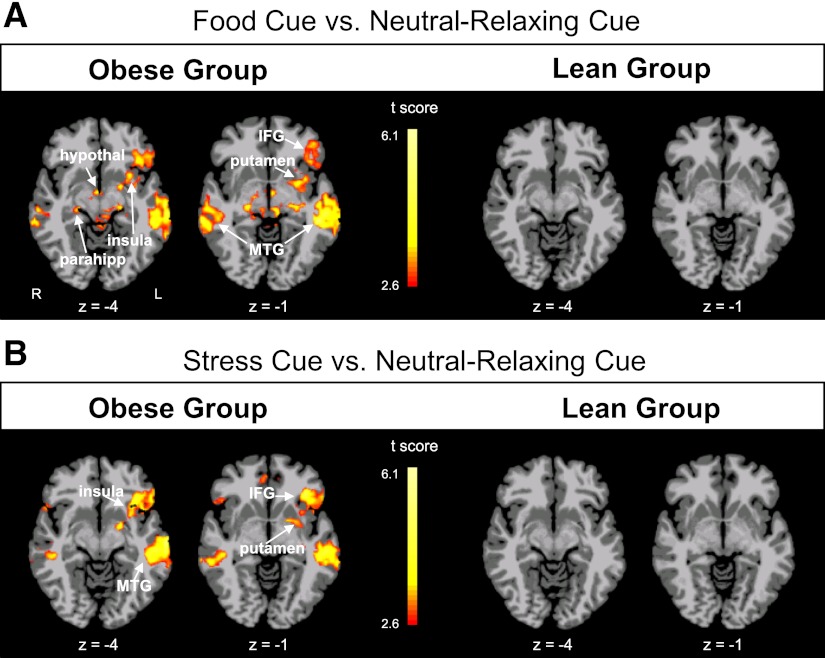
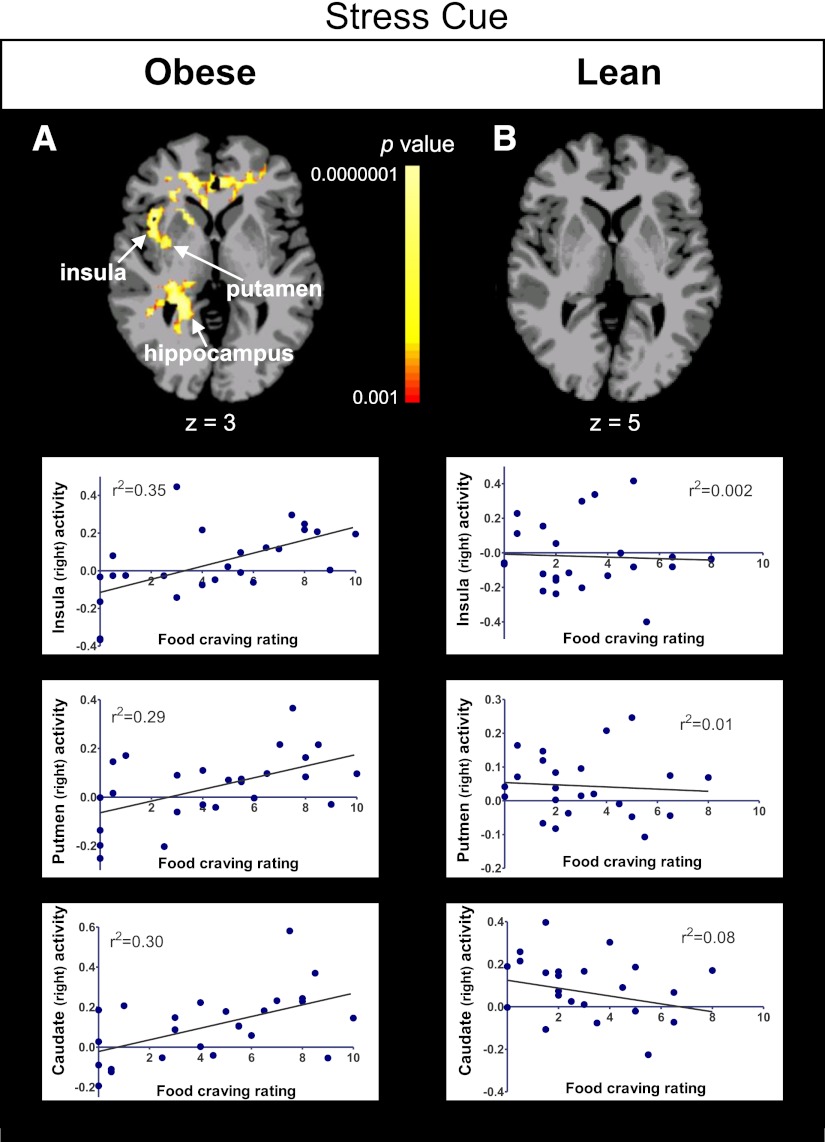
Obese, but not lean, individuals exhibited increased activation in striatal, insular, and hypothalamic regions during exposure to favorite-food and stress cues. In obese but not lean individuals, food craving, insulin, and HOMA-IR levels correlated positively with neural activity in corticolimbic-striatal brain regions during favorite-food and stress cues. The relationship between insulin resistance and food craving in obese individuals was mediated by activity in motivation-reward regions including the striatum, insula, and thalamus.
These findings demonstrate that obese, but not lean, individuals exhibit increased corticolimbic-striatal activation in response to favorite-food and stress cues and that these brain responses mediate the relationship between HOMA-IR and food craving. Improving insulin sensitivity and in turn reducing corticolimbic-striatal reactivity to food cues and stress may diminish food craving and affect eating behavior in obesity.
肥胖与参与食物动机和奖励的皮质边缘纹状体脑区的改变有关。应激和食物线索的存在可能会分别激发进食并参与皮质边缘纹状体神经回路。目前尚不清楚这些因素如何相互作用以影响大脑反应,以及这些相互作用是否受到肥胖、胰岛素水平和胰岛素敏感性的影响。我们假设肥胖个体在暴露于应激和食物线索后,在皮质边缘纹状体神经回路中会表现出更大的反应,并且大脑激活与主观食物渴望、胰岛素水平和 HOMA-IR 相关。
在功能磁共振成像期间,对暴露于个体化应激和喜爱食物线索的肥胖和瘦个体进行空腹胰岛素水平评估。
肥胖个体而不是瘦个体在暴露于喜爱食物和应激线索时,纹状体、岛叶和下丘脑区域的激活增加。在肥胖个体中,但在瘦个体中,食物渴望、胰岛素和 HOMA-IR 水平与皮质边缘纹状体脑区在喜爱食物和应激线索期间的神经活动呈正相关。肥胖个体中胰岛素抵抗和食物渴望之间的关系由包括纹状体、岛叶和丘脑在内的动机-奖励区域的活动介导。
这些发现表明,肥胖个体而不是瘦个体,在暴露于喜爱食物和应激线索时会表现出增加的皮质边缘纹状体激活,并且这些大脑反应介导了 HOMA-IR 与食物渴望之间的关系。改善胰岛素敏感性,进而减少皮质边缘纹状体对食物线索和应激的反应性,可能会减少食物渴望并影响肥胖中的进食行为。