de Jong H K, Koh G C K W, Bulder I, Stephan F, Wiersinga W J, Zeerleder S S
Center for Experimental and Molecular Medicine (CEMM), Academic Medical Center, University of Amsterdam, Amsterdam, the Netherlands; Division of Infectious Diseases, Department of Medicine, Academic Medical Center, Amsterdam, the Netherlands.
J Thromb Haemost. 2015 Jan;13(1):41-6. doi: 10.1111/jth.12776. Epub 2014 Dec 6.
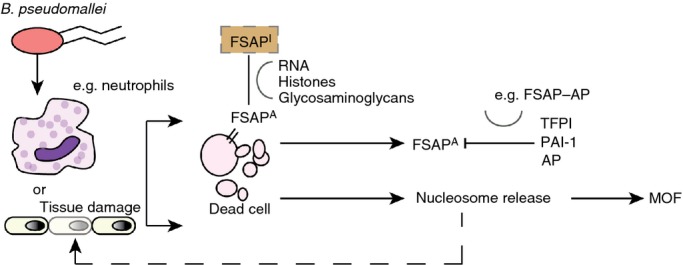
The plasma protease factor VII-activating protease (FSAP) can release nucleosomes from late apoptotic cells. Nucleosomes are markers of cell death, and extracellular cell-free DNA has been suggested to play an important role in inflammation and has been demonstrated to correlate with severity and outcome in sepsis patients.
To investigate FSAP activation in patients suffering from Burkholderia pseudomallei infection (melioidosis), an important cause of Gram-negative sepsis in Southeast Asia. As diabetes mellitus (DM) is the most important risk factor for both melioidosis and sepsis, we were also able to examine the role of DM in FSAP activation in this cohort of patients.
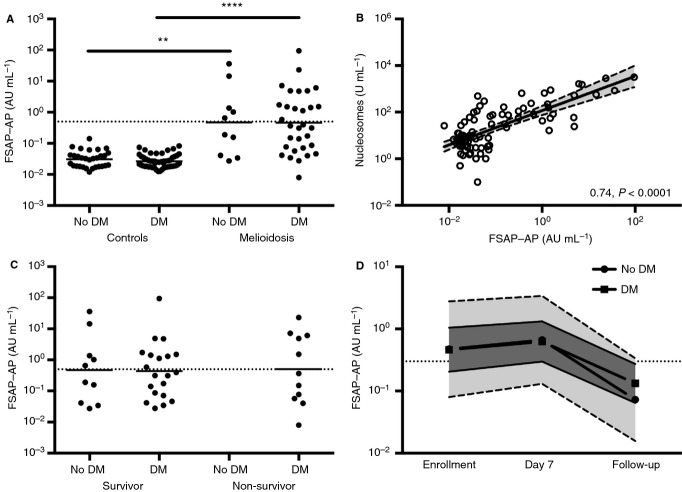
In a prospective observational study, complexes of FSAP with α2 -antiplasmin (AP) were assayed in 44 patients with melioidosis, 34 of whom were classified as diabetic. Eighty-two healthy subjects served as controls (52 with DM and 30 without).
FSAP-AP complex levels were markedly elevated in patients as compared with controls. The FSAP level increased by 16.82 AU mL(-1) in patients with melioidosis after adjustment for the effect of DM in the regression model. As expected, FSAP activation was correlated with nucleosome release (slope = 0.74). No difference in FSAP activation on admission was seen between survivors and non-survivors, but the extent of FSAP activation correlated with stage of the disease; repeated testing during convalescence showed a return towards normal values (day 0 vs. day 28, 4.16 AU mL(-1) , 95% confidence interval [CI] 1.42-12.22).
Patients with Gram-negative sepsis caused by B. pseudomallei have abundant FSAP activation, which significantly correlates with stage of disease. The presence of DM, however, does not influence the extent of FSAP activation.
血浆蛋白酶因子VII激活蛋白酶(FSAP)可从晚期凋亡细胞中释放核小体。核小体是细胞死亡的标志物,细胞外游离DNA被认为在炎症中起重要作用,并且已被证明与脓毒症患者的严重程度和预后相关。
研究东南亚地区革兰阴性脓毒症的重要病因——类鼻疽杆菌感染(类鼻疽)患者的FSAP激活情况。由于糖尿病(DM)是类鼻疽和脓毒症的最重要危险因素,我们还能够研究DM在该组患者FSAP激活中的作用。
在一项前瞻性观察性研究中,对44例类鼻疽患者检测了FSAP与α2抗纤溶酶(AP)的复合物,其中34例被分类为糖尿病患者。82名健康受试者作为对照(52例患有DM,30例未患DM)。
与对照组相比,患者的FSAP-AP复合物水平显著升高。在回归模型中校正DM的影响后,类鼻疽患者的FSAP水平增加了16.82 AU mL(-1)。正如预期的那样,FSAP激活与核小体释放相关(斜率=0.74)。幸存者和非幸存者入院时FSAP激活无差异,但FSAP激活程度与疾病阶段相关;康复期重复检测显示其值恢复正常(第0天与第28天,4.16 AU mL(-1),95%置信区间[CI]1.42-12.22)。
由类鼻疽杆菌引起的革兰阴性脓毒症患者有大量FSAP激活,这与疾病阶段显著相关。然而,DM的存在并不影响FSAP激活程度。