Arifin S M Niaz, Zhou Ying, Davis Gregory J, Gentile James E, Madey Gregory R, Collins Frank H
Department of Computer Science and Engineering, University of Notre Dame, Notre Dame, IN 46556, USA.
Malar J. 2014 Nov 5;13:424. doi: 10.1186/1475-2875-13-424.
Agent-based models (ABMs) have been used to model the behaviour of individual mosquitoes and other aspects of malaria. In this paper, a conceptual entomological model of the population dynamics of Anopheles gambiae and the agent-based implementations derived from it are described. Hypothetical vector control interventions (HVCIs) are implemented to target specific activities in the mosquito life cycle, and their impacts are evaluated.
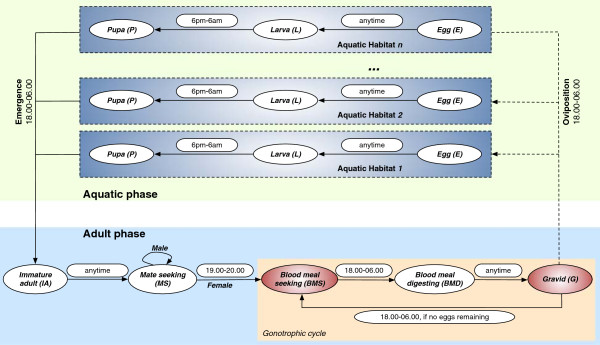
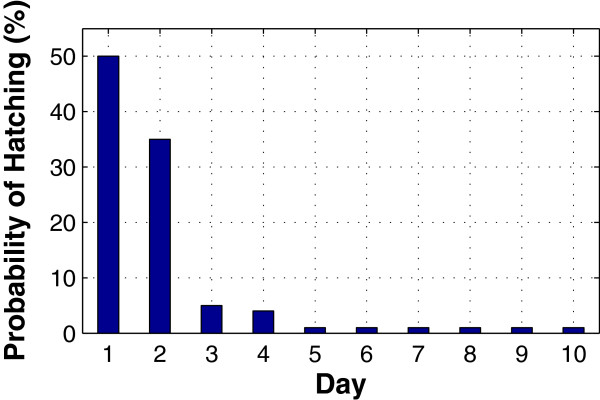
The core model is described in terms of the complete An. gambiae mosquito life cycle. Primary features include the development and mortality rates in different aquatic and adult stages, the aquatic habitats and oviposition. The density- and age-dependent larval and adult mortality rates (vector senescence) allow the model to capture the age-dependent aspects of the mosquito biology. Details of hypothetical interventions are also described.
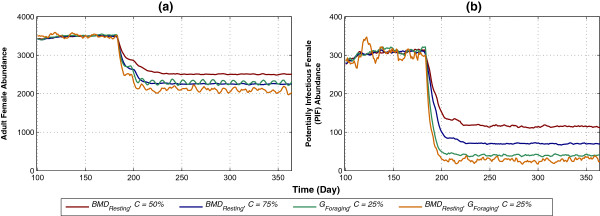
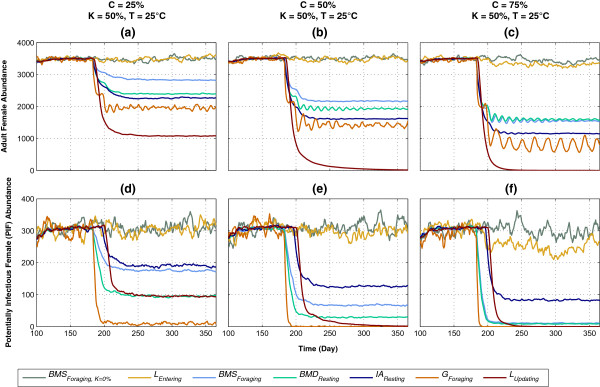
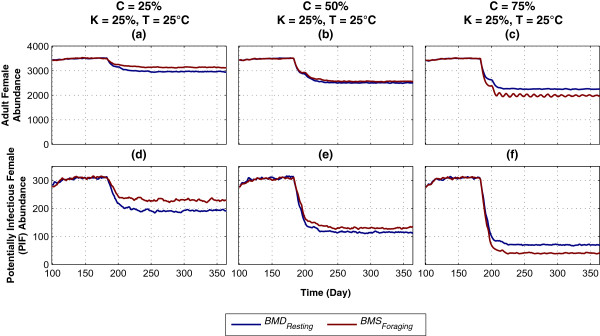
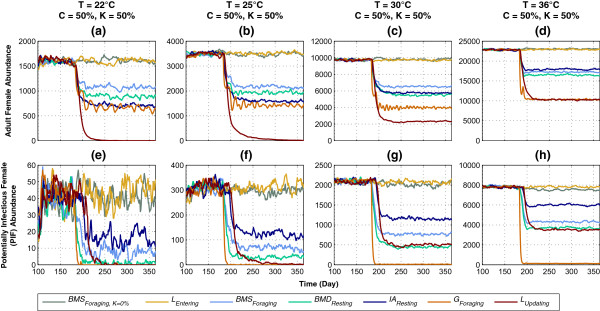
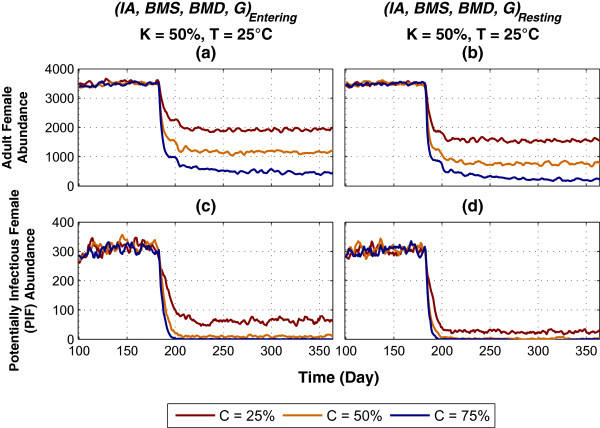
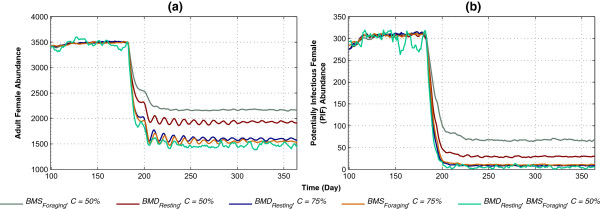
Results show that with varying coverage and temperature ranges, the hypothetical interventions targeting the gonotrophic cycle stages produce higher impacts than the rest in reducing the potentially infectious female (PIF) mosquito populations, due to their multi-hour mortality impacts and their applicability at multiple gonotrophic cycles. Thus, these stages may be the most effective points of target for newly developed and novel interventions. A combined HVCI with low coverage can produce additive synergistic impacts and can be more effective than isolated HVCIs with comparatively higher coverages. It is emphasized that although the model described in this paper is designed specifically around the mosquito An. gambiae, it could effectively apply to many other major malaria vectors in the world (including the three most efficient nominal anopheline species An. gambiae, Anopheles coluzzii and Anopheles arabiensis) by incorporating a variety of factors (seasonality cycles, rainfall, humidity, etc.). Thus, the model can essentially be treated as a generic Anopheles model, offering an excellent framework for such extensions. The utility of the core model has also been demonstrated by several other applications, each of which investigates well-defined biological research questions across a variety of dimensions (including spatial models, insecticide resistance, and sterile insect techniques).
基于主体的模型(ABM)已被用于模拟单个蚊子的行为以及疟疾的其他方面。本文描述了冈比亚按蚊种群动态的概念性昆虫学模型及其衍生的基于主体的实现方式。实施了假设的病媒控制干预措施(HVCI)以针对蚊子生命周期中的特定活动,并评估其影响。
核心模型是根据完整的冈比亚按蚊生命周期来描述的。主要特征包括不同水生和成虫阶段的发育和死亡率、水生栖息地和产卵情况。幼虫和成虫的密度和年龄依赖性死亡率(病媒衰老)使该模型能够捕捉蚊子生物学中与年龄相关的方面。还描述了假设干预措施的细节。
结果表明,在不同的覆盖范围和温度范围内,针对生殖营养周期阶段的假设干预措施在减少潜在感染性雌蚊(PIF)种群方面比其他措施产生的影响更大,这是由于它们具有数小时的致死影响以及在多个生殖营养周期中的适用性。因此,这些阶段可能是新开发和新颖干预措施最有效的靶点。低覆盖范围的联合HVCI可以产生累加协同影响,并且可能比覆盖范围相对较高的单独HVCI更有效。需要强调的是,尽管本文描述的模型是专门围绕冈比亚按蚊设计的,但通过纳入各种因素(季节性周期、降雨、湿度等),它可以有效地应用于世界上许多其他主要的疟疾媒介(包括三种最有效的指名按蚊物种:冈比亚按蚊、科氏按蚊和阿拉伯按蚊)。因此,该模型基本上可以被视为一个通用的按蚊模型,为这种扩展提供了一个极好的框架。核心模型的实用性也已通过其他几个应用得到证明,每个应用都在多个维度(包括空间模型、杀虫剂抗性和不育昆虫技术)上研究了明确界定的生物学研究问题。