Fallahi Poupak, Ferrari Silvia Martina, Politti Ugo, Giuggioli Dilia, Ferri Clodoveo, Antonelli Alessandro
Department of Clinical and Experimental Medicine, University of Pisa, Via Savi 10, 56126 Pisa, Italy.
Department of Medical, Surgical, Maternal, Pediatric and Adult Sciences, University of Modena and Reggio Emilia, Via del Pozzo 71, 41100 Modena, Italy.
Int J Endocrinol. 2014;2014:935131. doi: 10.1155/2014/935131. Epub 2014 Oct 13.
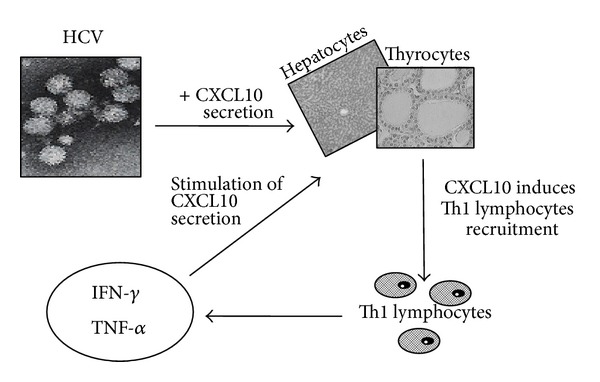
Frequently, patients with hepatitis C virus (HCV) chronic infection have high levels of serum anti-thyroperoxidase and/or anti-thyroglobulin autoantibodies, ultrasonographic signs of chronic autoimmune thyroiditis, and subclinical hypothyroidism, in female gender versus healthy controls, or hepatitis B virus infected patients. In patients with "HCV-associated mixed cryoglobulinemia" (MC + HCV), a higher prevalence of thyroid autoimmune disorders was shown not only compared to controls, but also versus HCV patients without cryoglobulinemia. Patients with MC + HCV or HCV chronic infection show a higher prevalence of papillary thyroid cancer than controls, in particular in patients with autoimmune thyroiditis. Patients with HCV chronic infection, or with MC + HCV, in presence of autoimmune thyroiditis, show higher serum levels of T-helper (Th)1 (C-X-C motif) ligand 10 (CXCL10) chemokine, but normal levels of Th2 (C-C motif) ligand 2 chemokine, than patients without thyroiditis. HCV thyroid infection could act by upregulating CXCL10 gene expression and secretion in thyrocytes recruiting Th1 lymphocytes that secrete interferon-γ and tumor necrosis factor-α. These cytokines might induce a further CXCL10 secretion by thyrocytes, thus perpetuating the immune cascade, which may lead to the appearance of autoimmune thyroid disorders in genetically predisposed subjects. A careful monitoring of thyroid function, particularly where nodules occur, is recommended in HCV patients.
丙型肝炎病毒(HCV)慢性感染患者血清抗甲状腺过氧化物酶和/或抗甲状腺球蛋白自身抗体水平通常较高,存在慢性自身免疫性甲状腺炎的超声征象以及亚临床甲状腺功能减退,在女性患者中与健康对照或乙型肝炎病毒感染患者相比更为明显。在“HCV相关混合性冷球蛋白血症”(MC + HCV)患者中,甲状腺自身免疫性疾病的患病率不仅高于对照组,而且高于无冷球蛋白血症的HCV患者。MC + HCV或HCV慢性感染患者的甲状腺乳头状癌患病率高于对照组,尤其是在患有自身免疫性甲状腺炎的患者中。与无甲状腺炎的患者相比,患有HCV慢性感染或MC + HCV且伴有自身免疫性甲状腺炎的患者血清辅助性T细胞(Th)1(C-X-C基序)配体10(CXCL10)趋化因子水平较高,但Th2(C-C基序)配体2趋化因子水平正常。HCV甲状腺感染可能通过上调甲状腺细胞中CXCL10基因的表达和分泌来发挥作用,从而募集分泌干扰素-γ和肿瘤坏死因子-α的Th1淋巴细胞。这些细胞因子可能会诱导甲状腺细胞进一步分泌CXCL10,从而使免疫级联反应持续存在,这可能导致遗传易感个体出现自身免疫性甲状腺疾病。建议对HCV患者进行甲状腺功能的仔细监测,尤其是在出现结节的情况下。