Ogi Hirotsugu, Fukukshima Masahiko, Hamada Hiroki, Noi Kentaro, Hirao Masahiko, Yagi Hisashi, Goto Yuji
Graduate School of Engineering Science, Osaka University, Toyonaka, Osaka 560-8531, Japan.
Institute for Protein Research, Osaka University, Yamadaoka 3-2, Suita, Osaka 565-0871, Japan.
Sci Rep. 2014 Nov 7;4:6960. doi: 10.1038/srep06960.
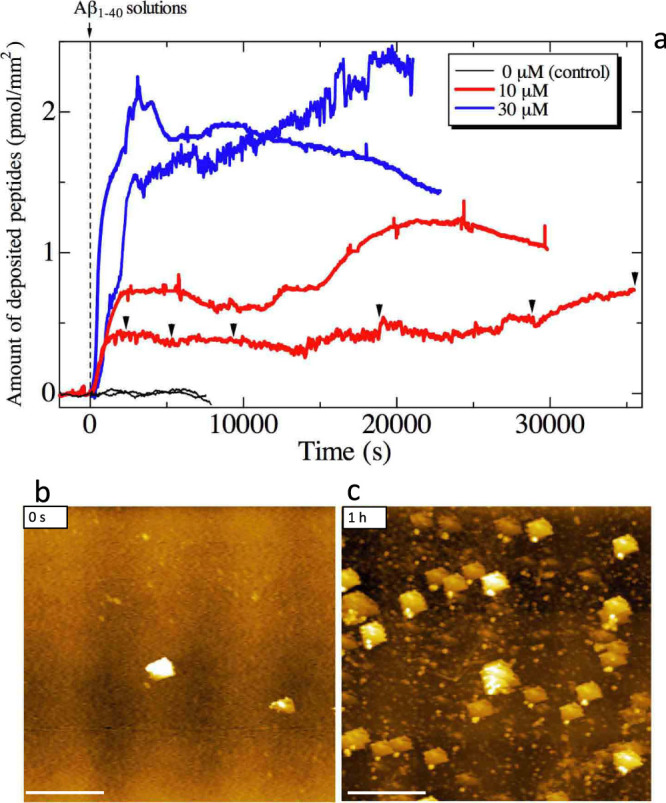
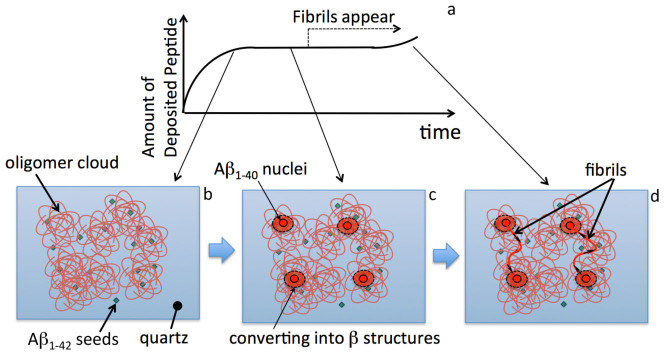
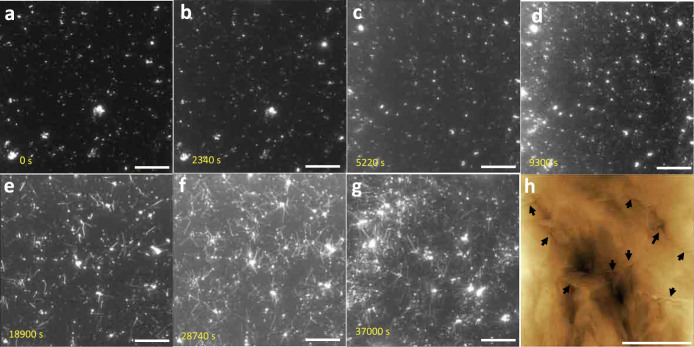
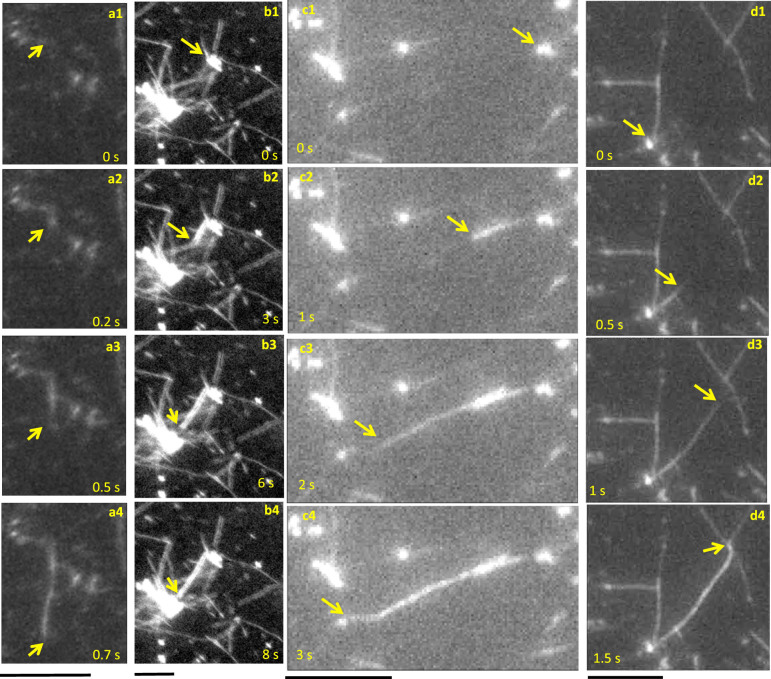
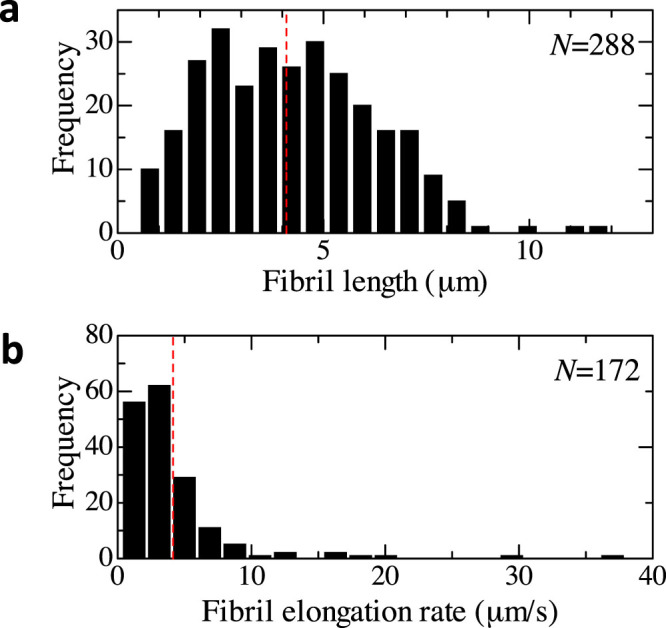
Interaction between monomer peptides and seeds is essential for clarifying the fibrillation mechanism of amyloid β (Aβ) peptides. We monitored the deposition reaction of Aβ(1-40) peptides on immobilized seeds grown from Aβ(1-42), which caused formation of oligomers in the early stage. The deposition reaction and fibrillation procedure were monitored throughout by novel total-internal-reflection-fluorescence microscopy with a quartz-crystal microbalance (TIRFM-QCM) system. This system allows simultaneous evaluation of the amount of deposited peptides on the surface seeds by QCM and fibril nucleation and elongation by TIRFM. Most fibrils reached other nuclei, forming the fibril network across the nucleus hubs in a short time. We found a fibril-elongation rate two-orders-of-magnitude higher in an oligomeric cloud than reported values, indicating ultrafast transition of oligomers into fibrils.
单体肽与种子之间的相互作用对于阐明淀粉样β(Aβ)肽的纤维化机制至关重要。我们监测了Aβ(1-40)肽在由Aβ(1-42)生长的固定化种子上的沉积反应,该反应在早期导致了寡聚体的形成。通过新型的石英晶体微天平全内反射荧光显微镜(TIRFM-QCM)系统对沉积反应和纤维化过程进行全程监测。该系统允许通过QCM同时评估表面种子上沉积肽的量,并通过TIRFM评估原纤维的成核和伸长。大多数原纤维在短时间内到达其他核,形成跨越核中心的原纤维网络。我们发现寡聚体云中的原纤维伸长率比报道的值高两个数量级,这表明寡聚体向原纤维的超快转变。