Awini Elizabeth, Sarpong Doris, Adjei Alexander, Manyeh Alfred Kwesi, Amu Alberta, Akweongo Patricia, Adongo Philip, Kukula Vida, Odonkor Gabriel, Narh Solomon, Gyapong Margaret
Dodowa Health Research Centre, Dodowa, Ghana; School of Public Health, University of Ghana, Accra, Ghana; INDEPTH Network, Accra, Ghana;
Dodowa Health Research Centre, Dodowa, Ghana; School of Public Health, University of Ghana, Accra, Ghana.
Glob Health Action. 2014 Oct 29;7:25543. doi: 10.3402/gha.v7.25543. eCollection 2014.
Data needed to estimate causes of death and the pattern of these deaths are scarce in sub-Saharan Africa. Such data are very important for targeting, monitoring, and evaluating health interventions.
To estimate the mortality rate and determine causes of death among adults (aged 15 years and older) in a rural district of southern Ghana, using the InterVA-4 model.
Data used were generated from verbal autopsies conducted for registered adult members of the Dodowa Health and Demographic Surveillance System who died between 2006 and 2010. The InterVA-4 model was used to assign the cause of death.
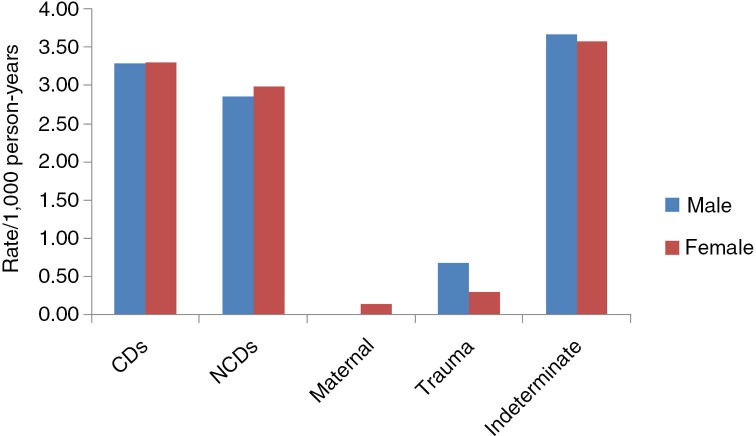
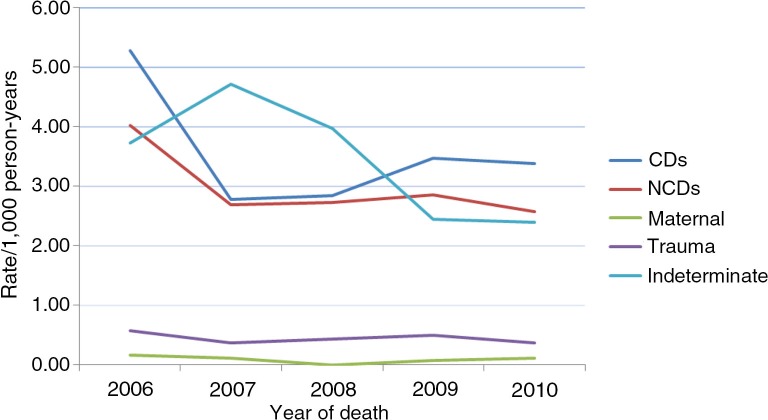
Overall, the mortality rate for the period under review was 7.5/1,000 person-years (py) for the general population and 10.4/1,000 py for those aged 15 and older. The leading cause of death was communicable diseases (CDs), with a malaria-specific mortality rate of 1.06/1,000 py. Pulmonary tuberculosis (TB)-specific mortality rate was the next highest (1.01/1,000 py). HIV/AIDS attributed deaths were lower among males than females. Non-communicable diseases (NCDs) contributed to 28.3% of the deaths with cause-specific mortality rate of 2.93/1,000 py. Stroke topped the list with cause-specific mortality rate of 0.69/1,000 py. As expected, young males (15-49 years) contributed to more road traffic accident (RTA) deaths; they had a lower RTA cause-specific mortality rate than older males (50-64 years).
Data indicate that CDs (e.g. malaria and TB) remain the major cause of death with NCDs (e.g. stroke) following closely behind. Verbal autopsy data can provide the causes of mortality in poorly resourced settings where access to timely and accurate data is scarce.
在撒哈拉以南非洲地区,估算死亡原因及这些死亡模式所需的数据十分匮乏。此类数据对于确定卫生干预措施的目标、进行监测和评估非常重要。
使用InterVA - 4模型估算加纳南部一个农村地区成年人(15岁及以上)的死亡率,并确定死亡原因。
所使用的数据来自为多杜瓦健康与人口监测系统中2006年至2010年间死亡的成年登记成员进行的口头尸检。采用InterVA - 4模型确定死亡原因。
总体而言,在审查期间,普通人群的死亡率为7.5/1000人年,15岁及以上人群的死亡率为10.4/1000人年。主要死亡原因是传染病,疟疾特异性死亡率为1.06/1000人年。肺结核特异性死亡率次之(1.01/1000人年)。男性因艾滋病毒/艾滋病导致的死亡人数低于女性。非传染性疾病导致的死亡占28.3%,病因特异性死亡率为2.93/1000人年。中风位居榜首,病因特异性死亡率为0.69/1000人年。正如预期的那样,年轻男性(15 - 49岁)因道路交通事故死亡的人数更多;他们的道路交通事故病因特异性死亡率低于老年男性(50 - 64岁)。
数据表明,传染病(如疟疾和肺结核)仍然是主要死亡原因,非传染性疾病(如中风)紧随其后。在缺乏及时准确数据的资源匮乏地区,口头尸检数据可提供死亡原因。