Department of Anesthesiology, Albany Medical College, Albany, NY, USA.
Global Scientific Affairs, Mallinckrodt Pharmaceuticals, St Louis, MO, USA ; Center for Bioethics, Pain Management and Medicine, St Louis, MO, USA.
J Pain Res. 2014 Oct 17;7:589-608. doi: 10.2147/JPR.S55782. eCollection 2014.
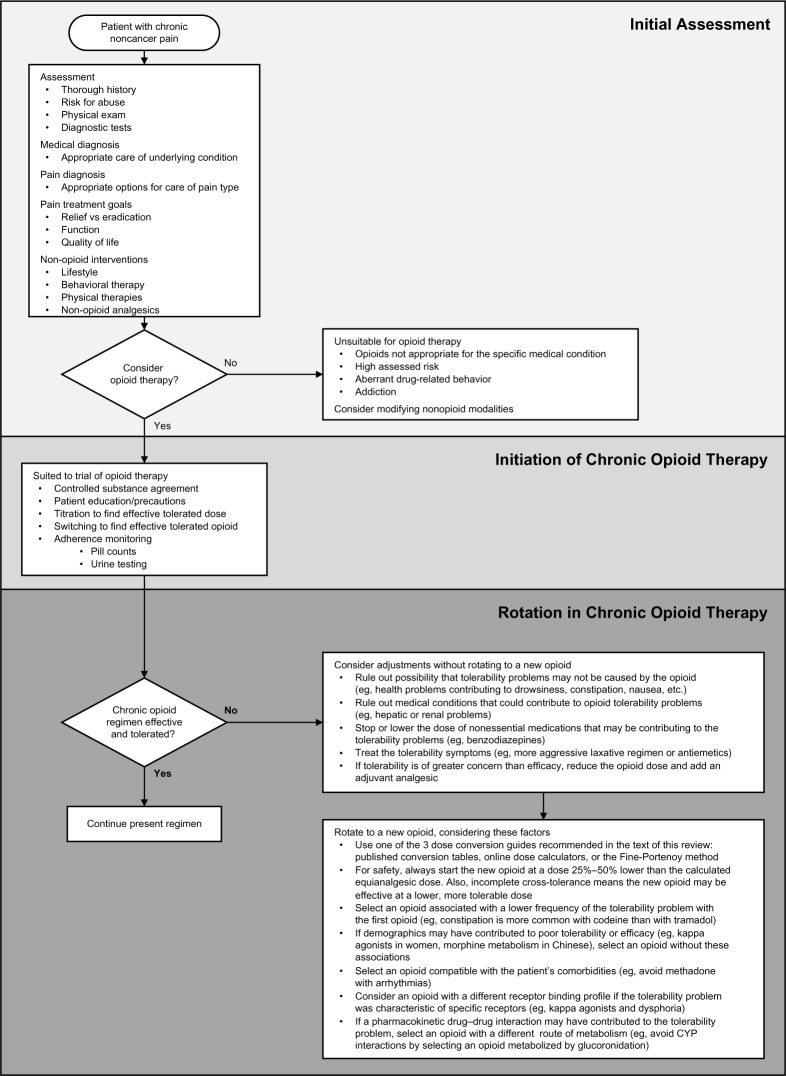
Patients requiring chronic opioid therapy may not respond to or tolerate the first opioid prescribed to them, necessitating rotation to another opioid. They may also require dose increases for a number of reasons, including worsening disease and increased pain. Dose escalation to restore analgesia using the primary opioid may lead to increased adverse events. In these patients, rotation to a different opioid at a lower-than-equivalent dose may be sufficient to maintain adequate tolerability and analgesia. In published trials and case series, opioid rotation is performed either using a predetermined substitute opioid with fixed conversion methods, or in a manner that appears to be no more systematic than trial and error. In clinical practice, opioid rotation must be performed with consideration of individual patient characteristics, comorbidities (eg, concurrent psychiatric, pulmonary, renal, or hepatic illness), and concurrent medications, using flexible dosing protocols that take into account incomplete opioid cross-tolerance. References cited in this review were identified via a search of PubMed covering all English language publications up to May 21, 2013 pertaining to opioid rotation, excluding narrative reviews, letters, and expert opinion. The search yielded a total of 129 articles, 92 of which were judged to provide relevant information and subsequently included in this review. Through a review of this literature and from the authors' empiric experience, this review provides practical information on performing opioid rotation in clinical practice.
需要长期接受阿片类药物治疗的患者可能对首次开的阿片类药物没有反应或不能耐受,需要更换其他阿片类药物。他们也可能因为许多原因需要增加剂量,包括病情恶化和疼痛加剧。为了恢复镇痛而增加阿片类药物的剂量可能会导致不良反应增加。在这些患者中,以低于等效剂量的不同阿片类药物进行转换可能足以维持足够的耐受性和镇痛效果。在已发表的试验和病例系列研究中,阿片类药物的转换要么使用具有固定转换方法的预定替代阿片类药物,要么采用似乎比反复试验更没有系统性的方法。在临床实践中,必须根据患者的个体特征、合并症(如同时存在精神、肺部、肾脏或肝脏疾病)和同时使用的药物来进行阿片类药物的转换,采用灵活的剂量方案,考虑到不完全的阿片类药物交叉耐受。本综述中引用的参考文献是通过对截至 2013 年 5 月 21 日在 PubMed 上发表的所有英文文献进行搜索而确定的,不包括叙述性综述、信件和专家意见。该搜索共产生了 129 篇文章,其中 92 篇被认为提供了相关信息,并随后被纳入本综述。通过对这些文献的回顾以及作者的经验,本综述提供了在临床实践中进行阿片类药物转换的实用信息。