van Bruinessen Inge Renske, van Weel-Baumgarten Evelyn M, Snippe Harm Wouter, Gouw Hans, Zijlstra Josée M, van Dulmen Sandra
NIVEL (Netherlands Institute for Health Services Research), Utrecht, Netherlands.
JMIR Res Protoc. 2014 Nov 6;3(4):e59. doi: 10.2196/resprot.3695.
An important and challenging part of living with cancer relates to the repeated visits to the hospital. Since how patients cope between these post-diagnostic visits depends partly on the information and support received from their physician during the visits, it is important to make the most of them. Recent findings reinforce the importance of training not only the health care professionals in communication skills, but providing patients with support in communication as well. Delivering such supportive interventions online can have potential benefits in terms of accessibility, cost-effectiveness, and ability to tailor information to personal needs. However, problems with attrition (dropout, non-usage) during the test phase and poor uptake after implementation are frequently reported. The marginal level of engagement of the patient as end user seems to play a role in this. Therefore, recent research suggests integrating theory-based development methods with methods that promote involvement of the patient at an early stage. This paper describes a participatory protocol, used to let patients guide a theory-informed development process.
The objective of this project was to apply a bottom-up inspired procedure to develop a patient-centered intervention with corresponding evaluation and implementation plan.
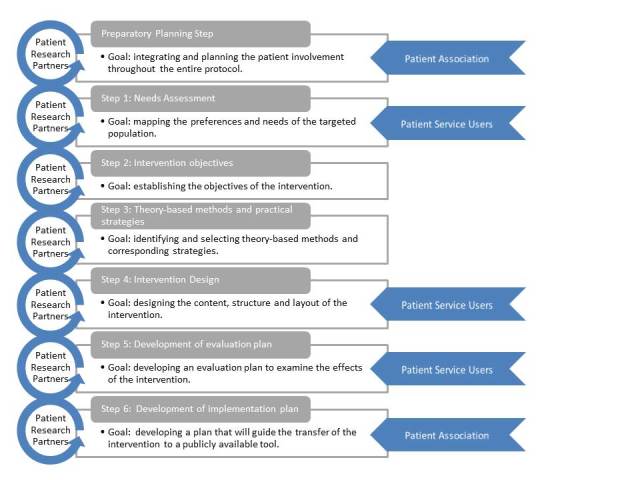
The applied development protocol was based on the intervention mapping framework, combined with patient participatory methods that were inspired by the participation ladder and user-centred design methods.
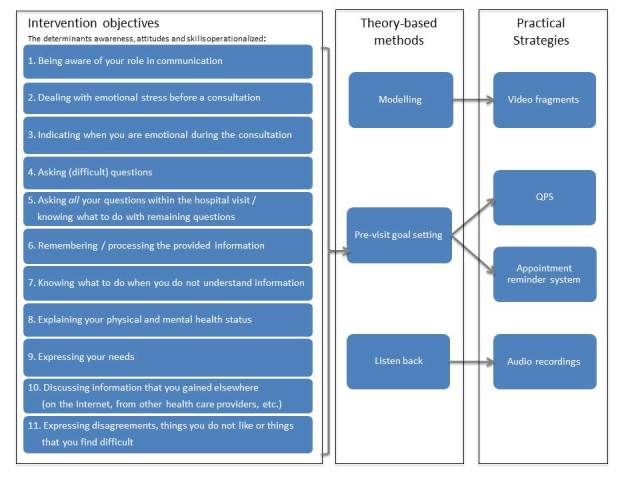
The applied protocol led to a self-directed online communication intervention aimed at helping patients gain control during their communications with health care professionals. It also led to an evaluation plan and an implementation plan. The protocol enabled the continuous involvement of patient research partners and the partial involvement of patient service users, which led to valuable insights and improvements.
The applied protocol realized patient participation on different levels throughout the entire project. Early involvement, involvement on different levels, and flexibility in terms of planning and setup seem to be preconditions to creating a bottom-up inspired development procedure with (seriously ill) patients. Further research is necessary to find out if a more patient-centered approach improves the implementation and uptake of eHealth interventions.
Netherlands National Trial Register ID number: NTR3779; http://www.trialregister.nl/trialreg/admin/rctview.asp?TC=3779 (Archived by WebCite at http://www.webcitation.org/6TdfALKxV).
癌症患者生活中一个重要且具有挑战性的部分与频繁就医有关。由于患者在这些诊断后就诊期间的应对方式部分取决于他们在就诊时从医生那里获得的信息和支持,因此充分利用这些就诊机会非常重要。最近的研究结果强化了不仅要对医护人员进行沟通技能培训,还要为患者提供沟通支持的重要性。在线提供此类支持性干预措施在可及性、成本效益以及根据个人需求量身定制信息的能力方面可能具有潜在益处。然而,测试阶段的损耗问题(退出、不使用)以及实施后的接受度低经常被报道。患者作为最终用户的参与程度有限似乎在其中起到了作用。因此,最近的研究建议将基于理论的开发方法与在早期阶段促进患者参与的方法相结合。本文描述了一种参与式方案,用于让患者指导一个基于理论的开发过程。
本项目的目的是应用一种自下而上的方法来开发一种以患者为中心的干预措施以及相应的评估和实施计划。
所应用的开发方案基于干预映射框架,结合了受参与阶梯和以用户为中心的设计方法启发的患者参与式方法。
所应用的方案导致了一种旨在帮助患者在与医护人员沟通时获得掌控力的自主在线沟通干预措施。它还产生了一个评估计划和一个实施计划。该方案使患者研究伙伴能够持续参与,患者服务用户能够部分参与,从而带来了有价值的见解和改进。
所应用的方案在整个项目中实现了不同层面的患者参与。早期参与、不同层面的参与以及规划和设置方面的灵活性似乎是创建一个受(重症)患者启发的自下而上开发程序的先决条件。有必要进行进一步研究以确定更以患者为中心的方法是否能改善电子健康干预措施的实施和接受度。
荷兰国家试验注册编号:NTR3779;http://www.trialregister.nl/trialreg/admin/rctview.asp?TC=3779(由WebCite存档于http://www.webcitation.org/6TdfALKxV)。