Richardson George B, Freedlander Jonathan M, Katz Elizabeth C, Dai Chia-Liang, Chen Ching-Chen
School of Human Services, University of Cincinnati Cincinnati, OH, USA.
Centers for Medicare and Medicaid Services Baltimore, MD, USA.
Front Psychol. 2014 Oct 27;5:1194. doi: 10.3389/fpsyg.2014.01194. eCollection 2014.
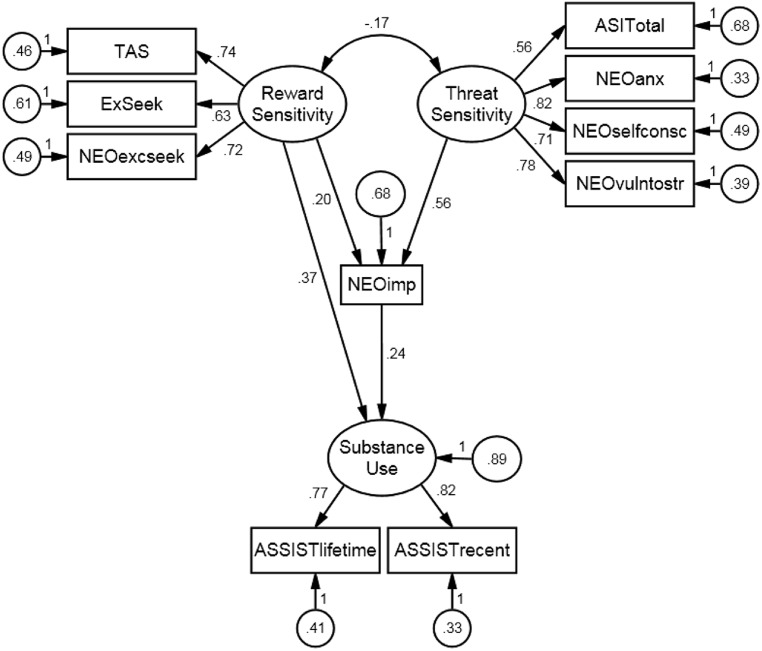
This study used structural equations modeling and undergraduate student data to examine the effects of reward and threat sensitivities on substance use, along with the extent to which impulsivity explained these effects. Our results suggest that impulsivity may translate inversely related reward and threat sensitivities into substance use, completely mediate the effect between threat sensitivity and substance use, and partially mediate the effect between reward sensitivity and substance use. Our results also suggest that individuals with a combination of higher levels on both reward and threat sensitivities may be most impulsive and vulnerable to heightened substance use. We discuss implications for research at the interface of personality and substance use and also substance abuse prevention and treatment.
本研究使用结构方程模型和大学生数据来检验奖励敏感性和威胁敏感性对物质使用的影响,以及冲动性在多大程度上解释了这些影响。我们的研究结果表明,冲动性可能将与奖励和威胁敏感性呈负相关的因素转化为物质使用,完全介导威胁敏感性与物质使用之间的关系,并部分介导奖励敏感性与物质使用之间的关系。我们的研究结果还表明,奖励敏感性和威胁敏感性都较高的个体可能最冲动,且最容易出现物质使用增加的情况。我们讨论了这些结果对人格与物质使用交叉领域研究以及物质滥用预防和治疗的启示。