Division of Infectious Diseases, VA Greater Los Angeles Healthcare System, Los Angeles, CA, 90073, USA,
Curr Top Microbiol Immunol. 2015;387:187-221. doi: 10.1007/978-3-662-45059-8_8.
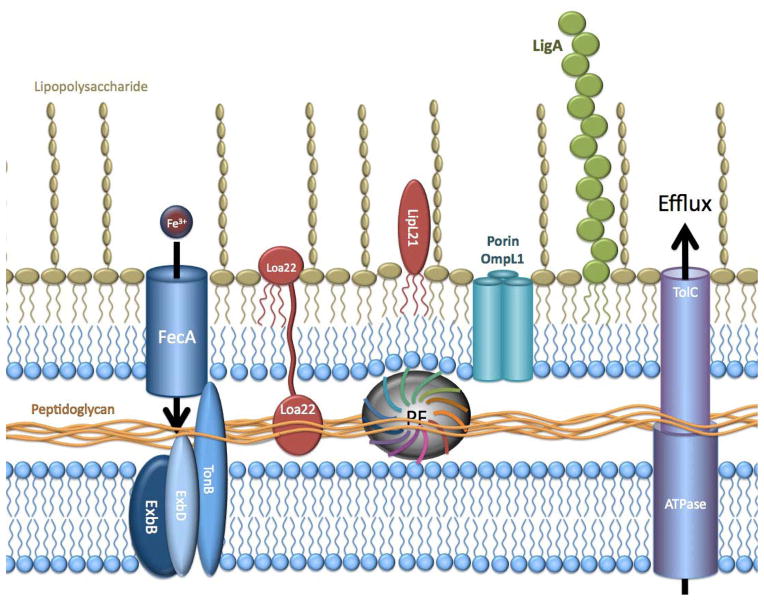
The outer membrane (OM) is the front line of leptospiral interactions with their environment and the mammalian host. Unlike most invasive spirochetes, pathogenic leptospires must be able to survive in both free-living and host-adapted states. As organisms move from one set of environmental conditions to another, the OM must cope with a series of conflicting challenges. For example, the OM must be porous enough to allow nutrient uptake, yet robust enough to defend the cell against noxious substances. In the host, the OM presents a surface decorated with adhesins and receptors for attaching to, and acquiring, desirable host molecules such as the complement regulator, Factor H.Factor H. On the other hand, the OM must enable leptospires to evade detection by the host's immune system on their way from sites of invasion through the bloodstream to the protected niche of the proximal tubule. The picture that is emerging of the leptospiral OM is that, while it shares many of the characteristics of the OMs of spirochetes and Gram-negative bacteria, it is also unique and different in ways that make it of general interest to microbiologists. For example, unlike most other pathogenic spirochetes, the leptospiral OM is rich in lipopolysaccharide (LPS). Leptospiral LPS is similar to that of Gram-negative bacteria but has a number of unique structural features that may explain why it is not recognized by the LPS-specific Toll-like receptor 4 of humans. As in other spirochetes, lipoproteins are major components of the leptospiral OM, though their roles are poorly understood. The functions of transmembrane outer membrane proteins (OMPs) in many cases are better understood, thanks to homologies with their Gram-negative counterparts and the emergence of improved genetic techniques. This chapter will review recent discoveries involving the leptospiral OM and its role in leptospiral physiology and pathogenesis.
外膜(OM)是钩端螺旋体与环境和哺乳动物宿主相互作用的第一道防线。与大多数侵袭性螺旋体不同,致病性钩端螺旋体必须能够在自由生活和适应宿主的状态下生存。当生物体从一组环境条件转移到另一组环境条件时,OM 必须应对一系列相互矛盾的挑战。例如,OM 必须足够多孔以允许营养物质吸收,但又必须足够坚固,以抵御有害物质。在宿主中,OM 呈现出一种表面,表面上装饰着附着和获取所需宿主分子的黏附素和受体,例如补体调节剂因子 H。另一方面,OM 必须使钩端螺旋体能够在从入侵部位通过血液进入近端小管的保护部位的过程中逃避宿主免疫系统的检测。目前对钩端螺旋体外膜的认识是,虽然它与螺旋体和革兰氏阴性菌的 OM 有许多共同特征,但它也具有独特性和不同之处,这使得它对微生物学家具有普遍的兴趣。例如,与大多数其他致病性螺旋体不同,钩端螺旋体的 OM 富含脂多糖(LPS)。钩端螺旋体 LPS 与革兰氏阴性菌相似,但具有许多独特的结构特征,这可能解释了为什么它不能被人类 LPS 特异性 Toll 样受体 4 识别。与其他螺旋体一样,脂蛋白是钩端螺旋体 OM 的主要成分,尽管它们的作用尚不清楚。由于与革兰氏阴性菌具有同源性以及出现了改进的遗传技术,因此许多情况下,跨膜外膜蛋白(OMP)的功能得到了更好的理解。本章将综述涉及钩端螺旋体 OM 及其在钩端螺旋体生理学和发病机制中的作用的最新发现。