Silva Valter, Grande Antonio Jose, Carvalho Alan Pedrosa Viegas de, Martimbianco Ana Luiza Cabrera, Riera Rachel
Escola Paulista de Medicina, Universidade Federal de São Paulo (EPM-Unifesp), São Paulo, Brazil.
Sao Paulo Med J. 2015 May-Jun;133(3):206-17. doi: 10.1590/1516-3180.2013.8150015. Epub 2014 Nov 7.
Overviews of Systematic Reviews (OoRs) are a new type of study in which multiple evidence from systematic reviews (SRs) is compiled into an accessible and useful document. The aim here was to describe the state of the art and critically assess Cochrane OoRs that have been published.
Descriptive study conducted at a research center.
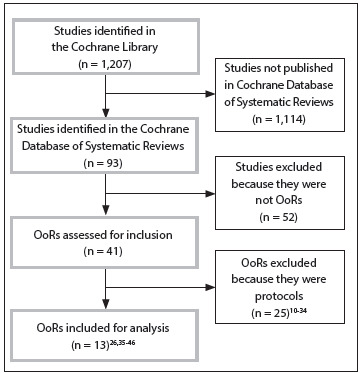
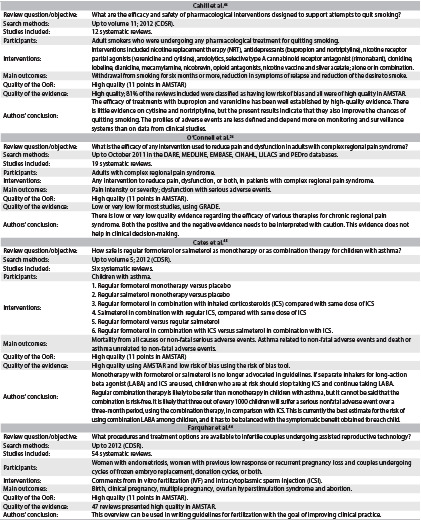
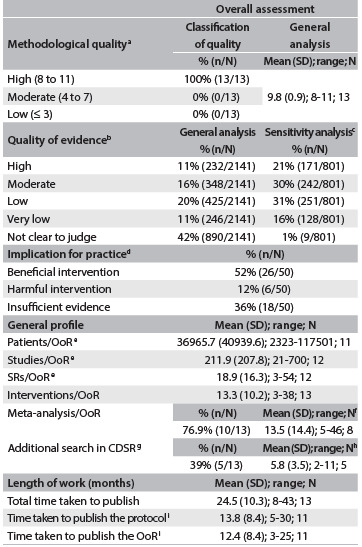
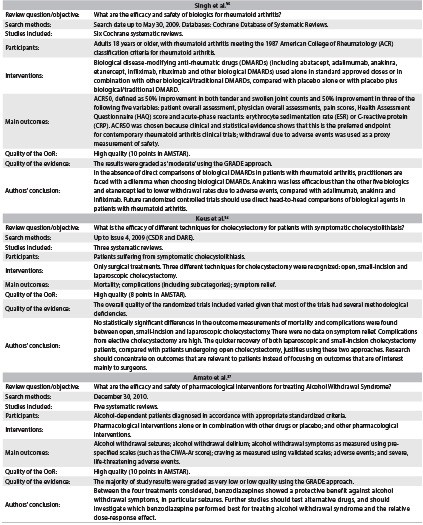
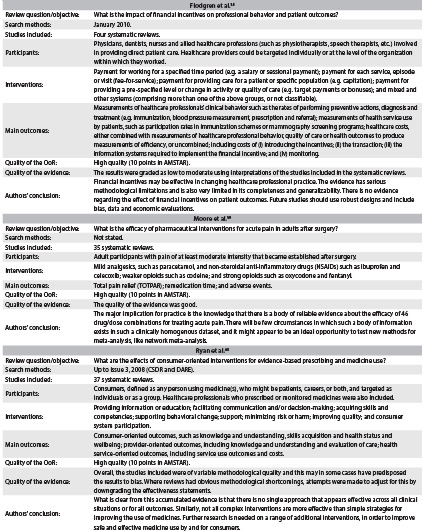
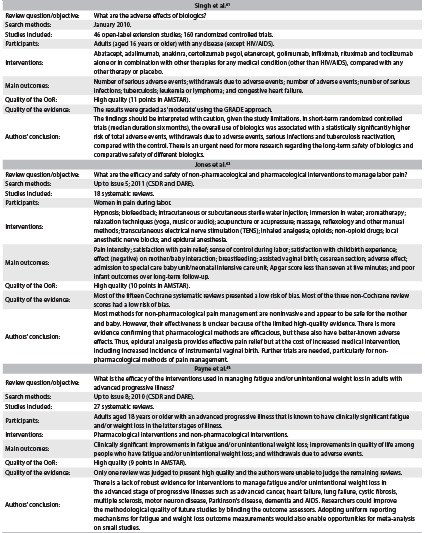
The OoRs identified through the filter developed in Part I of this study were evaluated in five domains: methodological quality; quality of evidence; implications for practice; general profile of OoRs; and length of work.
All 13 OoRs included had high methodological quality. Some OoRs did not present sufficient data to judge the quality of evidence; using sensitivity analysis, the quality of evidence of the OoRs increased. Regarding implications for practice, 64% of the interventions were judged as beneficial or harmful, while 36% of them showed insufficient evidence for judgment. It is expected (with 95% confidence interval) that one OoR will include 9,462 to 64,469 patients, 9 to 29 systematic reviews and 80 to 344 primary studies, and assess 6 to 21 interventions; and that 50 to 92% of OoRs will produce meta-analysis. The OoRs generated 2 to 26 meta-analyses over a period of 18 to 31 months.
The OoRs presented high methodological quality; the quality of evidence tended to be moderate/high; most interventions were judged to be beneficial/harmful; the mean length of work was 24 months. The OoR profile adds power to decision-making.
系统评价概述(OoR)是一种新型研究,它将来自系统评价(SR)的多项证据汇编成一份便于获取且有用的文件。本文旨在描述其发展现状并对已发表的Cochrane系统评价概述进行批判性评估。
在一个研究中心进行的描述性研究。
通过本研究第一部分开发的筛选器确定的系统评价概述在五个领域进行评估:方法学质量;证据质量;对实践的影响;系统评价概述的总体概况;以及工作时长。
纳入的所有13篇系统评价概述都具有较高的方法学质量。一些系统评价概述没有提供足够的数据来判断证据质量;通过敏感性分析,系统评价概述的证据质量有所提高。关于对实践的影响,64%的干预措施被判定为有益或有害,而其中36%的干预措施显示证据不足,无法做出判断。预计(95%置信区间)一篇系统评价概述将纳入9462至64469名患者、9至29篇系统评价和80至344项原始研究,并评估6至21项干预措施;50%至92%的系统评价概述将进行荟萃分析。系统评价概述在18至31个月的时间内产生了2至26项荟萃分析。
系统评价概述呈现出较高的方法学质量;证据质量趋于中/高;大多数干预措施被判定为有益/有害;平均工作时长为24个月。系统评价概述的概况增强了决策的力度。