Gadalla Moustafa A, Norman Robert J, Tay Chau T, Hiam Danielle S, Melder Angela, Pundir Jyotsna, Thangaratinam Shakila, Teede Helena J, Mol Ben W J, Moran Lisa J
Women's Health Hospital, Department of Obstetrics and Gynaecology, Assiut University, Assiut, Egypt.Elevtronic Address:
Robinson Research Institute, Discipline of Obstetrics and Gynaecology, University of Adelaide, Adelaide, Australia.
Int J Fertil Steril. 2020 Jan;13(4):257-270. doi: 10.22074/ijfs.2020.5608. Epub 2019 Nov 11.
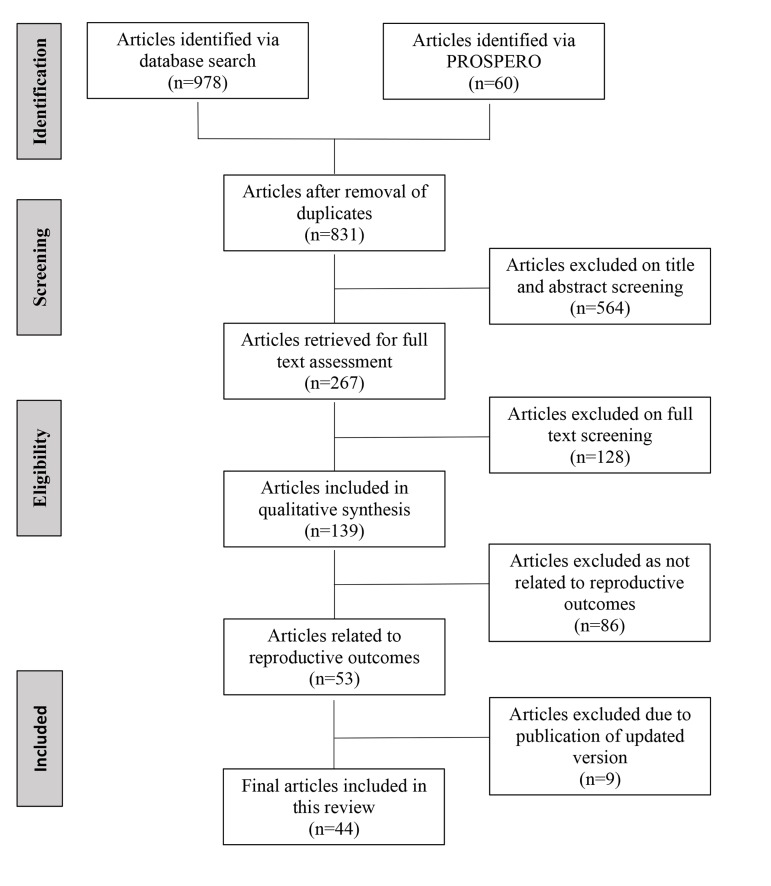
Polycystic ovary syndrome (PCOS) is a common, complex condition that affects up to 18% of reproductiveaged women, causing reproductive, metabolic and psychological dysfunctions. We performed an overview and appraisal of methodological quality of systematic reviews that assessed medical and surgical treatments for reproductive outcomes in women with PCOS. Databases (MEDLINE, EMBASE, CINAHL PLUS and PROSPERO) were searched on the 15th of September 2017. We included any systematic review that assessed the effect of medical or surgical management of PCOS on reproductive, pregnancy and neonatal outcomes. Eligibility assessment, data extraction and quality assessment by the Assessing the Methodological Quality of Systematic Reviews (AMSTAR) tool were performed in duplicate. We identified 53 reviews comprising 44 reviews included in this overview; the majority were moderate to high quality. In unselected women with PCOS, letrozole was associated with a higher live birth rate than clomiphene citrate (CC), while CC was better than metformin or placebo. In women with CC-resistant PCOS, gonadotrophins were associated with a higher live birth rate than CC plus metformin, which was better than laparoscopic ovarian drilling (LOD). LOD was associated with lower multiple pregnancy rates than other medical treatments. In women with PCOS undergoing fertilization/intracytoplasmic sperm injection (IVF/ICSI), the addition of metformin to gonadotrophins resulted in less ovarian hyperstimulation syndrome (OHSS), and higher pregnancy and live birth rates than gonadotrophins alone. Gonadotrophin releasing hormone (GnRH) antagonist was associated with less OHSS, gonadotrophin units and shorter stimulation length than GnRH agonist. Letrozole appears to be a good first line treatment and gonadotrophins, as a second line treatment, for anovulatory women with PCOS. LOD results in lower multiple pregnancy rates. However, due to the heterogeneous nature of the included populations of women with PCOS, further larger scale trials are needed with more precise assessment of treatments according to heterogeneous variants of PCOS.
多囊卵巢综合征(PCOS)是一种常见的复杂病症,影响着高达18%的育龄妇女,会导致生殖、代谢和心理功能障碍。我们对评估PCOS女性生殖结局的医学和手术治疗的系统评价的方法学质量进行了概述和评估。于2017年9月15日检索了数据库(MEDLINE、EMBASE、CINAHL PLUS和PROSPERO)。我们纳入了任何评估PCOS的医学或手术管理对生殖、妊娠和新生儿结局影响的系统评价。通过系统评价方法学质量评估(AMSTAR)工具进行的资格评估、数据提取和质量评估重复进行了两次。我们识别出53篇综述,其中44篇纳入了本概述;大多数质量为中等至高。在未选择的PCOS女性中,来曲唑与高于枸橼酸氯米芬(CC)的活产率相关,而CC优于二甲双胍或安慰剂。在CC抵抗的PCOS女性中,促性腺激素与高于CC加二甲双胍的活产率相关,CC加二甲双胍优于腹腔镜卵巢打孔术(LOD)。LOD与低于其他医学治疗的多胎妊娠率相关。在接受体外受精/卵胞浆内单精子注射(IVF/ICSI)的PCOS女性中,在促性腺激素中添加二甲双胍导致卵巢过度刺激综合征(OHSS)更少,且妊娠率和活产率高于单独使用促性腺激素。促性腺激素释放激素(GnRH)拮抗剂与比GnRH激动剂更少的OHSS、促性腺激素单位和更短的刺激时间相关。来曲唑似乎是PCOS无排卵女性的良好一线治疗药物,促性腺激素作为二线治疗药物。LOD导致较低的多胎妊娠率。然而,由于纳入的PCOS女性人群的异质性,需要进一步进行更大规模的试验,并根据PCOS的异质变体更精确地评估治疗方法。