Tastesen Hanne Sørup, Rønnevik Alexander Krokedal, Borkowski Kamil, Madsen Lise, Kristiansen Karsten, Liaset Bjørn
Department of Biology, University of Copenhagen, Copenhagen, Denmark; National Institute of Nutrition and Seafood Research, Bergen, Norway.
Department of Biology, University of Copenhagen, Copenhagen, Denmark.
PLoS One. 2014 Nov 12;9(11):e112859. doi: 10.1371/journal.pone.0112859. eCollection 2014.
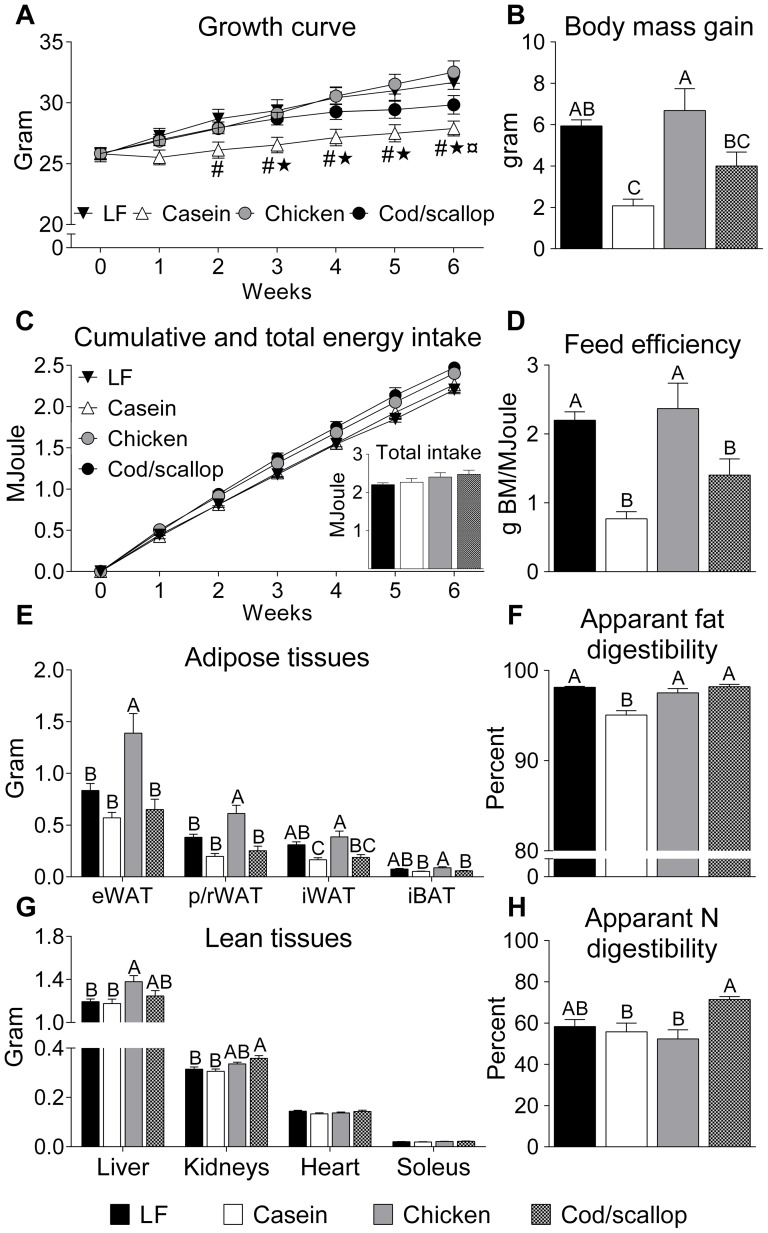
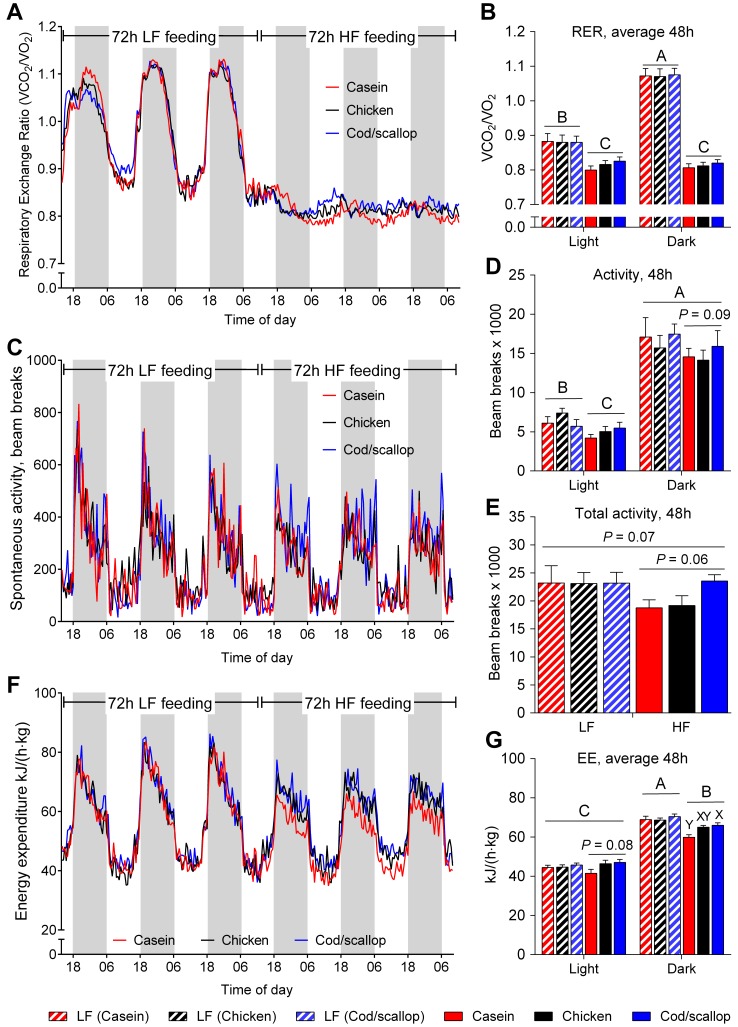
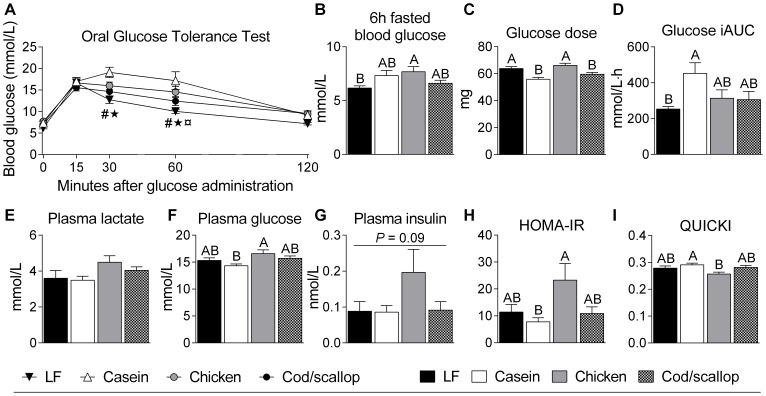
Low-protein and high-protein diets regulate energy metabolism in animals and humans. To evaluate whether different dietary protein sources modulate energy balance when ingested at average levels obesity-prone male C57BL/6J mice were pair-fed high-fat diets (67 energy percent fat, 18 energy percent sucrose and 15 energy percent protein) with either casein, chicken filet or a mixture of cod and scallop (1:1 on amino acid content) as protein sources. At equal energy intake, casein and cod/scallop fed mice had lower feed efficiency than chicken fed mice, which translated into reduced adipose tissue masses after seven weeks of feeding. Chicken fed mice had elevated hepatic triglyceride relative to casein and cod/scallop fed mice and elevated 4 h fasted plasma cholesterol concentrations compared to low-fat and casein fed mice. In casein fed mice the reduced adiposity was likely related to the observed three percent lower apparent fat digestibility compared to low-fat, chicken and cod/scallop fed mice. After six weeks of feeding an oral glucose tolerance test revealed that despite their lean phenotype, casein fed mice had reduced glucose tolerance compared to low-fat, chicken and cod/scallop fed mice. In a separate set of mice, effects on metabolism were evaluated by indirect calorimetry before onset of diet-induced obesity. Spontaneous locomotor activity decreased in casein and chicken fed mice when shifting from low-fat to high-fat diets, but cod/scallop feeding tended (P = 0.06) to attenuate this decrease. Moreover, at this shift, energy expenditure decreased in all groups, but was decreased to a greater extent in casein fed than in cod/scallop fed mice, indicating that protein sources regulated energy expenditure differently. In conclusion, protein from different sources modulates energy balance in C57BL/6J mice when given at normal levels. Ingestion of a cod/scallop-mixture prevented diet-induced obesity compared to intake of chicken filet and preserved glucose tolerance compared to casein intake.
低蛋白和高蛋白饮食可调节动物和人类的能量代谢。为评估在肥胖易感雄性C57BL/6J小鼠摄入平均水平的不同膳食蛋白质来源时是否会调节能量平衡,将小鼠成对饲养于高脂肪饮食(67%能量来自脂肪,18%能量来自蔗糖,15%能量来自蛋白质)中,分别以酪蛋白、鸡胸肉或鳕鱼与扇贝的混合物(氨基酸含量1:1)作为蛋白质来源。在能量摄入相等的情况下,摄入酪蛋白和鳕鱼/扇贝的小鼠的饲料效率低于摄入鸡肉的小鼠,这导致在喂养7周后脂肪组织质量降低。与摄入酪蛋白和鳕鱼/扇贝的小鼠相比,摄入鸡肉的小鼠肝脏甘油三酯升高,与低脂和摄入酪蛋白的小鼠相比,其禁食4小时后的血浆胆固醇浓度升高。在摄入酪蛋白的小鼠中,与低脂、摄入鸡肉和鳕鱼/扇贝的小鼠相比,脂肪减少可能与观察到的表观脂肪消化率低3%有关。喂养6周后,口服葡萄糖耐量试验显示,尽管摄入酪蛋白的小鼠体型较瘦,但与低脂、摄入鸡肉和鳕鱼/扇贝的小鼠相比,其葡萄糖耐量降低。在另一组小鼠中,在饮食诱导肥胖开始前通过间接量热法评估对代谢的影响。从低脂饮食转变为高脂肪饮食时,摄入酪蛋白和鸡肉的小鼠的自发运动活动减少,但摄入鳕鱼/扇贝的小鼠有减轻这种减少的趋势(P = 0.06)。此外,在这种转变时,所有组的能量消耗均降低,但摄入酪蛋白的小鼠比摄入鳕鱼/扇贝的小鼠降低幅度更大,这表明蛋白质来源对能量消耗的调节方式不同。总之,当以正常水平给予时,不同来源的蛋白质可调节C57BL/6J小鼠的能量平衡。与摄入鸡胸肉相比,摄入鳕鱼/扇贝混合物可预防饮食诱导的肥胖,与摄入酪蛋白相比,可保持葡萄糖耐量。