Cai Yonglin, Li Jun, Lu Aiying, Zhong Weiming, Gao Jianquan, Zheng Yuming, Zeng Hong, Wang Wei, Tang Minzhong
Wuzhou Health System Key Laboratory for Nasopharyngeal Carcinoma Etiology and Molecular Mechanism (YC, JL, AL, YZ, HZ, MT); Clinical Laboratory (YC, JL, AL); Department of Radiation Oncology (WZ, JG), Wuzhou Red Cross Hospital, Wuzhou, Guangxi; Second People's Hospital of Zhuhai (WW), Zhuhai, Guangdong; and College of Life Science and Bioengineering (MT), Beijing University of Technology, Beijing, China.
Medicine (Baltimore). 2014 Nov;93(22):e123. doi: 10.1097/MD.0000000000000123.
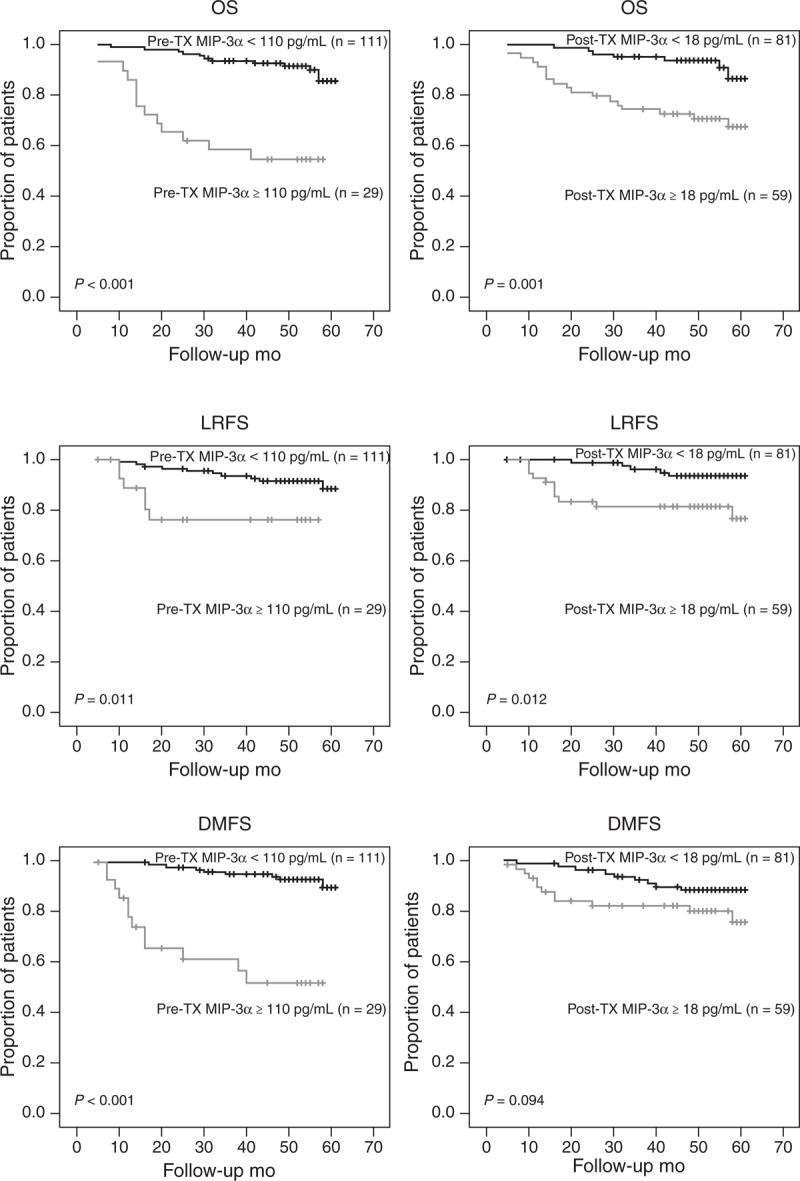
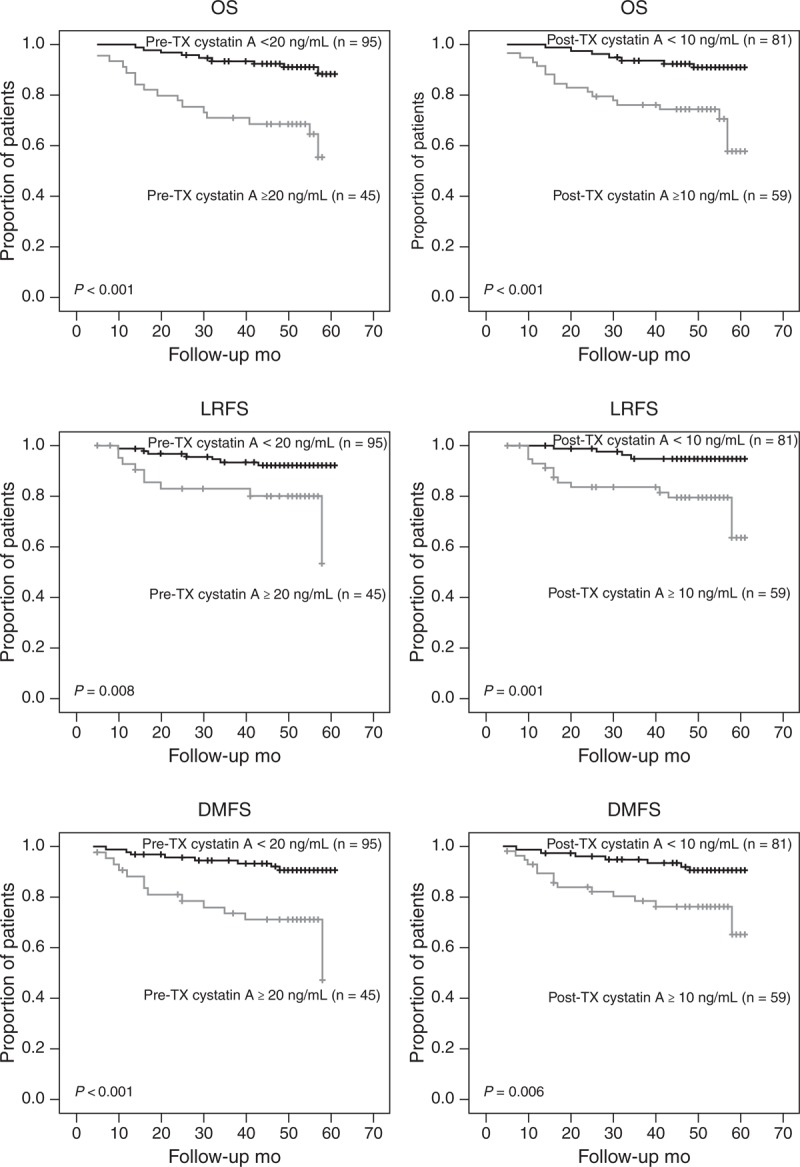
This study was aimed to investigate the roles of serum macrophage inflammatory protein-3α (MIP-3α) and cystatin A in nasopharyngeal carcinoma (NPC) prognosis.The serum levels of MIP-3α and cystatin A in 140 primary NPC patients without distant metastasis were detected by enzyme-linked immunosorbent assay before and after treatment. The results were compared with those in 100 healthy controls. The log-rank test was used to compare survival curves of the 2 groups. Multivariate analysis of prognostic factors used Cox proportional hazards regression model.Serum levels of MIP-3α and cystatin A in pretreatment patients with NPC were higher than those in healthy controls. Concentrations of these 2 factors in the majority of patients after the therapy decreased to control level. Patients with high serum level of MIP-3α and cystatin A before treatment had poorer overall survival (OS), local recurrence-free survival, and distant metastasis-free survival than the ones with low level. In addition, serum pretreatment MIP-3α and cystatin A levels were independent prognostic factors for OS and distant metastasis-free survival of NPC patients; serum posttreatment MIP-3α and cystatin A levels were independent prognostic factors of local recurrence-free survival.Our results revealed that serum MIP-3α and cystatin A may be promising candidate prognostic factors for NPC, and higher serum levels of MIP-3α and cystatin A correlate with shorter probability of OS, local recurrence, and distant metastasis.
本研究旨在探讨血清巨噬细胞炎性蛋白-3α(MIP-3α)和胱抑素A在鼻咽癌(NPC)预后中的作用。采用酶联免疫吸附测定法检测140例无远处转移的原发性NPC患者治疗前后血清MIP-3α和胱抑素A水平,并与100例健康对照者的结果进行比较。采用对数秩检验比较两组的生存曲线。采用Cox比例风险回归模型对预后因素进行多因素分析。NPC患者治疗前血清MIP-3α和胱抑素A水平高于健康对照者。大多数患者治疗后这两种因子的浓度降至对照水平。治疗前血清MIP-3α和胱抑素A水平高的患者总生存期(OS)、无局部复发生存期和无远处转移生存期均较水平低的患者差。此外,血清治疗前MIP-3α和胱抑素A水平是NPC患者OS和无远处转移生存期的独立预后因素;血清治疗后MIP-3α和胱抑素A水平是无局部复发生存期的独立预后因素。我们的结果显示,血清MIP-3α和胱抑素A可能是NPC有前景的候选预后因素,血清MIP-3α和胱抑素A水平越高,OS、局部复发和远处转移的概率越低。