Wang Yong, Cai En, Rosenkranz Tobias, Ge Pinghua, Teng Kai Wen, Lim Sung Jun, Smith Andrew M, Chung Hee Jung, Sachs Frederick, Green William N, Gottlieb Philip, Selvin Paul R
Department of Physics, ‡Center for the Physics of Living Cells, and §Center for Biophysics and Computational Biology, ∥Department of Bioengineering, and ⊥Department of Molecular and Integrative Physiology, University of Illinois at Urbana-Champaign , Urbana, Illinois 61801, United States.
Bioconjug Chem. 2014 Dec 17;25(12):2205-11. doi: 10.1021/bc5004179. Epub 2014 Nov 25.
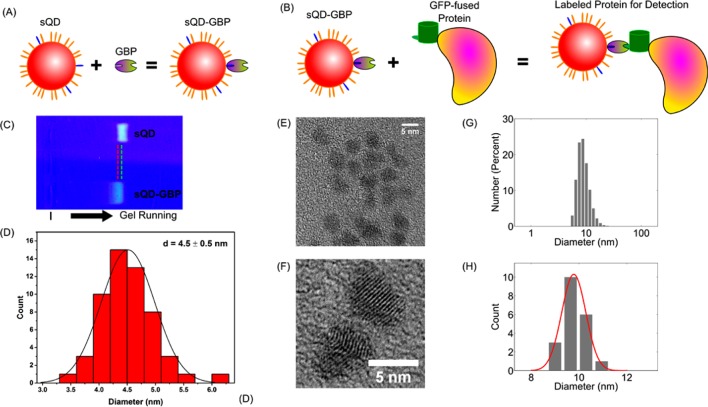
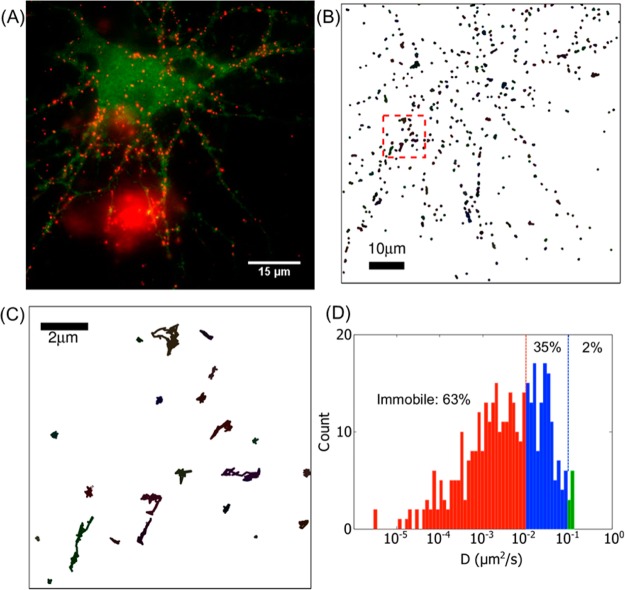
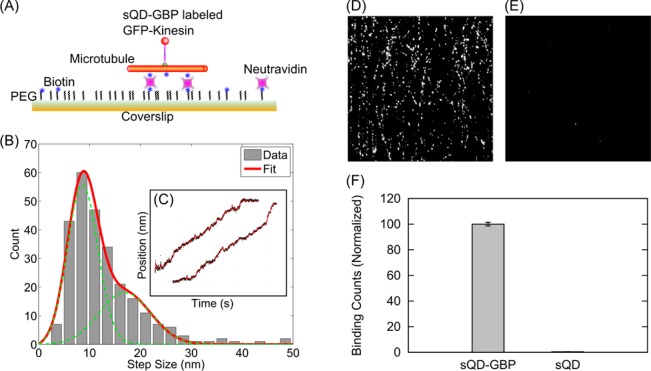
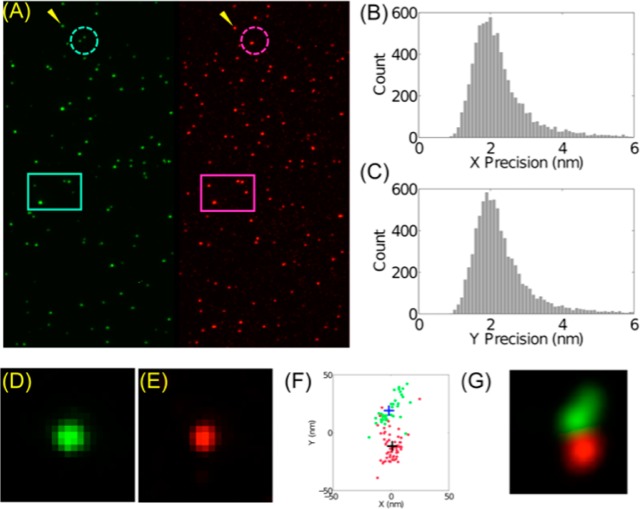
Immunofluorescence, a powerful technique to detect specific targets using fluorescently labeled antibodies, has been widely used in both scientific research and clinical diagnostics. The probes should be made with small antibodies and high brightness. We conjugated GFP binding protein (GBP) nanobodies, small single-chain antibodies from llamas, with new ∼7 nm quantum dots. These provide simple and versatile immunofluorescence nanoprobes with nanometer accuracy and resolution. Using the new probes we tracked the walking of individual kinesin motors and measured their 8 nm step sizes; we tracked Piezo1 channels, which are eukaryotic mechanosensitive channels; we also tracked AMPA receptors on living neurons. Finally, we used a new super-resolution algorithm based on blinking of (small) quantum dots that allowed ∼2 nm precision.
免疫荧光是一种利用荧光标记抗体检测特定靶标的强大技术,已广泛应用于科学研究和临床诊断。探针应由小抗体和高亮度制成。我们将绿色荧光蛋白(GFP)结合蛋白(GBP)纳米抗体(来自骆驼的小单链抗体)与新的约7纳米量子点偶联。这些提供了具有纳米精度和分辨率的简单通用的免疫荧光纳米探针。使用新探针,我们追踪了单个驱动蛋白马达的行走并测量了它们8纳米的步长;我们追踪了Piezo1通道,其为真核机械敏感通道;我们还追踪了活神经元上的AMPA受体。最后,我们使用了一种基于(小)量子点闪烁的新超分辨率算法,其精度可达约2纳米。