Balzer Felix, Treskatsch Sascha, Spies Claudia, Sander Michael, Kastrup Mark, Grubitzsch Herko, Wernecke Klaus-Dieter, Braun Jan P
Department of Anesthesiology and Intensive Care Medicine, Campus Charité Mitte and Campus Virchow-Klinikum, Charité - Universitätsmedizin Berlin, Charitéplatz 1, Berlin, 10117, Germany.
Department of Cardiovascular Surgery, Campus Charité Mitte, Charité - Universitätsmedizin Berlin, Berlin, Germany.
J Cardiothorac Surg. 2014 Nov 18;9:167. doi: 10.1186/s13019-014-0167-8.
Several animal studies suggest beneficial effects on kidney function upon administration of levosimendan. As recent data from clinical studies are heterogeneous, we sought to investigate whether levosimendan is associated with improved postoperative kidney function in cardiac surgery patients with respect to timing of its administration.
Retrospective, single centre, observational analysis at a university hospital in Berlin, Germany. All adult patients without preoperative renal dysfunction that underwent coronary artery bypass grafting and/or valve reconstruction/replacement between 01/01/2007 and 31/12/2011 were considered for analyses.
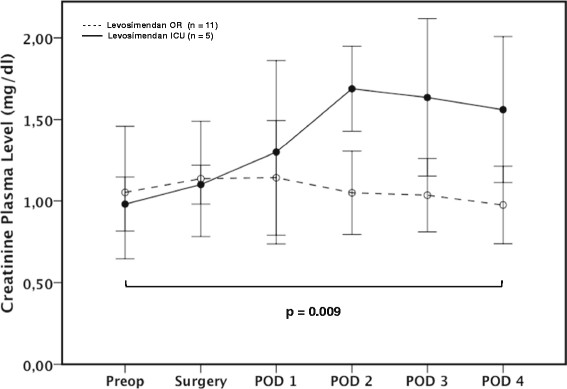
Out of 1.095 included patients, 46 patients were treated with levosimendan due to a severely reduced left ventricular systolic function preoperatively (LVEF < 35%) and/or clinical signs of a low cardiac output syndrome. Sixty-one percent received the drug whilst in the OR, 39% after postoperative intensive care unit admission. When levosimendan was given immediately after anaesthesia induction, creatinine plasma levels (p = 0.009 for nonparametric analysis of longitudinal data in a two-factorial design) and incidence of postoperative renal dysfunction (67.9% vs. 94.4%; p = 0.033) were significantly reduced in contrast to a later start of treatment. In addition, duration of renal replacement therapy was significantly shorter (79 [35;332] vs. 272 [132;703] minutes; p = 0.046) in that group.
Postoperative kidney dysfunction is a common condition in patients under going cardiac surgery. Patients with severely reduced left ventricular function and/or clinical signs of a low cardiac output syndrome who preoperatively presented with a normal kidney function may benefit from an early start of levosimendan administration, i.e. immediately after anaesthesia.
Clinicaltrials.gov-ID: NCT01918618 .
多项动物研究表明,左西孟旦给药后对肾功能有有益影响。由于近期临床研究数据存在异质性,我们试图研究左西孟旦在心脏手术患者中的给药时机是否与术后肾功能改善相关。
在德国柏林的一家大学医院进行回顾性、单中心观察性分析。纳入所有在2007年1月1日至2011年12月31日期间接受冠状动脉搭桥术和/或瓣膜重建/置换且术前无肾功能不全的成年患者进行分析。
在纳入的1095例患者中,46例患者因术前左心室收缩功能严重降低(左心室射血分数<35%)和/或低心排血量综合征的临床体征而接受左西孟旦治疗。61%的患者在手术室期间接受该药物治疗,39%在术后重症监护病房入院后接受治疗。与稍后开始治疗相比,麻醉诱导后立即给予左西孟旦时,血浆肌酐水平(双因素设计中纵向数据的非参数分析,p = 0.009)和术后肾功能不全的发生率(67.9%对94.4%;p = 0.033)显著降低。此外,该组患者的肾脏替代治疗持续时间显著缩短(79[35;332]分钟对272[132;703]分钟;p = 0.046)。
术后肾功能不全是心脏手术患者的常见情况。术前肾功能正常、左心室功能严重降低和/或有低心排血量综合征临床体征的患者可能受益于早期开始使用左西孟旦,即在麻醉后立即使用。
Clinicaltrials.gov识别号:NCT01918618 。