Hamainza Busiku, Masaninga Freddie, Moonga Hawela, Mwenda Mulenga, Chanda-kapata Pascalina, Chalwe Victor, Chanda Emmanuel, Kamuliwo Mulakwa, Babaniyi Olusegun Ayorinde
Ministry of Health, National Malaria Control Centre, Chainama Hospital College Grounds, off Great East road, P,O, Box 32509, Lusaka, Zambia.
Malar J. 2014 Nov 17;13:430. doi: 10.1186/1475-2875-13-430.
Anti-malarial drug resistance continues to be a leading threat to ongoing malaria control efforts and calls for continued monitoring of the efficacy of these drugs in order to inform national anti-malarial drug policy decision-making. This study assessed the therapeutic efficacy and safety of artemether-lumefantrine (AL)(Coartem®) for the treatment of uncomplicated Plasmodium falciparum malaria in two sentinel high malaria transmission districts in the Eastern Province of Zambia in persons aged six months and above, excluding women aged 12 to 18 years.
This was an observational cohort of 176 symptomatic patients diagnosed with uncomplicated Plasmodium falciparum mono-infection. A World Health Organization (WHO)-standardized 28-day assessment protocol was used to assess clinical and parasitological responses to directly observed AL treatment of uncomplicated malaria. DNA polymerase chain reaction (PCR) analysis for molecular markers of AL resistance was conducted on positive blood samples and differentiated recrudescence from re-infections of the malaria parasites.
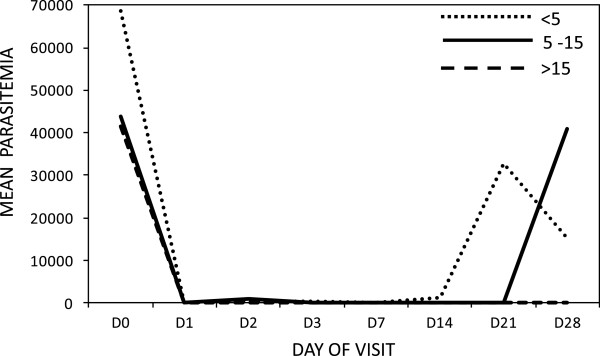
All patients (CI 97.6-100) had adequate clinical and parasitological responses to treatment with AL. At the time of enrolment, mean slide positivity among study participants was 71.8% and 55.2% in Katete and Chipata, respectively. From a mean parasite density of 55,087, 98% of the study participants presented with zero parasitaemia by day 3 of the study. Fever clearance occurred within 24 hours of treatment with AL. However mean parasite density declines were most dramatic in participants in the older age. No adverse reactions to AL treatment were observed during the study.
AL remains a safe and efficacious drug for the treatment of uncomplicated Plasmodium falciparum malaria in Zambia, endemic for malaria, with some provinces experiencing high transmission intensity. However, the delayed parasite clearance in younger patients calls for further sentinel and periodical monitoring of AL efficacy in different areas of the country.
抗疟药物耐药性仍然是当前疟疾防治工作面临的主要威胁,因此需要持续监测这些药物的疗效,以便为国家抗疟药物政策决策提供依据。本研究评估了蒿甲醚-本芴醇(AL)(商品名:科泰复®)在赞比亚东部省两个疟疾高传播哨点地区,对6个月及以上(12至18岁女性除外)人群的非复杂性恶性疟原虫疟疾的治疗效果和安全性。
这是一项对176例被诊断为非复杂性恶性疟原虫单一感染的有症状患者进行的观察性队列研究。采用世界卫生组织(WHO)标准化的28天评估方案,评估对直接观察下的非复杂性疟疾AL治疗的临床和寄生虫学反应。对阳性血样进行DNA聚合酶链反应(PCR)分析,以检测AL耐药性的分子标记,并区分疟原虫再感染与复发。
所有患者(置信区间97.6 - 100)对AL治疗均有充分的临床和寄生虫学反应。入组时,卡特特和奇帕塔研究参与者的平均血片阳性率分别为71.8%和55.2%。研究参与者的平均寄生虫密度为55,087,到研究第3天,98%的参与者血中疟原虫血症为零。发热在AL治疗后24小时内消退。然而老年参与者的平均寄生虫密度下降最为显著。研究期间未观察到对AL治疗的不良反应。
在疟疾流行且部分省份传播强度高的赞比亚,AL仍然是治疗非复杂性恶性疟原虫疟疾的安全有效药物。然而,年轻患者疟原虫清除延迟,需要在该国不同地区进一步开展哨点监测和定期监测AL疗效。