Dondorp Arjen M, Nosten François, Yi Poravuth, Das Debashish, Phyo Aung Phae, Tarning Joel, Lwin Khin Maung, Ariey Frederic, Hanpithakpong Warunee, Lee Sue J, Ringwald Pascal, Silamut Kamolrat, Imwong Mallika, Chotivanich Kesinee, Lim Pharath, Herdman Trent, An Sen Sam, Yeung Shunmay, Singhasivanon Pratap, Day Nicholas P J, Lindegardh Niklas, Socheat Duong, White Nicholas J
Mahidol Oxford Research Unit, Faculty of Tropical Medicine, Mahidol University, Bangkok, Thailand.
N Engl J Med. 2009 Jul 30;361(5):455-67. doi: 10.1056/NEJMoa0808859.
Artemisinin-based combination therapies are the recommended first-line treatments of falciparum malaria in all countries with endemic disease. There are recent concerns that the efficacy of such therapies has declined on the Thai-Cambodian border, historically a site of emerging antimalarial-drug resistance.
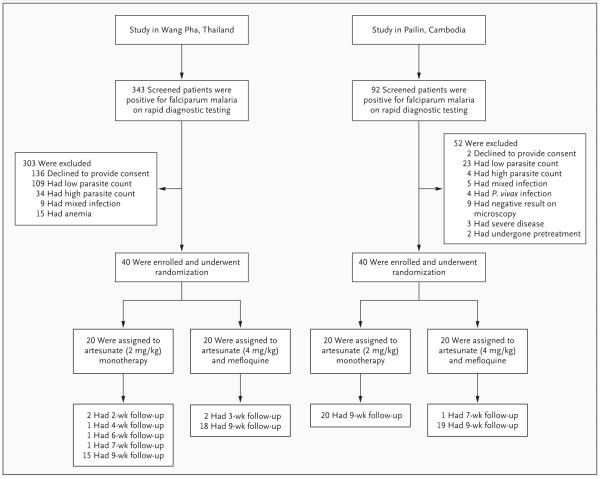
In two open-label, randomized trials, we compared the efficacies of two treatments for uncomplicated falciparum malaria in Pailin, western Cambodia, and Wang Pha, northwestern Thailand: oral artesunate given at a dose of 2 mg per kilogram of body weight per day, for 7 days, and artesunate given at a dose of 4 mg per kilogram per day, for 3 days, followed by mefloquine at two doses totaling 25 mg per kilogram. We assessed in vitro and in vivo Plasmodium falciparum susceptibility, artesunate pharmacokinetics, and molecular markers of resistance.
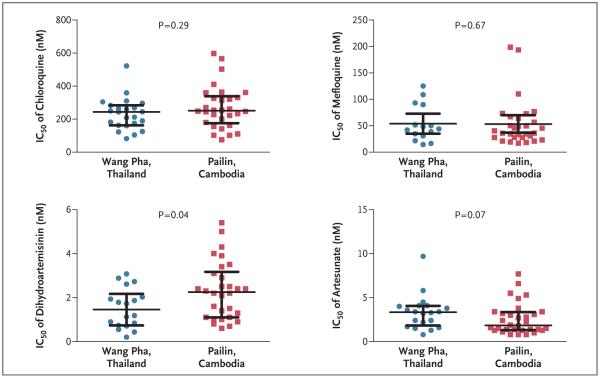
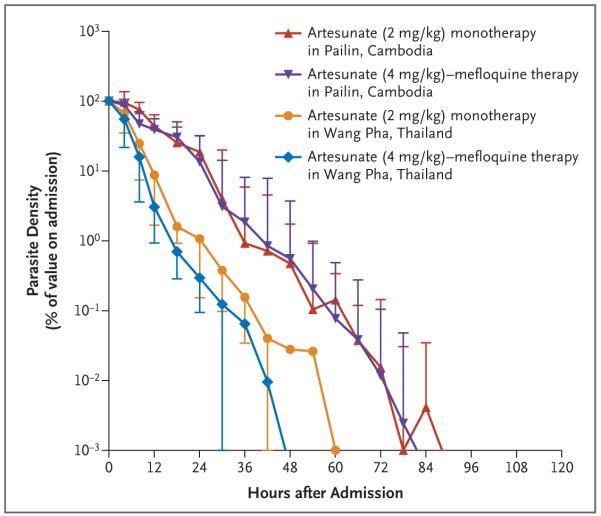
We studied 40 patients in each of the two locations. The overall median parasite clearance times were 84 hours (interquartile range, 60 to 96) in Pailin and 48 hours (interquartile range, 36 to 66) in Wang Pha (P<0.001). Recrudescence confirmed by means of polymerase-chain-reaction assay occurred in 6 of 20 patients (30%) receiving artesunate monotherapy and 1 of 20 (5%) receiving artesunate-mefloquine therapy in Pailin, as compared with 2 of 20 (10%) and 1 of 20 (5%), respectively, in Wang Pha (P=0.31). These markedly different parasitologic responses were not explained by differences in age, artesunate or dihydroartemisinin pharmacokinetics, results of isotopic in vitro sensitivity tests, or putative molecular correlates of P. falciparum drug resistance (mutations or amplifications of the gene encoding a multidrug resistance protein [PfMDR1] or mutations in the gene encoding sarco-endoplasmic reticulum calcium ATPase6 [PfSERCA]). Adverse events were mild and did not differ significantly between the two treatment groups.
P. falciparum has reduced in vivo susceptibility to artesunate in western Cambodia as compared with northwestern Thailand. Resistance is characterized by slow parasite clearance in vivo without corresponding reductions on conventional in vitro susceptibility testing. Containment measures are urgently needed. (ClinicalTrials.gov number, NCT00493363, and Current Controlled Trials number, ISRCTN64835265.)
在所有疟疾流行国家,以青蒿素为基础的联合疗法是恶性疟的推荐一线治疗方案。近期有人担心,在泰国-柬埔寨边境地区,此类疗法的疗效有所下降,该地区历来是抗疟药耐药性出现的地方。
在两项开放标签的随机试验中,我们比较了柬埔寨西部拜林和泰国西北部旺帕治疗非复杂性恶性疟的两种疗法的疗效:一种是口服青蒿琥酯,剂量为每日每公斤体重2毫克,共7天;另一种是青蒿琥酯,剂量为每日每公斤体重4毫克,共3天,随后服用甲氟喹,分两次给药,总量为每公斤体重25毫克。我们评估了恶性疟原虫的体外和体内敏感性、青蒿琥酯的药代动力学以及耐药性的分子标志物。
我们在两个地点各研究了40例患者。拜林的总体寄生虫清除时间中位数为84小时(四分位间距为60至96小时),旺帕为48小时(四分位间距为36至66小时)(P<0.001)。在拜林,接受青蒿琥酯单药治疗的20例患者中有6例(30%)经聚合酶链反应检测证实复发,接受青蒿琥酯-甲氟喹联合治疗的20例患者中有1例(5%)复发;相比之下,在旺帕,接受单药治疗和联合治疗的20例患者中分别有2例(10%)和1例(5%)复发(P=0.31)。这些明显不同的寄生虫学反应无法用年龄、青蒿琥酯或双氢青蒿素的药代动力学、体外同位素敏感性试验结果或恶性疟原虫耐药性的假定分子关联因素(编码多药耐药蛋白的基因[PfMDR1]的突变或扩增,或编码肌浆网钙ATP酶6的基因[PfSERCA]的突变)的差异来解释。不良事件较轻,两个治疗组之间无显著差异。
与泰国西北部相比,柬埔寨西部的恶性疟原虫对青蒿琥酯的体内敏感性降低。耐药性的特点是体内寄生虫清除缓慢,而传统体外敏感性试验结果无相应降低。迫切需要采取遏制措施。(ClinicalTrials.gov编号:NCT00493363,Current Controlled Trials编号:ISRCTN64835265。)