Brod Meryl, Pohlman Betsy, Højbjerre Lise, Adalsteinsson Johan Erpur, Rasmussen Michael Højby
The Brod Group, 219 Julia Avenue, Mill Valley, CA 94941, USA.
BMC Res Notes. 2014 Nov 18;7:813. doi: 10.1186/1756-0500-7-813.
Adult Growth Hormone Deficiency (AGHD) is a debilitating condition resulting from tumors, pituitary surgery, radiation of the head, head injury, or hypothalamic-pituitary disease. This qualitative study was conducted to better understand the multi-faceted impacts and treatment effects of GHD on adult patients' daily lives.Seven focus groups and four telephone interviews were conducted in three countries. Eligible AGHD patients were age 22 or older who had started and stopped growth hormone treatment at least once as an adult. Transcripts were analyzed thematically.
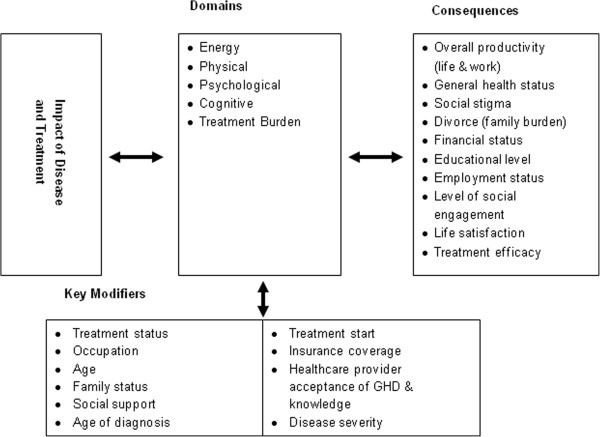
Thirty-nine patients were interviewed; majority etiology was pituitary disease or tumor (62%). Thirty-four patients (87%) were currently on growth hormone replacement therapy; therapy initiation mean age was 43 years. Analysis identified five domains of disease impact: 1) Psychological Health--changed body or self-image and negative emotional impacts; 2) Physical Health--problems with sleep/fatigue, sex drive, weight gain, hair, skin, muscle/bone loss; 3) Cognition--concentration or memory trouble; 4) Energy Loss and its negative impacts (productivity, exercise, chores, socialization, or motivation); and 5) Treatment Effect--treatment enhances quality of life, enabling patients to increase effort (exercise, chores, or work improvements). Energy and sleep are improved. Saturation of themes was reached after the sixth focus group. A conceptual model of GHD disease impacts was developed.
Untreated AGHD has significant negative impacts for patients, which treatment often improves. It is important for clinicians and researchers to understand these multiple impacts so that they can address them in individualized treatment plans and incorporate them when assessing treatment outcomes.
成人生长激素缺乏症(AGHD)是一种由肿瘤、垂体手术、头部放疗、头部损伤或下丘脑 - 垂体疾病引起的使人衰弱的病症。本定性研究旨在更好地了解生长激素缺乏症对成年患者日常生活的多方面影响及治疗效果。在三个国家进行了七个焦点小组讨论和四次电话访谈。符合条件的AGHD患者年龄在22岁及以上,成年后至少开始并停止过一次生长激素治疗。对访谈记录进行了主题分析。
共访谈了39名患者;主要病因是垂体疾病或肿瘤(62%)。34名患者(87%)目前正在接受生长激素替代治疗;开始治疗的平均年龄为43岁。分析确定了疾病影响的五个领域:1)心理健康——身体或自我形象改变以及负面情绪影响;2)身体健康——睡眠/疲劳、性欲、体重增加、头发、皮肤、肌肉/骨质流失等问题;3)认知——注意力或记忆力问题;4)能量丧失及其负面影响(生产力、运动、家务、社交或动力);5)治疗效果——治疗提高生活质量,使患者能够增加努力(运动、家务或工作改善)。能量和睡眠得到改善。在第六个焦点小组讨论后主题达到饱和。构建了生长激素缺乏症疾病影响的概念模型。
未经治疗的AGHD对患者有重大负面影响,而治疗通常可改善这些影响。临床医生和研究人员了解这些多方面影响很重要,以便他们能够在个性化治疗方案中加以解决,并在评估治疗结果时予以考虑。