Makene Christina Lulu, Plotkin Marya, Currie Sheena, Bishanga Dunstan, Ugwi Patience, Louis Henry, Winani Kiholeth, Nelson Brett D
Jhpiego Tanzania, PO Box 9170, Dar es Salaam, Tanzania.
Jhpiego Baltimore, Baltimore, MD, USA.
BMC Pregnancy Childbirth. 2014 Nov 19;14:381. doi: 10.1186/s12884-014-0381-3.
Every year, more than a million of the world's newborns die on their first day of life; as many as two-thirds of these deaths could be saved with essential care at birth and the early newborn period. Simple interventions to improve the quality of essential newborn care in health facilities - for example, improving steps to help newborns breathe at birth - have demonstrated up to 47% reduction in newborn mortality in health facilities in Tanzania. We conducted an evaluation of the effects of a large-scale maternal-newborn quality improvement intervention in Tanzania that assessed the quality of provision of essential newborn care and newborn resuscitation.
Cross-sectional health facility surveys were conducted pre-intervention (2010) and post intervention (2012) in 52 health facilities in the program implementation area. Essential newborn care provided by health care providers immediately following birth was observed for 489 newborns in 2010 and 560 in 2012; actual management of newborns with trouble breathing were observed in 2010 (n = 18) and 2012 (n = 40). Assessments of health worker knowledge were conducted with case studies (2010, n = 206; 2012, n = 217) and a simulated resuscitation using a newborn mannequin (2010, n = 299; 2012, n = 213). Facility audits assessed facility readiness for essential newborn care.
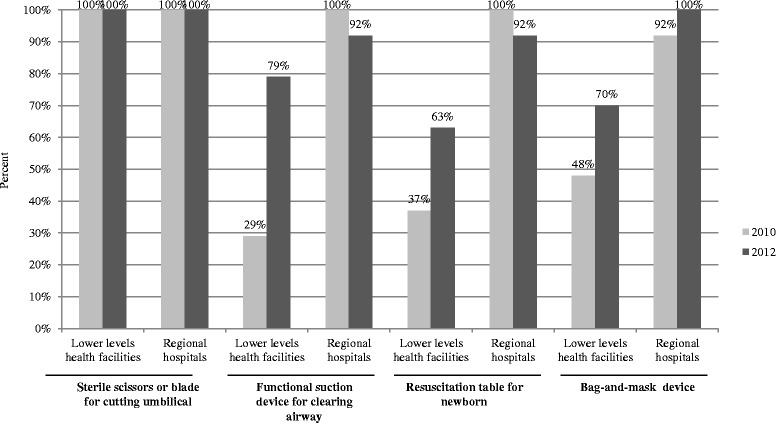
Index scores for quality of observed essential newborn care showed significant overall improvement following the quality-of-care intervention, from 39% to 73% (p <0.0001). Health worker knowledge using a case study significantly improved as well, from 23% to 41% (p <0.0001) but skills in resuscitation using a newborn mannequin were persistently low. Availability of essential newborn care supplies, which was high at baseline in the regional hospitals, improved at the lower-level health facilities.
Within two years, the quality improvement program was successful in raising the quality of essential newborn care services in the program facilities. Some gaps in newborn care were persistent, notably practical skills in newborn resuscitation. Continued investment in life-saving improvements to newborn care through the health services is a priority for reduction of newborn mortality in Tanzania.
每年,全球有超过100万新生儿在出生首日死亡;其中多达三分之二的死亡可通过出生时及新生儿早期的基本护理得以避免。在医疗机构中采取简单干预措施以提高基本新生儿护理质量——例如,改进帮助新生儿出生时呼吸的步骤——已证明可使坦桑尼亚医疗机构中的新生儿死亡率降低多达47%。我们对坦桑尼亚一项大规模母婴质量改进干预措施的效果进行了评估,该措施评估了基本新生儿护理及新生儿复苏的提供质量。
在项目实施地区的52家医疗机构中,于干预前(2010年)和干预后(2012年)开展了横断面医疗机构调查。观察了2010年489名新生儿和2012年560名新生儿出生后医护人员立即提供的基本新生儿护理;观察了2010年(n = 18)和2012年(n = 40)有呼吸问题的新生儿的实际处理情况。通过案例研究(2010年,n = 206;2012年,n = 217)以及使用新生儿模型进行模拟复苏(2010年,n = 299;2012年,n = 213)对卫生工作者的知识进行了评估。机构审计评估了医疗机构对基本新生儿护理的准备情况。
观察到的基本新生儿护理质量的指数得分在护理质量干预后总体有显著提高,从39%提高到73%(p < 0.0001)。通过案例研究得出的卫生工作者知识也有显著提高,从23%提高到41%(p < 0.0001),但使用新生儿模型进行复苏的技能一直较低。基本新生儿护理用品的可获得性在地区医院基线时较高,在基层医疗机构有所改善。
在两年内,质量改进项目成功提高了项目机构中基本新生儿护理服务的质量。新生儿护理方面仍存在一些差距,尤其是新生儿复苏的实践技能。通过卫生服务持续投资于挽救生命的新生儿护理改进措施是坦桑尼亚降低新生儿死亡率的优先事项。