Nakagawa Takayuki, Kumakawa Kozo, Usami Shin-ichi, Hato Naohito, Tabuchi Keiji, Takahashi Mariko, Fujiwara Keizo, Sasaki Akira, Komune Shizuo, Sakamoto Tatsunori, Hiraumi Harukazu, Yamamoto Norio, Tanaka Shiro, Tada Harue, Yamamoto Michio, Yonezawa Atsushi, Ito-Ihara Toshiko, Ikeda Takafumi, Shimizu Akira, Tabata Yasuhiko, Ito Juichi
Department of Otolaryngology, Head and Neck Surgery, Graduate school of Medicine, Kyoto University, Kyoto 606-8507, Japan.
BMC Med. 2014 Nov 19;12:219. doi: 10.1186/s12916-014-0219-x.
To date, no therapeutic option has been established for sudden deafness refractory to systemic corticosteroids. This study aimed to examine the efficacy and safety of topical insulin-like growth factor-1 (IGF-1) therapy in comparison to intratympanic corticosteroid therapy.
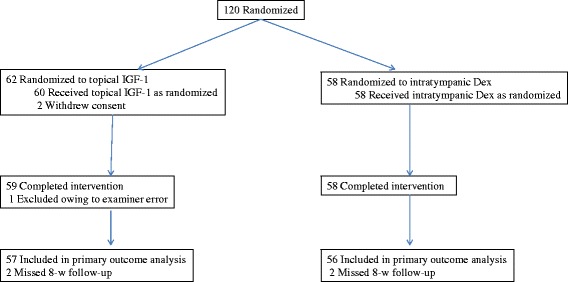
We randomly assigned patients with sudden deafness refractory to systemic corticosteroids to receive either gelatin hydrogels impregnated with IGF-1 in the middle ear (62 patients) or four intratympanic injections with dexamethasone (Dex; 58 patients). The primary outcome was the proportion of patients showing hearing improvement (10 decibels or greater in pure-tone average hearing thresholds) 8 weeks after treatment. The secondary outcomes included the change in pure-tone average hearing thresholds over time and the incidence of adverse events.
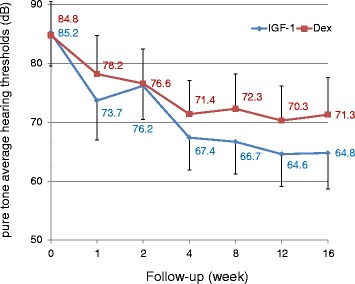
In the IGF-1 group, 66.7% (95% confidence interval [CI], 52.9-78.6%) of the patients showed hearing improvement compared to 53.6% (95% CI, 39.7-67.0%) of the patients in the Dex group (P = 0.109). The difference in changes in pure-tone average hearing thresholds over time between the two treatments was statistically significant (P = 0.003). No serious adverse events were observed in either treatment group. Tympanic membrane perforation did not persist in any patient in the IGF-1 group, but did persist in 15.5% (95% CI, 7.3-27.4%) of the patients in the Dex group (P = 0.001).
The positive effect of topical IGF-1 application on hearing levels and its favorable safety profile suggest utility for topical IGF-1 therapy in patients with sudden deafness.
UMIN Clinical Trials Registry Number UMIN000004366, October 30th, 2010.
迄今为止,对于全身用糖皮质激素难治性突发性聋尚无已确立的治疗方案。本研究旨在比较局部应用胰岛素样生长因子-1(IGF-1)治疗与鼓室内糖皮质激素治疗的疗效和安全性。
我们将全身用糖皮质激素难治性突发性聋患者随机分为两组,一组在中耳接受含IGF-1的明胶水凝胶治疗(62例患者),另一组接受4次鼓室内注射地塞米松(Dex;58例患者)。主要结局是治疗8周后听力改善(纯音平均听阈提高10分贝或更多)的患者比例。次要结局包括纯音平均听阈随时间的变化以及不良事件的发生率。
IGF-1组66.7%(95%置信区间[CI],52.9 - 78.6%)的患者听力改善,而Dex组为53.6%(95%CI,39.7 - 67.0%)的患者(P = 0.109)。两种治疗方法在纯音平均听阈随时间变化上的差异具有统计学意义(P = 0.003)。两个治疗组均未观察到严重不良事件。IGF-1组没有患者鼓膜穿孔持续存在,但Dex组有15.5%(95%CI,7.3 - 27.4%)的患者鼓膜穿孔持续存在(P = 0.001)。
局部应用IGF-1对听力水平的积极作用及其良好的安全性表明,IGF-1局部治疗对突发性聋患者有用。
UMIN临床试验注册号UMIN000004366,2010年10月30日。